商业房地产贷款

Search documents
Why Is Zions (ZION) Up 0.8% Since Last Earnings Report?
ZACKS· 2026-02-19 17:30
Core Viewpoint - Zions' recent earnings report shows strong performance with adjusted earnings per share beating estimates and significant year-over-year growth, driven by higher net interest income (NII) and non-interest income, despite rising non-interest expenses [2][4]. Financial Performance - Q4 2025 adjusted earnings per share were $1.75, exceeding the Zacks Consensus Estimate of $1.57, and up 30.5% from the previous year [2]. - Full-year 2025 earnings were $6.01 per share, surpassing the Zacks Consensus Estimate of $5.93, and reflecting a 21.4% increase year-over-year [4]. - Net income attributable to common shareholders for Q4 was $262 million, a 31% increase year-over-year [3]. Revenue and Expenses - Q4 net revenues (tax equivalent) reached $902 million, an 8.4% increase year-over-year, beating the Zacks Consensus Estimate of $864.4 million [5]. - For the full year 2025, net revenues were $3.43 billion, up 8.1% year-over-year, also exceeding the Zacks Consensus Estimate of $3.38 billion [5]. - NII for Q4 was $683 million, an 8.9% increase from the prior year, with a net interest margin (NIM) expansion of 26 basis points to 3.31% [6]. Non-Interest Income and Expenses - Non-interest income for Q4 was $208 million, up 7.8% year-over-year, driven by higher retail and business banking fees [7]. - Adjusted non-interest expenses rose 7.6% year-over-year to $548 million [7]. Credit Quality - The ratio of non-performing assets to loans and leases was 0.52%, an increase of 2 basis points from the prior year [9]. - Net loan and lease charge-offs were $7 million, significantly down from $36 million in the year-ago quarter [10]. Profitability and Capital Ratios - As of December 31, 2025, the common equity tier 1 capital ratio was 11.5%, up from 10.9% a year ago [11]. - Return on average assets was 1.16%, an increase from 0.96% in the previous year [11]. 2026 Outlook - Loan balances are expected to increase moderately, driven by commercial loans, while consumer loans are anticipated to remain stable [12]. - NII is projected to see moderate year-over-year growth, influenced by earning asset remix and loan growth [13]. - Adjusted non-interest expenses are expected to rise moderately due to technology costs and increased marketing expenses [14]. Market Performance - Zions has experienced an upward trend in estimates revisions since the earnings release, indicating positive investor sentiment [15]. - The stock currently holds a Zacks Rank 3 (Hold), suggesting an expectation of in-line returns in the coming months [17].


星展香港:料今年贷款会有单位数的升幅 不良贷款率呈下降趋势
智通财经网· 2026-02-09 08:33
Group 1: Financial Performance - DBS Hong Kong's loans grew by 1% year-on-year to HKD 378 billion, while deposits increased by 10% to HKD 522 billion [1] - The non-performing loan (NPL) ratio rose from 1.57% to 2.16% year-on-year [1] - The net interest margin (NIM) increased from 1.8% to 1.82% last year [1] Group 2: Future Outlook - The CEO expects a downward trend in the NPL ratio this year, although no specific forecast was provided [1] - The bank anticipates a single-digit increase in loans for this year [1] - The CEO predicts the Federal Reserve will cut interest rates by 50 basis points this year, which may lead to a reduction in NIM by 10-12 basis points [1] Group 3: Sector-Specific Insights - The rise in NPL ratio was primarily attributed to one private enterprise, with the bank's exposure to mainland loans reduced to 7%, of which 5% are state-owned enterprises [1] - DBS Hong Kong maintains a cautious approach towards commercial real estate (CRE) loans, which have remained around 27% of the portfolio, focusing on strong blue-chip companies and investment-grade firms [1] - The bank is actively seeking quality clients while ensuring adequate provisions for potential risks in the CRE sector [1] Group 4: Support for SMEs - DBS Hong Kong continues to support the development of small and medium-sized enterprises (SMEs) in Hong Kong, despite anticipated pressures on their operations this year [2] - The challenges for SMEs are attributed to local consumers shopping in mainland China and a downgrade in spending by mainland tourists [2] - A gradual balance is expected as commercial rents decrease, but it may take several years for SMEs' operating conditions to improve [2]
USCB Financial (USCB) - 2025 Q4 - Earnings Call Transcript
2026-01-23 17:00
Financial Data and Key Metrics Changes - Total assets reached $2.8 billion, up 8.1% year-over-year [2] - Loans grew by $216 million, or 11%, reflecting strong commercial activity [2] - Deposits increased to $171 million, or 7.9%, demonstrating continued franchise growth [2] - Net interest income expanded to 3.27%, improving from 3.16% in the prior year [2] - Non-performing loans stood at 0.14% of total loans, indicating excellent credit quality [3] - Tangible book value per share increased 10.8% year-over-year to $11.97 [3] - GAAP-diluted EPS was reported at $0.07, with operational diluted EPS at $0.44 [4] Business Line Data and Key Metrics Changes - Average loans increased $31.9 million, or 6.02% annualized compared to the prior quarter [10] - Gross loan production totaled $196 million in Q4, with 43% from correspondent banking [12] - Average deposits were stable, down $3.9 million compared to the prior quarter but up $314.6 million year-over-year [10] - Non-interest income was $3.3 million for Q4, consistent with prior quarters, excluding the securities loss [21] Market Data and Key Metrics Changes - The bank's loan portfolio increased to just under $2.2 billion, with commercial real estate representing 57% [19] - The average interest-bearing deposit rates decreased to 3.02%, down from 3.29% in the third quarter [10] - The bank's balance sheet is liability sensitive, with 61% of the loan portfolio being variable-rate or hybrid [15] Company Strategy and Development Direction - The company aims to expand and strengthen its deposit base, focusing on relationship-driven growth rather than rate-driven [26] - Key business lines include Business Banking, Private Client Group, Association Banking, and Correspondent Banking, each with clear plans for growth [26][27] - The strategy for 2026 includes launching a new lending and deposit gathering team in targeted markets [26] Management's Comments on Operating Environment and Future Outlook - Management expressed confidence in the bank's ability to build back deposits lost at year-end and emphasized the importance of deposit growth for 2026 [36] - The company anticipates further NIM improvement supported by rate cuts and ongoing execution of its deposit strategy [13] - The tax expense is expected to be modeled at 26.4% going forward, reflecting compliance with state tax liabilities [9][57] Other Important Information - The board approved a 25% increase in the quarterly cash dividend to $0.12 per share [5] - The company completed a $40 million subordinated debt issuance, primarily used for share repurchase [3] Q&A Session Summary Question: Deposit trends and year-end shrinkage - Management noted a significant deposit move of over $100 million from a long-term client, which is expected to rebuild over time [36] Question: Loan-to-deposit ratio preferences - Management prefers a loan-to-deposit ratio between 90-95% for optimal liquidity [39] Question: SBA vertical expansion - The SBA initiative has been growing prudently, with plans to increase annual volume to $40-50 million over the next three years [42] Question: Capital strategy and priorities for 2026 - The focus remains on building capital and returning it to shareholders, with no significant plans for new initiatives beyond organic growth [47] Question: Margin expectations for the first quarter - Management expects NIM to be flat to slightly up in the first quarter, influenced by deposit runoff and potential rate cuts [54] Question: Expense outlook and new hires - The expense base is expected to gradually increase with new hires, targeting a low 50% efficiency ratio [66] Question: Fee income outlook - Non-interest income is anticipated to build around $3.5-$3.8 million for 2026, driven by various fee-generating activities [68]

告别疲软?美工商贷款回暖,商业地产贷款增速仍低于历史均值
智通财经网· 2025-12-31 07:43
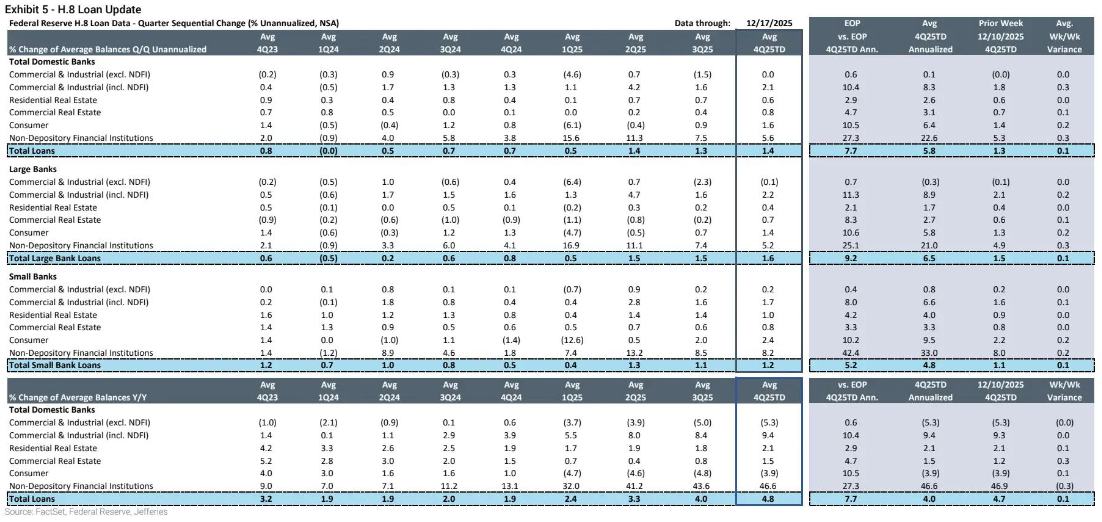
Core Insights - Jefferies recently released a report on the U.S. banking sector, commenting on H.8 loan data and interest rate updates, indicating a loan growth of 1.4% for Q4 2025 year-to-date, surpassing the historical average of 1.1% over the past decade and matching the growth rate of 1.3% from Q3 2025 [1][4] Loan Growth Analysis - The average loan growth for commercial and industrial loans (C&I) including non-depository financial institutions (NDFI) for Q4 2025 year-to-date is 2.1%, significantly higher than the historical trend of 0.7% for this category [1][5] - Commercial real estate loans (CRE) have shown a year-to-date growth of 0.7%, which is below the historical average of 1.4% [1][6] Consumer and Residential Loans - Consumer loans have experienced a year-to-date growth of 1.6% in Q4 2025, up from 0.9% in Q3 2025, primarily driven by small banks with a growth rate of 2.4% [5] - Residential real estate loans have shown a modest growth of 0.6% year-to-date in Q4 2025, slightly down from 0.7% in Q3 2025 [5][6] Deposits and Borrowings - As of December 17, total deposits increased by $97 billion, a growth of 0.6%, reaching a total of $17.4 trillion, with large banks contributing $93 billion to this increase [6] - Total borrowings rose by $11 billion, reflecting a year-to-date growth of 0.9%, with large banks' borrowings increasing by $13 billion [6]
美联储:银行监管机构正关注房地产贷款
Xin Hua Cai Jing· 2025-12-02 00:09
Core Viewpoint - The Federal Reserve is closely monitoring community and regional banks' commercial real estate portfolios due to concerns over rising interest rates, tightening underwriting standards, and declining commercial real estate values [1] Group 1: Regulatory Oversight - Regulatory agencies are focusing on the impact of rising interest rates, tightening underwriting standards, and declining commercial real estate values on borrowers' ability to refinance or repay loans [1] - The Federal Reserve's report indicates that most banks reported capital levels significantly above the applicable regulatory requirements as of the second quarter [1] Group 2: Stress Testing and Capital Resilience - Stress test results show that large banks have the capacity to maintain minimum capital requirements while continuing to lend to households and businesses, even under severe recession scenarios [1] - The report emphasizes the importance of monitoring commercial real estate loan trends and reviewing underwriting practices and credit loss reserves [1]
RPT(RPT) - 2025 Q3 - Earnings Call Transcript
2025-10-31 13:00
Financial Data and Key Metrics Changes - The company reported flat earnings quarter over quarter, maintaining a dividend of $0.06 [5][11] - Cash and cash equivalents at the end of the quarter were $81 million, with total equity at $292 million [11] - The portfolio value is approximately $308 million, with the company holding around $100 million in cash [10][11] Business Line Data and Key Metrics Changes - During the quarter, the company originated a $21 million loan on a grocery-anchored retail center, expected to yield in the mid-teens [11] - The company has liquidated several residential assets and added higher-yielding commercial real estate floaters [5][6] Market Data and Key Metrics Changes - The company is exploring opportunities in the commercial real estate market, particularly in office spaces, which are currently seen as undervalued [21][26] - The market for commercial mortgage REITs is experiencing significant discounts, influenced by recent bankruptcies and credit concerns [20][21] Company Strategy and Development Direction - The company is considering several strategic options, including recapitalization through equity offerings, liquidation, or continuing its current strategy [6][7] - The management is focused on growing the direct lending business and exploring opportunistic investments in commercial real estate [8][21] - The recent acquisition of Paramount is seen as a significant opportunity for growth, with plans to participate in the transaction [7][26] Management's Comments on Operating Environment and Future Outlook - Management expressed optimism about the company's clean balance sheet and lack of legacy issues, positioning it well for future growth [20][34] - The company is actively seeking to grow earnings and believes the current equity valuation is fundamentally mispriced [34] Other Important Information - The company has a pipeline of potential investments and is keen on executing its growth strategy [10][11] - The management highlighted the importance of capital for growth and is considering various funding options [23][29] Q&A Session Summary Question: What does the loan pool look like currently? - Management discussed the Paramount deal and the potential for direct lending growth, mentioning a $21 million loan originated this quarter [15][16] Question: What are the economics of the Paramount transaction? - The Paramount deal is primarily equity-based, with expectations of significant returns due to acquiring assets at a discount to replacement costs [26][27] Question: Could Rithm Capital deploy capital into Rithm Property Trust? - Management acknowledged ongoing discussions about potential equity offerings and the possibility of a rights offering backed by a pool of assets [28][29] Question: Has the Paramount deal opened up potential partners for Rithm Property Trust? - Management confirmed that the deal has led to new conversations with potential partners, enhancing opportunities for funding [30][31]

恒生银行尾盘跌超3% 据报汇丰敦促恒生出售香港地产不良贷款组合
Zhi Tong Cai Jing· 2025-09-25 07:27
Core Viewpoint - Hang Seng Bank's stock has seen a significant decline, attributed to HSBC's intervention in managing bad debts related to commercial real estate loans in Hong Kong, with expectations of selling over $3 billion in non-performing loans [1] Group 1: Stock Performance - Hang Seng Bank's shares fell over 3% at the close, currently down 2.79% at HKD 114.9, with a trading volume of HKD 378 million [1] Group 2: Bad Debt Management - HSBC has directly intervened in Hang Seng Bank's bad debt management, sending senior executives to oversee the sale of non-performing loans related to Hong Kong real estate [1] - The expected sale involves over $3 billion in bad loans, with the bank's commercial real estate non-performing loans reaching approximately HKD 25 billion as of June, marking an 85% increase year-on-year [1] Group 3: Credit Ratings and Outlook - Fitch Ratings has downgraded Hang Seng Bank's risk rating from "a" to "a-" due to high concentration in commercial real estate loans and a significant deterioration in credit quality since 2024 [1] - As of mid-2025, these loans are projected to account for 46% of Hang Seng Bank's impaired loans, with expectations of further deterioration in the next one to two years due to declining property valuations [1] - Despite the downgrade, Fitch maintains a stable outlook, indicating that Hang Seng Bank's credit risk management is proactive [1]

余伟文:香港商业房产贷款信贷风险可控 设立“坏帐银行”不符银行稳健情况
智通财经网· 2025-08-13 12:40
Core Viewpoint - The Hong Kong Monetary Authority (HKMA) is closely monitoring the banking sector's stability, particularly regarding commercial real estate loans, which are under pressure due to rising interest rates and changing market conditions [1][2][3] Group 1: Loan Classification and Risk Management - The specific classified loan ratio for Hong Kong banks at the end of Q2 was 1.97%, showing slight pressure for an increase compared to 1.98% at the end of March [1] - The HKMA believes that the credit risk associated with commercial real estate loans is manageable, with most exposure directed towards financially stable large local enterprises [2][3] - Banks have implemented credit risk mitigation measures for small and medium-sized developers and investors, ensuring that most loans are secured by collateral [2] Group 2: Market Conditions and Loan Valuation - Commercial real estate prices and rents are under pressure due to interest rates and market supply-demand dynamics, leading to concerns about the value of collateral and potential immediate repayment requests from banks [2] - The HKMA and the banking sector emphasize that loan assessments will consider a range of factors beyond just the value of collateral, including the borrower's financial situation and repayment ability [2] - The specific classified loan ratio has increased from 0.89% at the end of 2021 to around 2%, still significantly lower than the 7.43% observed during the Asian financial crisis in 1999 [3] Group 3: Financial Health of the Banking Sector - The banking sector in Hong Kong is characterized by strong capital adequacy, sufficient provisions, and robust financial health to withstand market fluctuations [3] - The concept of "expected credit loss" used in accounting does not equate to bad debts and should not be the sole measure of a bank's asset quality [3] - The idea of establishing a "bad bank" is deemed unnecessary given the current strong financial position of Hong Kong banks [3]
California Banp(CALB) - 2025 Q2 - Earnings Call Presentation
2025-07-28 12:00
Company Overview - California BanCorp has a market capitalization of $533 million [11] - The company possesses total assets of $40 billion and deposits of $33 billion as of June 30, 2025 [11] - The company has a 5-year asset CAGR of 207% and a 5-year deposit CAGR of 234% [11] Balance Sheet and Loan Portfolio - Total loans held for investment were $30 billion at June 30, 2025, compared to $31 billion at March 31, 2025, and $19 billion at June 30, 2024 [10] - Noninterest-bearing deposits accounted for 368% of total deposits as of June 30, 2025 [10] - As of June 30, 2025, total multifamily loans amounted to $2585 million, representing 86% of total loans [66] Financial Performance - Net income for Q2 2025 was $141 million, with diluted EPS at $043 [25] - The return on average assets for Q2 2025 was 145%, and the return on average common equity was 1050% [25] - The net interest margin for Q2 2025 was 461% [25] - The efficiency ratio for Q2 2025 was 561% [25] - Non-performing assets to total assets stood at 046% for Q2 2025 [25] - The allowance for credit losses to total loans held for investment was 146% as of June 30, 2025 [25]

Banc of California(BANC) - 2025 Q2 - Earnings Call Transcript
2025-07-24 18:00
Financial Data and Key Metrics Changes - The company reported net income of $18.4 million or $0.12 per share, with adjusted net income of $48.4 million or $0.31 per share, reflecting a strong performance in the second quarter [12][13] - Net interest income increased by 3.4% from the prior quarter to $240 million, driven by strong loan growth and higher loan yields [14] - The net interest margin expanded to 3.1%, supported by a three basis point increase in average loan yields to 5.93% [14][15] Business Line Data and Key Metrics Changes - Total annualized loan growth reached 9%, with significant contributions from lender finance, fund finance, and purchased single-family residential loans [5][14] - Core held for sale loans increased by 12% annualized, while construction loans declined due to payoffs and completed projects [7][8] - Non-interest income totaled $32.6 million, down 3% from the prior quarter, primarily due to fluctuations in CRA-related equity investments [18] Market Data and Key Metrics Changes - The company experienced strong production levels in loan origination, achieving the highest level of originations since the merger at $1.2 billion [7] - Average core deposits increased by 5% annualized, although the average balance per account faced pressure due to seasonal and macroeconomic factors [16][19] - The multifamily portfolio, representing 26% of the loan portfolio, has significant repricing opportunities with $3.2 billion maturing over the next two and a half years [17] Company Strategy and Development Direction - The company is focused on optimizing its balance sheet through strategic sales of loans, aiming for high-quality, consistent, and sustainable earnings growth [5][10] - There is a strong emphasis on maintaining disciplined pricing and underwriting standards while proactively managing credit risk [9][11] - The company aims to capitalize on growth opportunities in California, leveraging its position as a leading business bank in the region [25][26] Management's Comments on Operating Environment and Future Outlook - Management expressed confidence in the resilience of the market and strong demand for products and services, despite uncertainties in the broader macroeconomic environment [11] - The outlook for the second half of 2025 includes expectations for continued growth in core profitability and mid-single-digit increases in net interest income [21][22] - Management highlighted the importance of maintaining a strong credit quality profile while pursuing growth opportunities [20][21] Other Important Information - The company repurchased $150 million of common stock, representing about 6.8% of shares, with $150 million remaining in the buyback program [6] - A one-time non-cash income tax expense of $9.8 million was recorded, primarily related to the revaluation of deferred tax assets [13] - The company anticipates $243 million of loan sales to close in the third quarter, with a focus on maintaining a healthy capital position [13][19] Q&A Session Summary Question: Loan sales and balance sheet impact - Management clarified that loan sales do not necessitate a one-to-one relationship with unwinding wholesale funding, as they have been growing rapidly and providing leverage on sold loans [31][34] Question: Expense guidance and ECR - Management indicated that while expenses came in below guidance, they expect to settle at the lower end of the range due to investments in compensation and infrastructure [38][39] Question: Asset quality and provisioning expectations - Management expects normalized provisioning to be around $10 to $12 million per quarter, depending on the type of loans being grown [109][110] Question: M&A considerations - Management emphasized the focus on organic growth and maintaining independence, while remaining open to opportunities if market conditions normalize [112][114]