资本管理

Search documents
中国银行股份有限公司2025年年度报告摘要
Shang Hai Zheng Quan Bao· 2026-03-30 22:54
Core Viewpoint - The company reported a steady growth in revenue and net profit for the year 2025, with a focus on high-quality development and effective cost management [11][22]. Financial Performance - The company achieved operating revenue of 658.31 billion RMB, an increase of 28.22 billion RMB, or 4.48% year-on-year [11]. - Net profit reached 257.94 billion RMB, up by 5.22 billion RMB, or 2.06% year-on-year [11]. - The return on average total assets (ROA) was 0.70%, and the return on equity (ROE) was 8.94% [11]. Dividend Distribution - The board proposed a final cash dividend of 1.169 RMB per 10 shares (pre-tax) for the year-end 2025, pending shareholder approval [2]. - The total cash dividend for 2025, including the interim dividend, amounts to 2.263 RMB per 10 shares (pre-tax) [2]. Shareholder Information - As of December 31, 2025, the total number of ordinary shareholders was 641,594, including 483,689 A-share shareholders and 157,905 H-share shareholders [4]. - The top ten ordinary shareholders held significant stakes, with Central Huijin Investment Ltd. being the controlling shareholder [6][4]. Asset and Liability Management - Total assets reached 38.36 trillion RMB, an increase of 3.30 trillion RMB, or 9.40% year-on-year [22]. - Total liabilities amounted to 35.15 trillion RMB, up by 3.04 trillion RMB, or 9.47% year-on-year [22]. Loan and Deposit Growth - The total amount of loans and advances was 23.45 trillion RMB, increasing by 1.86 trillion RMB, or 8.61% year-on-year [24]. - Total deposits reached 26.18 trillion RMB, an increase of 1.98 trillion RMB, or 8.18% year-on-year [28]. Capital Management - The capital adequacy ratio stood at 18.85%, indicating a reasonable level of capital sufficiency [36]. - The company successfully raised 165 billion RMB through the issuance of A-shares and 70 billion RMB in perpetual bonds [36]. Future Outlook - The company aims to enhance its service quality and expand its financial offerings, focusing on technology finance, green finance, and inclusive finance [39][40]. - The expected growth rate for domestic RMB customer loans in 2026 is around 8% [39].

SiriusPoint(SPNT) - 2025 Q4 - Earnings Call Transcript
2026-02-19 14:32
Financial Data and Key Metrics Changes - The company's top line grew by 16% in 2025, with diluted book value per share increasing by 28% [4][22] - Operating earnings per share rose by 49% year-over-year, with a full-year operating return on equity of 16.2%, exceeding the target of 12%-15% [5][24] - The fourth quarter saw an operating return on equity of 17.1% and a GAAP return on equity of 44.9% due to the sale of Armada for $250 million [5][24] - Net income for 2025 increased by 141% to $444 million, with a return on equity of 22.1% [24] Business Line Data and Key Metrics Changes - Gross written premiums grew by 18% in the fourth quarter, with accident and health premiums increasing by 20% [25][31] - The core combined ratio for the year improved to 91.6%, reflecting a 1.5-point improvement from the previous year [28] - Accident and health gross written premiums reached around $1 billion, accounting for 27% of the business mix [12][31] Market Data and Key Metrics Changes - 60% of the company's growth in 2025 came from lines less correlated with property and casualty pricing cycles, with accident and health being the largest contributor [10] - The casualty segment saw an 8% increase in premiums, driven by strong rates despite decreased volumes in certain areas [32] Company Strategy and Development Direction - The company aims to focus on underwriting performance over growth, with a strategic shift towards higher growth in insurance compared to reinsurance [10][11] - The acquisition of Assist America and World Nomads is expected to enhance service fees and expand global distribution capabilities [15][16] - The company is committed to maintaining a diversified portfolio and partnering with specialist MGAs to mitigate market pressures [10][17] Management's Comments on Operating Environment and Future Outlook - Management acknowledges tougher market conditions in 2026 but believes the diversified portfolio will help maintain profitability [9][46] - The company is optimistic about its growth opportunities in accident and health and other specialty lines, despite potential challenges in the broader market [10][68] Other Important Information - The company plans to repurchase $100 million of outstanding common shares over the next twelve months, which is expected to be accretive to EPS and ROE [21] - The BSCR ratio improved to 247% in the fourth quarter, indicating a strong capital position [20][40] Q&A Session Summary Question: Outlook for insurance segment and attritional loss ratio - Management confirmed that the combined ratio of 91.7% is a good run rate for 2026, with expectations for the attritional loss ratio to remain stable [45][51] Question: Fee income expectations for 2026 - Management indicated that fee income for 2026 is expected to be around $30 million, excluding contributions from recent acquisitions [53][56] Question: Sustainability of Surety business growth - Management expressed confidence in the sustainability of growth in the Surety business, noting minimal reliance on government infrastructure growth [58][60] Question: Rate environment for casualty insurance - Management expects rates to remain disciplined and in line with trends, indicating a stable outlook for casualty insurance [67][68] Question: Talent acquisition focus areas - The company is attracting talent across various functions, including underwriting, to strengthen its capabilities [69][70] Question: Retention rate opportunities - Management sees continued opportunities for improving retention rates, emphasizing a prudent risk management approach [71][72]

德州仪器公布2026年Q1业绩指引及资本管理日活动安排
Jing Ji Guan Cha Wang· 2026-02-12 17:37
Core Viewpoint - Texas Instruments (TXN) has provided an optimistic financial outlook for Q1 2026, indicating a recovery in demand across sectors such as data centers and industrial applications [2]. Group 1: Recent Financial Guidance - The company expects revenue for Q1 2026 to be in the range of $4.32 billion to $4.68 billion, with earnings per share projected between $1.22 and $1.48 [2]. - This guidance represents a significant increase compared to the same period last year, highlighting a positive trend in demand recovery [2]. Group 2: Upcoming Events - Texas Instruments is scheduled to hold its annual Capital Management Day on February 24, 2026, where it will share long-term strategic outlooks, capacity planning, and capital allocation strategies [3]. - The event will typically involve discussions from management regarding free cash flow, profit margin targets, and shareholder return plans [3].

泰勒斯2025财年财报将发布,AI战略与资本管理成焦点
Jing Ji Guan Cha Wang· 2026-02-11 22:44
Core Insights - The company is set to release its Q4 and full-year financial results for FY2025, with a focus on revenue growth in its technology segment and the achievement of AI revenue guidance [1][2] Performance Overview - The company typically announces its Q4 and full-year results in February, with investors keen on whether it meets its FY2025 targets, particularly a revenue growth of 2%-4% in the technology segment (including health) and AI revenue nearing $800 million [2] Strategic Developments - The company launched its first sovereign AI factory in Canada in September 2025, marking it as North America's first official NVIDIA cloud partner, with customer expansion and computing service revenue being key focus areas [3] - The company aims to increase AI-related revenue to approximately $2 billion by 2028, starting from a base of about $800 million in 2025, with attention on the latest growth data and modular construction progress in the upcoming financial report [3] Financial Movements - The company has announced a 4% increase in its quarterly dividend to CAD 0.4184, with plans to gradually eliminate the discounted dividend reinvestment plan starting in 2026 [4] - The company is seeking partners for its health and agriculture businesses, with any related transaction announcements potentially impacting its capital structure and leverage ratio (currently at 3.5x, with a target to reduce to 3x by the end of 2027) [4] Business Status - The integration of Workplace Options (WPO) is under scrutiny to see if the synergy effects continue, with this business segment reporting an 18% revenue growth in Q3 2025 [5] - The company faces challenges in its wireless business, with a focus on whether Average Revenue Per User (ARPU) can improve through product bundling and AI technology applications, as well as trends in customer churn rates [5] Financial Condition - Following the completion of a long-term debt acquisition tender in July 2025, the company’s weighted average cost of capital (4.61%) and free cash flow (reported at $611 million in Q3) will be critical in supporting future investments and dividends [6]
Aflac(AFL) - 2025 Q4 - Earnings Call Transcript
2026-02-04 22:02
Financial Data and Key Metrics Changes - Adjusted earnings per diluted share increased 0.6% year-over-year to $1.57, excluding the effect of foreign currency [1] - Adjusted book value per share increased 0.5%, with an adjusted ROE of 11.7% and 14.5% excluding foreign currency remeasurement [1] - Overall results for the quarter were viewed as solid [1] Business Line Data and Key Metrics Changes - In Japan, net earned premiums in yen terms declined 1.9%, while underlying earned premiums decreased 1.2% [2] - Japan's total benefit ratio improved to 65%, down 150 basis points year-over-year, with reserve remeasurement gains favorably impacting the ratio [2] - In the U.S., net earned premiums increased by 4%, but premium persistency declined slightly by 10 basis points to 79.2% [4] - The total benefit ratio in the U.S. was 48.6%, up 230 basis points year-over-year, driven by higher claims activity [4] Market Data and Key Metrics Changes - Japan's expense ratio was 22%, up 120 basis points year-over-year, primarily due to sales promotion expenses [3] - U.S. expense ratio was 40.4%, up 10 basis points year-over-year, influenced by timing of spend from previous quarters [4] - Adjusted net investment income in Japan was down 3.9%, while in the U.S. it decreased by 2.8% [3][5] Company Strategy and Development Direction - The company plans to continue focusing on growth initiatives in group life and disability, network dental and vision, and direct-to-consumer segments [4] - For 2026, the company expects underlying earned premiums in Japan to decline by 1%-2% and anticipates a benefit ratio in the 60%-63% range [11][12] - In the U.S., net earned premium growth is expected to be in the lower end of the 3%-6% range, with a benefit ratio forecasted between 48%-52% [12] Management's Comments on Operating Environment and Future Outlook - Management expressed satisfaction with the performance of the investment portfolio, noting no charge-offs for the commercial real estate portfolio [6] - The company has improved its liquidity and capital flexibility, lowering the minimum liquidity balance at the holding company [9] - Capital ratios remain strong, with an estimated combined RBC of 575% and an SMR above 970% [10] Other Important Information - The company repurchased $800 million of its own stock and paid dividends of $303 million in Q4, indicating strong capital management [11] - Adjusted leverage was 21.4%, within the target range of 20%-25%, influenced by currency exchange rates [9] Q&A Session Summary Question: What is the outlook for Aflac Japan's earned premiums? - The company expects underlying earned premiums in Japan to decline by 1%-2% in 2026 [11] Question: How does the company view its expense ratios moving forward? - The expense ratio in Japan is expected to be in the 20%-23% range, while the U.S. expense ratio is anticipated to be in the 36%-39% range [12]

MGIC Investment (MTG) - 2025 Q4 - Earnings Call Transcript
2026-02-03 16:02
Financial Data and Key Metrics Changes - The company reported a net income of $169 million for the fourth quarter, resulting in an annualized return on equity of 13% [5] - For the full year, net income reached $738 million, with a return on equity of 14.3% [6] - Book value per share increased to $23.47, reflecting a 13% year-over-year growth [6] - Insurance in force grew to over $303 billion, a 3% increase from the previous year [7] - The in-force premium yield remained stable at 38 basis points [14] Business Line Data and Key Metrics Changes - The company wrote $17 billion in new business during the fourth quarter and $60 billion for the full year, marking an 8% increase from the prior year [8] - The average credit score at origination for the insurance portfolio was 748, indicating solid credit quality [8] Market Data and Key Metrics Changes - The consensus mortgage origination forecasts suggest that the size of the mortgage insurance market in 2026 will be similar to that of 2025, with elevated mortgage rates expected to persist [8] - Annual persistency remained stable at 85% throughout 2025, aligning with initial expectations [7] Company Strategy and Development Direction - The company aims to maintain a strong, well-diversified insurance portfolio while focusing on disciplined risk management and capital management strategies [9][10] - The reinsurance program was strengthened with a $250 million excess of loss transaction and a 40% quota share transaction covering most of the 2027 new insurance written [10] - The company emphasizes the importance of private mortgage insurance in enhancing housing affordability and plans to engage with industry stakeholders to support responsible policy changes [20][21] Management's Comments on Operating Environment and Future Outlook - Management expressed confidence in the company's position and ability to execute business strategies in 2026 and beyond, despite challenges in housing affordability [20] - The company noted that while there is potential for increased refinance volume if mortgage rates decrease, this could lead to lower persistency [8][59] Other Important Information - The company returned $915 million to shareholders through dividends and share repurchases, reducing shares outstanding by 12% [17] - The quarterly common stock dividend was increased by 15% in the third quarter, marking five consecutive years of dividend growth [17] Q&A Session Summary Question: Any price competition or changes in the industry? - Management noted that premiums remained stable and they were able to find value without major adjustments in premiums [25][26] Question: Any updates on potential reduction in FHA premiums? - Management indicated that while affordability discussions are ongoing, there is no imminent indication of a reduction in FHA premiums [27][28] Question: Insights on credit trends by region or state? - Management reported no significant geographic movement in new delinquencies, with no areas of concern identified [30][32] Question: Comparison of reserve releases to previous quarters? - Management explained that reserve releases are based on the comparison of initial estimates to current best estimates, with recent quarters reflecting different notice ages [33][36] Question: Composition of new delinquencies and their vintages? - Management stated that there has been no significant divergence in cure activity based on vintage, with recent vintages performing better than pre-COVID levels [40][42] Question: Any levers to improve returns on capital? - Management highlighted the importance of a robust reinsurance program to enhance returns on equity, especially in a challenging market environment [46][47] Question: Impact of refinance activity on premium rates? - Management noted that while premium rates have been stable, the impact of refinancing could lead to lower premiums for new loans [49][50] Question: Expectations for default rates in 2026 and 2027? - Management suggested that while there may be modestly higher delinquency rates in newer vintages, the overall market conditions are expected to stabilize [60][62]

Trustmark(TRMK) - 2025 Q4 - Earnings Call Transcript
2026-01-28 15:32
Financial Data and Key Metrics Changes - Net income for the fourth quarter totaled $57.9 million, with diluted EPS of $0.97, reflecting a 3.2% increase linked-quarter and a 5.4% increase year-over-year [4] - For the full year, net income reached a record $224.1 million, with diluted EPS of $3.70, and adjusted continuing operations net income increased by $37.8 million, or 20.3% [4] - Return on average assets was 1.21% and return on average tangible equity was 12.97% [4] - Loans held for investment increased by $126 million, or 0.9% linked-quarter, and $584 million, or 4.5% year-over-year [4][5] - Total revenue for the fourth quarter was $204 million, while full-year revenue reached $800 million, marking a record for the company [7] Business Line Data and Key Metrics Changes - The mortgage banking business saw increased production and significant profitability improvements [3] - Wealth management revenue reached an all-time high, driven by improved asset values and new account acquisitions [3][32] - Non-interest income for the fourth quarter totaled $41 million, up 3.3% linked-quarter, and for the full year, it was $164 million, representing 20.5% of total revenue [8] Market Data and Key Metrics Changes - The deposit base declined by $131 million, or 0.8% linked-quarter, primarily due to a decrease in public fund deposits [5] - Year-over-year, deposits increased by $392 million, or 2.6%, driven by growth in commercial and personal balances [5] Company Strategy and Development Direction - The company aims for mid-single digit growth in loans held for investment and deposits for the full year 2026 [11] - The net interest margin is expected to be in the range of 3.8%-3.85% for 2026, with net interest income also anticipated to increase mid-single digits [11] - The company is focused on organic loan growth, potential market expansion, and M&A opportunities depending on market conditions [12] Management's Comments on Operating Environment and Future Outlook - Management expressed confidence in maintaining momentum into 2026, highlighting significant improvements in financial performance over recent years [12] - The company noted that credit quality has improved, with net charge-offs for 2025 at 13 basis points of average loans, and expects normalization of credit costs [20][22] Other Important Information - The board announced a 4.2% increase in the regular quarterly dividend to $0.25 per share, payable on March 15, 2026 [10] - The company repurchased $80 million of common stock during the year, including $43 million in the fourth quarter [7][10] Q&A Session Summary Question: Inquiry about new hires in the fourth quarter and talent acquisition strategy - Management reported 13 new production hires in the fourth quarter, focusing on organic expansion and improved loan growth [16][17] Question: Clarification on credit cost normalization and expectations for charge-offs - Management expects net charge-offs to stabilize at 13-15 basis points of average loans, with improvements in credit quality contributing to lower provisioning costs [20][22] Question: Discussion on guidance and key levers impacting growth - Loan growth and capital deployment were identified as key drivers for guidance, with management expressing confidence in maintaining solid loan growth while managing capital effectively [28][29] Question: Inquiry about expense growth cadence throughout the year - Management indicated that expense increases are typically higher in the second half of the year due to merit increases and performance-based bonuses [40][42] Question: Discussion on M&A activity and market opportunities - Management acknowledged increased discussions around M&A but emphasized a cautious and selective approach, focusing on organic growth while remaining open to opportunistic deals [45][51]

Trustmark(TRMK) - 2025 Q4 - Earnings Call Transcript
2026-01-28 15:30
Financial Data and Key Metrics Changes - Net income for Q4 2025 totaled $57.9 million, with diluted EPS of $0.97, reflecting a 3.2% increase linked-quarter and a 5.4% increase year-over-year [4] - Full year net income reached a record $224.1 million, with diluted EPS of $3.70, and adjusted continuing operations net income increased by $37.8 million, or 20.3% in 2025 [4] - Return on average assets was 1.21% and return on average tangible equity was 12.97% [4] - Loans held for investment increased by $126 million, or 0.9% linked-quarter, and $584 million, or 4.5% year-over-year [4] Business Line Data and Key Metrics Changes - The traditional banking business drove continued loan and deposit growth, with a strong net interest margin of 3.81% in Q4 [6] - Mortgage banking business saw increased production and significant improvement in profitability, while wealth management revenue reached an all-time high [3] - Non-interest income for Q4 totaled $41 million, up 3.3% linked-quarter, and for the full year, it totaled $164 million, representing 20.5% of total revenue [7] Market Data and Key Metrics Changes - Deposit base declined by $131 million, or 0.8% linked-quarter, primarily due to a decrease in public fund deposits [5] - Year-over-year, deposits increased by $392 million, or 2.6%, driven by growth in commercial and personal balances [5] - The cost of total deposits in Q4 was 1.72%, a decrease of 12 basis points linked-quarter [5] Company Strategy and Development Direction - The company plans to continue its disciplined approach to capital deployment, focusing on organic loan growth, potential market expansion, and M&A opportunities depending on market conditions [12] - The company aims to maintain momentum into 2026, with guidance for loans and deposits to increase mid-single digits [11] Management's Comments on Operating Environment and Future Outlook - Management expressed confidence in the company's strong credit performance, with net charge-offs for 2025 at 13 basis points of average loans, and expects normalization of credit costs [20] - The company anticipates net interest margin to be in the range of 3.8%-3.85% for 2026, with net interest income expected to increase mid-single digits [11] Other Important Information - The board announced a 4.2% increase in the quarterly dividend to $0.25 per share, bringing the full year dividend to $1 per share [10] - The company repurchased $80 million of common stock during the year, including $43 million in Q4 [6] Q&A Session Summary Question: How many new hires were made in Q4 and how does M&A activity affect talent acquisition? - In Q4, the company made approximately 13 new production hires across various markets, continuing to focus on organic expansion and talent acquisition [16] - M&A activity creates opportunities for recruitment and the company is monitoring market disruptions closely [17] Question: Can you provide context on the normalization of credit costs? - Management expects net charge-offs to stabilize around 13-15 basis points of average loans, with significant improvements in credit quality noted in 2025 [20] Question: What are the key levers impacting guidance for 2026? - Loan growth is identified as a key driver, with capital deployment interrelated to supporting solid loan growth and share repurchase [27] Question: What is the expected cadence of expense growth throughout the year? - Expense growth is expected to be steady, with merit increases typically occurring in the second half of the year [38] Question: Is there a scenario where the company may not pursue M&A due to market disruptions? - Management acknowledged that market disruptions could lead to a focus on organic growth rather than M&A, depending on the opportunities available [50]
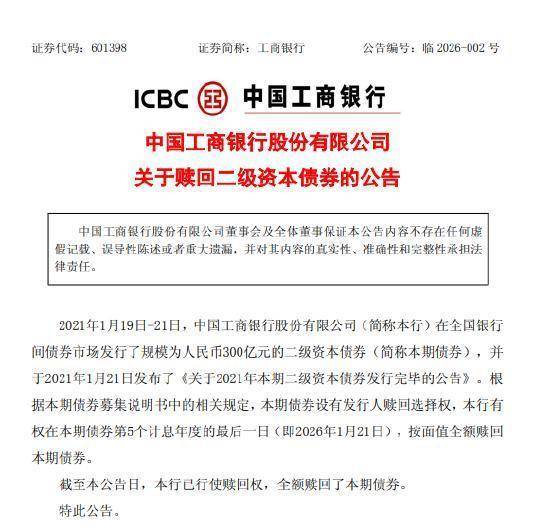
工商银行全额赎回债券,300亿规模,资本结构迎来新变化
Sou Hu Cai Jing· 2026-01-24 02:11
Core Viewpoint - The issuance and subsequent redemption of subordinated capital bonds by banks, particularly ICBC, reflect a strategic capital management decision that balances liquidity, cost, and regulatory compliance, while also transferring market uncertainties to bond investors [1][3][5]. Group 1: Bank's Perspective - The issuance of 30 billion yuan in subordinated capital bonds by ICBC is a common practice that allows banks to optimize their capital structure, especially if future interest rates decline or alternative capital tools become available at lower costs [1][3]. - The redemption of these bonds indicates that ICBC has sufficient liquidity or access to cheaper funding sources, suggesting a proactive approach to capital management [1][3]. - This action also highlights the bank's ability to navigate market conditions and regulatory requirements effectively, demonstrating a sophisticated understanding of capital management [1][3][5]. Group 2: Investor's Perspective - Investors in subordinated capital bonds face credit and liquidity risks, and they must be aware of the potential for capital write-downs, which are often underestimated due to a lack of risk pricing awareness [5][9]. - Many investors mistakenly treat these bonds as stable income-generating assets, particularly in a declining interest rate environment, leading to a mispricing of risks until redemption or market shocks occur [5][9]. - The need for investors to recognize the quasi-equity nature of these bonds is crucial, as they should not be viewed as safe alternatives like government bonds [9][12]. Group 3: Regulatory Perspective - Regulators encourage banks to diversify their capital sources to mitigate macro and micro risks, with subordinated capital bonds being a recognized component of this strategy [5][9]. - There is a tension between promoting bond issuance and preventing these instruments from becoming tools for evading capital constraints, leading to increasingly detailed regulations [5][9][12]. - The regulatory framework must evolve to provide clearer guidance on information disclosure and product suitability, ensuring that market participants are not left vulnerable to the complexities of capital management strategies [9][12][14]. Group 4: Market Implications - The full redemption by ICBC is seen as a normal capital management action, but it raises questions about the clarity of information disclosure and the need for transparent communication regarding the implications for capital adequacy [7][16]. - Frequent design of capital tools as "redeemable" could undermine investor confidence in the sustainability of returns, potentially leading to higher risk premiums and increased financing costs over time [14][16]. - The interaction between banks, investors, and regulators in this context emphasizes the importance of a well-functioning institutional framework, where transparency and risk awareness are prioritized for the benefit of all market participants [16].


USCB Financial (USCB) - 2025 Q4 - Earnings Call Transcript
2026-01-23 17:02
Financial Data and Key Metrics Changes - Total assets reached $2.8 billion, up 8.1% year-over-year [2] - Loans grew by $216 million, or 11%, reflecting strong commercial activity [2] - Deposits increased to $171 million, or 7.9%, demonstrating continued franchise growth [2] - Net interest income expanded to 3.27%, improving from 3.16% in the prior year [2] - Non-performing loans stood at 0.14% of total loans, indicating excellent credit quality [3] - Tangible book value per share increased 10.8% year-over-year to $11.97 [3] - GAAP-diluted EPS was $0.07, with operational diluted EPS at $0.44, consistent with the previous quarter [4] Business Line Data and Key Metrics Changes - Average loans increased $31.9 million, or 6.02% annualized compared to the prior quarter [10] - Gross loan production totaled $196 million in Q4, with $83.5 million from correspondent banking [12] - Net interest income increased $933,000 on a linked quarter basis, representing 17.4% annualized growth [13] - Portfolio yield declined modestly to 6.16% due to Federal Reserve rate cuts [11] Market Data and Key Metrics Changes - Average deposits were stable, down $3.9 million compared to the prior quarter but up $314.6 million year-over-year [10] - Interest-bearing deposit rates decreased 27 basis points to 3.02% [10] - Total deposit costs improved 25 basis points quarter-over-quarter [10] Company Strategy and Development Direction - The company aims to expand and strengthen its deposit base, focusing on multi-vertical and relationship-driven strategies [26] - Key business lines include Business Banking, Private Client Group, Association Banking, and Correspondent Banking, each with clear growth plans [27][28][29] - The strategy emphasizes building sticky, relationship-anchored deposits and expanding production capacity [27][28] Management's Comments on Operating Environment and Future Outlook - Management expressed confidence in the bank's ability to execute its plans for 2026, focusing on profitability and shareholder value [26] - The company anticipates further NIM improvement supported by rate cuts and disciplined deposit pricing strategies [14] - Management highlighted the importance of maintaining a healthy loan-to-deposit ratio between 90% and 95% [40] Other Important Information - The board approved a 25% increase in quarterly cash dividends to $0.12 per share [5] - The bank's capital ratios exceed regulatory requirements comfortably [5] - The company executed a $40 million subordinated debt issuance, primarily used for share repurchase [3] Q&A Session Summary Question: Deposit trends and shrinkage at year-end - Management noted a significant deposit move of over $100 million from a long-term client, which is expected to rebuild over time [36] - A $50 million swing in correspondent banking deposits was also identified, which has been recovered in January [37] Question: Loan-to-deposit ratio expectations - Management prefers a loan-to-deposit ratio between 90% and 95%, indicating a desire for liquidity [40] Question: SBA vertical opportunity - The SBA initiative has been growing prudently, with plans to increase annual volume to $40 million or $50 million over the next three years [42] Question: Capital strategy and priorities - The focus remains on building capital and returning it to shareholders, with no significant plans for additional actions beyond producing good earnings [48]