HALO交易

Search documents
“HALO交易”主导!多只电力股连板涨停,电力ETF华宝(159146)放量冲高逾1.5%创上市新高!
Xin Lang Cai Jing· 2026-02-27 02:19
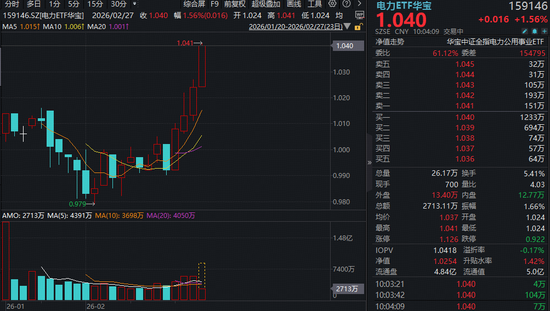
Group 1 - The electric power sector experienced a strong rally, with multiple stocks hitting the daily limit, including YN Energy Holdings with seven consecutive limit-ups, Gannan Energy with three, and Huayin Power with two [1][5] - The electric power ETF, Huabao (159146), surged over 1.5%, reaching a new high since its listing, and is on track for a fourth consecutive daily gain [1][5] Group 2 - Fund manager Cao Xuchen of the electric power ETF Huabao (159146) noted that the sector's strong performance post-Spring Festival is primarily driven by "HALO trading," where physical assets like energy and electricity are seen as essential amid the rise of AI, which is expected to increase electricity demand [3][7] - The ETF focuses on the electric utility sector, covering thermal, hydro, wind, nuclear, and solar power, and is positioned to benefit from both dividends and growth, with a high concentration of leading electric stocks [3][7]

Halo交易的终极赢家,是日本?
Hua Er Jie Jian Wen· 2026-02-26 08:45
Core Insights - The investment strategy focusing on heavy asset, low attrition rate (Halo) companies is gaining traction in the market, with the Japanese stock market positioned as a potential ultimate beneficiary of this trend [1][2] - The shift in investor focus towards companies with high barriers to entry and essential industrial capabilities is reshaping the pricing logic for Japanese assets, as these companies are seen as key safe havens against technological disruptions [1][2] Group 1: Investment Strategy - Investors are rapidly adjusting their portfolios to seek out "non-losers" that can withstand the disruptions caused by AI, leading to a preference for heavy asset companies [1][2] - Morgan Stanley notes a transition from light asset narratives to "HALO" trades, emphasizing investments in tangible production assets and infrastructure that are difficult to replace with technology [1][2] Group 2: Japanese Market Dynamics - Historically, Japanese companies were overlooked due to their heavy asset models, but their unique industrial foundations and technological barriers are now attracting global investors [1][2] - The Japanese stock market's appeal is heightened as it contains many companies with low attrition rates that dominate niche markets, avoiding direct competition with other Asian firms [2][4] Group 3: Industrial Structure and Collaboration - Japan's broad industrial coverage, with companies averaging involvement in 2.3 sectors compared to 1.5 in the US and Europe, is now seen as a valuable asset in the context of global supply chain needs [4] - The ongoing reindustrialization efforts in the US are creating opportunities for Japanese firms to become attractive partners, particularly in energy and infrastructure projects [5] Group 4: Semiconductor Industry Insights - The semiconductor industry's growth is shifting pricing power upstream to Japanese specialty materials manufacturers, which are crucial for advanced manufacturing processes [6] - Companies like Mitsui Kinzoku and Dowa are experiencing significant profit margin increases, with expectations of rising from around 10% to over 25% due to their monopolistic positions in the supply chain [6] Group 5: Cautionary Notes - While the current market dynamics favor Japanese Halo companies, there is a recognition that this status is fragile and could be challenged by future market narratives or shifts in AI development [7]
HALO 效应:人越来越成为 AI 时代最核心资产
投资实习所· 2025-07-21 14:16
Core Viewpoint - The article discusses a new transaction structure in the AI sector termed "HALO," which stands for "Hire And License Out," representing a hybrid model between acquisition and hiring, allowing companies to employ startup teams while licensing their intellectual property [1][5][6]. Group 1: HALO Transaction Characteristics - HALO transactions are characterized by rapid execution, high prices, and are currently unique to the AI industry [3][4]. - Unlike traditional acquihires, the acquiring company does not purchase the startup but hires its personnel and obtains a non-exclusive license for its intellectual property [2][7]. - The financial returns for startup investors and employees are structured to resemble those of an acquisition, with licensing fees set close to acquisition amounts [8][12]. Group 2: Social Contract and Market Dynamics - There are concerns that HALO transactions may disrupt the social contract between founders, investors, and employees, but they are seen as efforts to maintain this contract in a new environment [10][11]. - The rise of HALO transactions is partly attributed to the current antitrust environment, which has made traditional acquisitions more politically charged and uncertain [13][14]. Group 3: Talent Valuation in AI - The article emphasizes that in the AI sector, talent is increasingly valued over traditional assets, with companies willing to pay substantial amounts to secure key teams [16][17]. - The scarcity of experienced talent in AI makes these individuals highly sought after, as the technology itself depreciates rapidly [18][22]. Group 4: Future of HALO and Industry Implications - HALO is viewed as a signal of the evolving focus on human capital over company assets, indicating a shift in market dynamics [25]. - The structure of HALO transactions is still in its infancy and may require further refinement to establish clearer industry norms and improve efficiency [30][31].