
稀缺性重新定价

Search documents
HALO投资论火了,农业ETF华夏(516810)涨超1%冲击4连涨,亚盛集团涨停
Mei Ri Jing Ji Xin Wen· 2026-02-27 05:56
Group 1 - The core viewpoint of the article highlights a shift in market pricing logic from light asset expansion to the valuation of hard-to-replicate physical assets, driven by high real interest rates, geopolitical fragmentation, supply chain restructuring, and AI capital expenditures [1] - The agricultural sector is currently experiencing a resurgence, with the Agricultural ETF (516810) rising over 1% and benefiting from various factors such as the reversal of the pig cycle and chemical cycle, as well as the emphasis on food security [1] - The valuation of the agricultural sector is at historical lows, providing a high safety margin and anti-inflation attributes due to its strong internal circulation characteristics [1] Group 2 - The Agricultural ETF holds leading stocks in pig farming, agricultural chemicals, and planting industries, making it well-positioned to benefit from multiple positive trends [1] - The ETF offers advantages such as low entry barriers, risk diversification, and transparent holdings, making it an attractive option for investors looking to capitalize on the agricultural sector's rebound [1] - The report from Goldman Sachs emphasizes the revaluation of scarcity in the context of increasing global uncertainties, particularly regarding food security as a national strategic bottom line [1]

Halo交易的终极赢家,是日本?
Hua Er Jie Jian Wen· 2026-02-26 08:45
Core Insights - The investment strategy focusing on heavy asset, low attrition rate (Halo) companies is gaining traction in the market, with the Japanese stock market positioned as a potential ultimate beneficiary of this trend [1][2] - The shift in investor focus towards companies with high barriers to entry and essential industrial capabilities is reshaping the pricing logic for Japanese assets, as these companies are seen as key safe havens against technological disruptions [1][2] Group 1: Investment Strategy - Investors are rapidly adjusting their portfolios to seek out "non-losers" that can withstand the disruptions caused by AI, leading to a preference for heavy asset companies [1][2] - Morgan Stanley notes a transition from light asset narratives to "HALO" trades, emphasizing investments in tangible production assets and infrastructure that are difficult to replace with technology [1][2] Group 2: Japanese Market Dynamics - Historically, Japanese companies were overlooked due to their heavy asset models, but their unique industrial foundations and technological barriers are now attracting global investors [1][2] - The Japanese stock market's appeal is heightened as it contains many companies with low attrition rates that dominate niche markets, avoiding direct competition with other Asian firms [2][4] Group 3: Industrial Structure and Collaboration - Japan's broad industrial coverage, with companies averaging involvement in 2.3 sectors compared to 1.5 in the US and Europe, is now seen as a valuable asset in the context of global supply chain needs [4] - The ongoing reindustrialization efforts in the US are creating opportunities for Japanese firms to become attractive partners, particularly in energy and infrastructure projects [5] Group 4: Semiconductor Industry Insights - The semiconductor industry's growth is shifting pricing power upstream to Japanese specialty materials manufacturers, which are crucial for advanced manufacturing processes [6] - Companies like Mitsui Kinzoku and Dowa are experiencing significant profit margin increases, with expectations of rising from around 10% to over 25% due to their monopolistic positions in the supply chain [6] Group 5: Cautionary Notes - While the current market dynamics favor Japanese Halo companies, there is a recognition that this status is fragile and could be challenged by future market narratives or shifts in AI development [7]
高盛:HALO效应股票获追捧 美五大科技巨头2023至2026年资本支出将达1.5万亿 重资产组合自2025年以来跑赢轻资产35%
Jin Rong Jie· 2026-02-25 06:52
Group 1 - The core viewpoint of the report is that the current stock market pricing logic is shifting from a "scalable light asset narrative" to "buildable, irreplaceable physical capacity and networks," summarized as "scarcity repricing" [1] - Goldman Sachs defines HALO as a combination of "heavy assets" and "low obsolescence," where heavy assets are based on substantial physical capital with multi-dimensional replication barriers, and low obsolescence refers to assets that maintain economic value across technological cycles [1] - The report highlights that the past decade of zero interest rates and abundant liquidity has led to high valuations for light asset business models, but this balance is now disrupted by the rise of AI, which increases uncertainty in profitability and terminal value for light asset industries [1] Group 2 - Since 2025, Goldman Sachs' heavy asset portfolio has outperformed the light asset portfolio by 35%, indicating that asset intensity has become a core driver of valuation and returns [2] - The valuation gap between heavy and light assets has significantly narrowed, primarily driven by the revaluation of heavy asset companies, reflecting that market funds are willing to pay a premium for the strategic value of physical assets [2]
大摩交易员:“AI恐惧”可能已到达顶峰,如果没有,那么买HALO吧
Hua Er Jie Jian Wen· 2026-02-25 06:52
Core Insights - The market's fear regarding AI disrupting traditional industries may have peaked, with "HALO" trades (heavy assets, low obsolescence) being the best hedge for investors still concerned about AI impacts [1][8] Group 1: Market Sentiment and AI Impact - The recent briefing by AI company Anthropic indicated a preference for "cooperation" between AI and existing software providers, contrasting previous fears of complete replacement, leading to a rebound in previously shorted software stocks [1][7] - Despite the S&P 500 index remaining stable since late October last year, extreme fund flows have caused unprecedented internal market divergence, with significant capital inflows into AI beneficiaries and semiconductor sectors while indiscriminately selling software assets [1][4] Group 2: Stock Market Dynamics - The divergence in stock performance has been extreme, with growth and value stocks experiencing a 24% return difference, and the S&P 500's technology and consumer discretionary sectors facing an 11% decline [4] - Defensive and cyclical sectors have seen significant gains, with industrials up 13%, consumer staples up 16%, materials up 22%, and energy up 25% during the same period [4] Group 3: Fund Flows and Positioning - Hedge funds have significantly increased their exposure to semiconductor and AI-related stocks, reaching the highest levels since 2020, while infrastructure software has been the most sold theme, dropping to the 0th percentile since 2020 [7] - Following the Anthropic briefing, there was a reassessment of extreme positions, with software stocks previously labeled as "at risk from AI" rebounding approximately 5% [7] Group 4: HALO Strategy - For investors who believe the "AI fear" has not peaked, Morgan Stanley recommends investing in HALO assets, which are characterized by high production capacity and low obsolescence [8][10] - The HALO basket has risen 28% over the past year, while stocks affected by AI disruption have fallen 43%, indicating a significant attractiveness of this strategy [10]


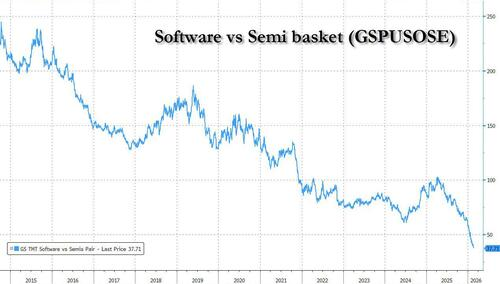
AI时代的“稀缺资产”?高盛:HALO--重资产、不过时
Hua Er Jie Jian Wen· 2026-02-25 02:24
Core Viewpoint - The market is shifting its pricing logic from "expandable light asset narratives" to "buildable, irreplaceable physical capacities and networks" due to higher real interest rates, geopolitical fragmentation, supply chain restructuring, and a wave of AI capital expenditure [2][3] Group 1: Market Dynamics - Goldman Sachs describes this shift as "scarcity repricing," where the market rewards capacity, infrastructure, and engineering complexity, which are costly to replicate and less likely to be technologically obsolete [3][4] - The report highlights that companies are decisively returning to tangible assets, with unprecedented value appreciation for capacity, infrastructure, and long-cycle assets [4][5] Group 2: Impact of AI on Asset Valuation - The rapid rise of AI is challenging the profitability and terminal value of previously dominant "new economy" models, particularly in software and IT services [6][7] - AI is reshaping capital expenditure patterns, with major tech companies expected to invest approximately $1.5 trillion in capital expenditures from 2023 to 2026, significantly surpassing their historical investments [9][10] Group 3: Performance of Heavy vs. Light Assets - The performance of Goldman Sachs' "heavy asset portfolio" has outperformed the "light asset portfolio" by 35% since 2025, indicating a market preference for tangible assets [10] - The valuation gap between heavy and light assets has narrowed significantly, with heavy asset companies driving the convergence rather than a broad devaluation of light asset companies [10][11] Group 4: Defining Heavy Assets - Heavy assets are characterized by high physical capital requirements and low obsolescence rates, with industries like utilities, energy, and telecommunications firmly in this category [11][12] - In contrast, software and IT services are categorized as light assets, heavily reliant on human capital rather than physical capital [12] Group 5: Macroeconomic Factors - Heavy asset stocks tend to perform well in high-interest rate environments, benefiting from stronger nominal economic activity and government spending [13][14] - The profitability outlook for heavy asset companies is improving, with expected EPS compound annual growth rates of 14%, compared to 10% for light asset companies [15] Group 6: Investment Trends - Despite recent performance, the rotation towards heavy assets is still in its early stages, with significant underallocation in value stocks compared to growth stocks [16][17] - The physical assets' "bulletproof" characteristics are becoming increasingly valuable in an AI-accelerated market, highlighting a potential long-term shift in market leadership [17]
