企业重整

Search documents
*ST新元(300472.SZ):与产业投资人签署重整投资协议
Ge Long Hui A P P· 2025-12-11 13:17
格隆汇12月11日丨*ST新元(300472.SZ)公布,2025年11月10日、11月11日,公司收到临时管理人发来的 《新元科技重整投资人遴选结果告知函》和《公证书》。获悉新元科技重整投资人遴选评审委员会根据 《新元科技重整投资人遴选评审规则及评分细则》依法评审打分,并经江西省抚州市赣东公证处进行现 场监督公证,确认随锐绿技行启宸联合体(牵头投资人:随锐科技集团股份有限公司)为新元科技重整 正选投资人;确认光和金资投资联合体(牵头投资人:汕头市光和投资合伙企业(有限合伙))为新元 科技重整备选投资人。本次签署《重整投资协议》是公司化解风险、预重整及重整程序的必要环节,但 该协议的签署不代表公司保壳成功,目前公司保壳事项仍存在较大不确定性,若最终未能成功保壳,公 司股票将面临终止上市的风险。 ...

宁夏原首富旗下公司执行重整计划:6409户申报1787亿元债权
Sou Hu Cai Jing· 2025-12-08 02:37
宝塔石化集团等167家公司正在执行重整计划。 2025年11月24日,全国企业破产重整案件信息网刊登了宝塔石化集团《关于书面核查债权的报告》,披露了宝塔石化集团等167家公司的重整进展,该报 告的落款时间为2025年11月24日。 《关于书面核查债权的报告》显示,截至本次书面核查债权前,管理人共接收并登记宝塔石化集团等167家公司的各类债权申报6409户,申报的债权总额 为1787.75亿元。 国家税务总局银川市西夏区税务局的债权金额为9.46亿元,其中社保债权6455.32万元,税款债权4.42亿元,普通债权4.40亿元。 黄桷树财经注意到,从申报的债权总额来看,宝塔石化集团等167家公司的重整已经超过了金科股份及其子公司重庆金科公司的重整,是西部有史以来规 模最大的一次重整。 据悉,管理人根据第二次债权人会议后债权审查、确定情况,编制了《宝塔石化集团等167家公司实质合并重整案债权表(三)》,共544户债权人合计申 报债权金额707.12亿元,经管理人审查,确认债权金额合计248.53亿元,暂缓确认债权金额合计424.53亿元,不予确认债权金额合计34.06亿元。 从确认的248.53亿元债权来看,宝塔石 ...

北京天宜上佳高新材料股份有限公司关于公开招募和遴选重整投资人的公告
Shang Hai Zheng Quan Bao· 2025-12-04 20:03
登录新浪财经APP 搜索【信披】查看更多考评等级 证券代码:688033 证券简称:天宜新材 公告编号:2025-065 北京天宜上佳高新材料股份有限公司关于公开招募和遴选重整投资人的公告 本公司董事会及全体董事保证本公告内容不存在任何虚假记载、误导性陈述或者重大遗漏,并对其内容 的真实性、准确性和完整性依法承担法律责任。 重要内容提示: 1、本次招募重整投资人具有不确定性,存在本次招募未招募到合格重整投资人、重整投资人未按期签 订投资协议等可能。 2、公司后续是否进入重整程序尚存在不确定性。如后续法院裁定受理对公司的重整申请,公司将依法 配合法院及管理人开展相关重整工作,并依法履行债务人的法定义务。根据《上海证券交易所科创板股 票上市规则(2025年4月修订)》(以下简称"《股票上市规则》")有关规定,如后续法院裁定受理对 公司的重整申请,上海证券交易所将对公司股票实施退市风险警示。 3、如公司顺利实施重整并执行完毕重整计划,将有利于改善公司经营和财务状况,提升经营能力。如 重整失败,公司将存在被宣告破产的风险,若公司被宣告破产,根据《股票上市规则》相关规定,公司 股票将面临被终止上市的风险,敬请广大投资者 ...
湖南国资出手 湖南盐业集团入局杉杉集团重整
Zheng Quan Shi Bao Wang· 2025-12-04 14:32
Group 1 - Hunan Salt Industry Group has officially registered as an intended restructuring investor for Shanshan Group, completing a deposit of 50 million yuan, marking a strategic move to accelerate its layout in the new energy and new materials sector [1] - The restructuring aims to integrate capital with industry, solidifying the "Salt + New Energy" industry layout and fostering a second growth curve for the group [1] - Hunan Salt Industry Group is a state-owned enterprise with a registered capital of 1 billion yuan, established to manage the province's salt industry and is actively seeking policy guidance and resource support for the restructuring [1][2] Group 2 - Hunan Salt Industry Group's main business includes salt, salt chemicals, and new energy materials, with total assets amounting to 20.561 billion yuan by the end of 2023 [2] - The group plans to leverage its strong industrial foundation and mature capital platform, along with collaborations with research institutions, to inject new vitality into Shanshan Co., Ltd.'s ongoing development [2] - Shanshan Group, along with its subsidiary Pengze Trading, was ordered to undergo substantial merger restructuring due to significant debt-related lawsuits, with a court ruling set for March 20, 2025 [2][3] Group 3 - In September, a consortium of restructuring investors, including Shanshan Group and others, signed a restructuring investment agreement, but the draft plan failed to pass a vote [3] - On November 24, the "Fangda System" announced its intention to participate in the restructuring of Shanshan Group, indicating increased market interest in the restructuring process [3] - Shanshan Co., Ltd. is a leader in the global lithium battery anode materials and polarizer industry, aligning well with Hunan Salt Industry Group's focus on new energy and materials [3]


拟控股财信发展!四川南充籍80后青年川商,将拿下年内第2家上市公司→
Sou Hu Cai Jing· 2025-12-03 12:18
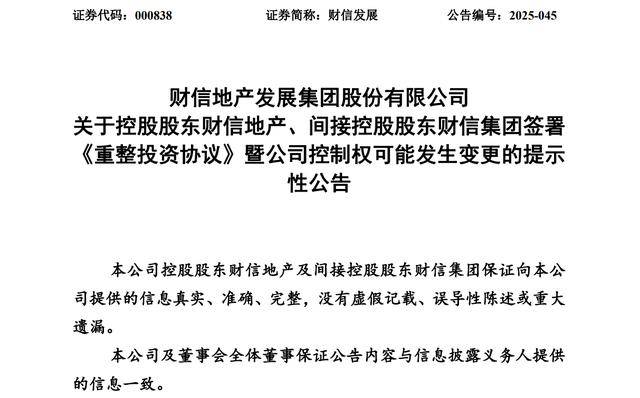
Core Viewpoint - The article discusses the acquisition of a significant stake in Caixin Development by Jiangxi Zhongjiu Natural Gas Group, led by entrepreneur Yong Zhijun, marking a strategic shift in the company's ownership and potential restructuring efforts [1][4]. Group 1: Company Background - Caixin Development, established in 1996, operates in real estate development and environmental protection, previously recognized as one of China's top 100 real estate companies from 2018 to 2022 [4]. - The company has faced continuous losses and operational challenges, with revenue declining from 5.055 billion yuan in 2021 to 828 million yuan in 2024, and net profits remaining negative over the same period [4][6]. Group 2: Acquisition Details - On December 2, 2023, Caixin Development announced that its controlling shareholder, Caixin Real Estate Development Group, signed a restructuring investment agreement with Jiangxi Zhongjiu, which plans to acquire 20% to 29.99% of the company's shares [1][4]. - If the acquisition is completed, Yong Zhijun will become the new actual controller of Caixin Development, changing the company's ownership structure [1][4]. Group 3: Financial Performance - As of the third quarter of 2025, Caixin Development reported total assets of 2.494 billion yuan and liabilities of 2.051 billion yuan, resulting in a high debt-to-asset ratio of 82.24% [7]. - The company reported a net profit of -18.65 million yuan for the year, reflecting a 209.14% year-on-year decline [8]. Group 4: Market Reaction - Following the announcement of the acquisition, Caixin Development's stock price surged to the daily limit of 3.89 yuan per share, with a total market capitalization of 4.281 billion yuan [8].

雍芝君有望入主财信发展
Zhong Guo Ji Jin Bao· 2025-12-02 15:42
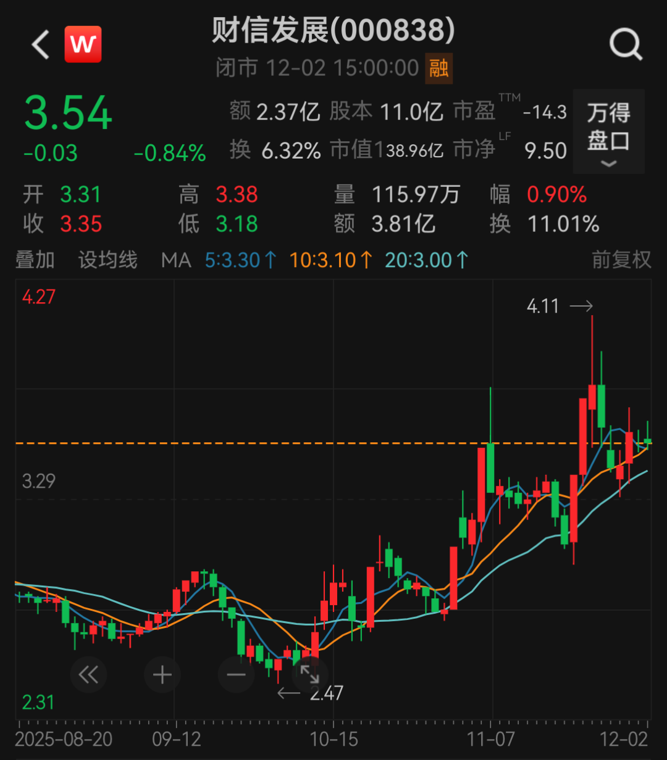
Core Viewpoint - Yong Zhijun, a low-profile entrepreneur from Jiangxi, is set to become the controlling shareholder of Caixin Development through his company Jiangxi Zhongjiu Natural Gas Group, which plans to acquire 20% to 29.99% of the shares in Caixin Development [3][4]. Group 1 - Caixin Development's stock closed at 3.54 CNY per share on December 2, with a market capitalization of 3.896 billion CNY [2]. - The acquisition will make Jiangxi Zhongjiu the controlling shareholder of Caixin Development, with Yong Zhijun as the actual controller [4]. - Jiangxi Zhongjiu was selected as the investor for the restructuring of Caixin Development and its related companies, completing the recruitment process for investors [4]. Group 2 - Yong Zhijun holds 90% of Jiangxi Zhongjiu, which has previously invested in other companies, including acquiring a 28.94% stake in Xinjiang Torch [4]. - Other potential investors, such as Huatai Asset and Oriental Asset, withdrew from the restructuring process, leaving Jiangxi Zhongjiu as the chosen investor [5].
重整在即,谁看中了*ST美谷的医美业务?
Guo Ji Jin Rong Bao· 2025-12-02 14:53
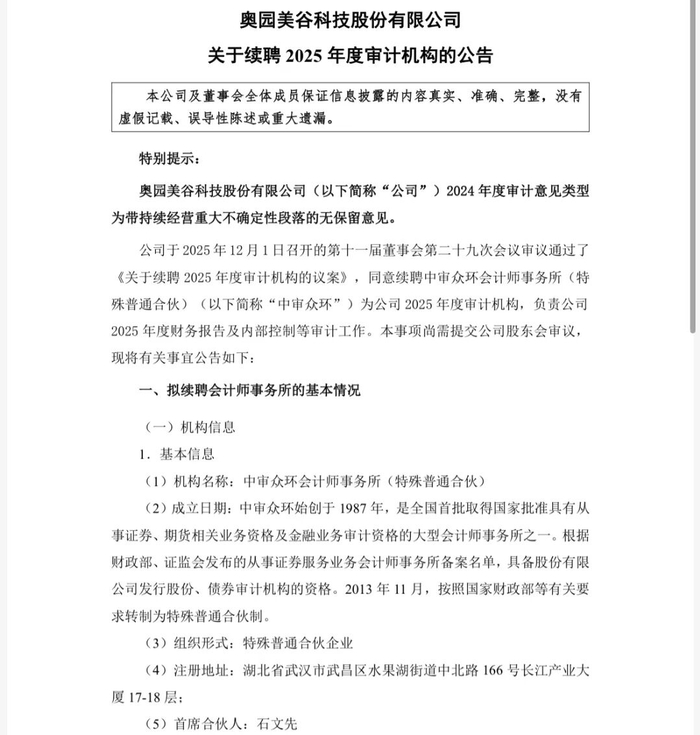
Core Viewpoint - The restructuring of *ST Meigu (000615.SZ) is a focal point for the market, with the company seeking to emerge from its current difficulties through a comprehensive restructuring plan and the appointment of an auditing firm for oversight [1][3]. Restructuring Plan - The board of *ST Meigu has approved the reappointment of Zhongshun Zhonghuan Accounting Firm as the auditing agency for the fiscal year 2025, pending approval from a temporary shareholders' meeting [1]. - The restructuring plan includes the recruitment of investors, with three main investors identified: Hubei Jiuzhou Industrial Park Operation Management Co., Tianjin Xinmeitongcheng Equity Investment Partnership, and six financial investors [4][5]. - The restructuring plan proposes a capital increase of approximately 10.24 billion shares, raising the total share capital to 17.87 billion shares, with a conversion ratio of 13.4278 shares for every 10 shares held [5]. Financial Details - Approximately 8.6 billion shares from the capital increase will be allocated to introduce restructuring investors, with a total investment amount of 1.536 billion yuan, where Hubei Jiuzhou accounts for 706 million yuan, nearly 46% of the total [5]. - The restructuring investors will use part of the shares for debt settlement with related guarantee creditors, and they will not be allowed to seek further compensation from *ST Meigu for these shares [5]. Business Strategy - Post-restructuring, *ST Meigu plans to leverage the funds and resources from industrial investors to strengthen its existing beauty and health services while expanding into related businesses within the health industry [6]. - The company aims to acquire quality assets related to its main business through retained funds and share issuance after the restructuring [6]. Medical Aesthetics Focus - *ST Meigu's core asset remains its medical aesthetics business, which began in 2021 with a 697 million yuan acquisition of a 55% stake in Zhejiang Liantianmei [6][7]. - The company has formed strategic partnerships with various entities in the medical aesthetics sector, although its real estate business has faced challenges leading to financial losses [7]. - In 2023, *ST Meigu was placed under "delisting risk warning" due to its inability to repay debts, prompting a restructuring application [7]. Investor Background - Jiuzhou Tong, through its subsidiary Jiuzhou Chuantou, signed a restructuring investment agreement with *ST Meigu, potentially becoming the controlling shareholder if the restructuring is successful [8]. - Jiuzhou Tong has been investing in the medical aesthetics sector since 2016, with significant growth in its medical aesthetics business, achieving a sales revenue of 851 million yuan in 2024, a 120.47% increase year-on-year [9]. - The company reported a compound annual growth rate of 111.64% in sales revenue from 2022 to 2024, indicating a robust growth trajectory in the medical aesthetics market [9].
“民营船王”,出局
Shang Hai Zheng Quan Bao· 2025-12-01 01:29
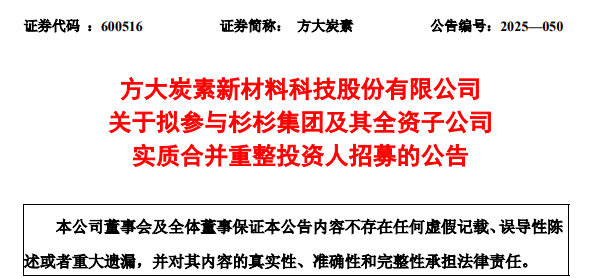
Group 1 - The restructuring plan proposed by Ren Yuanlin, known as the "private shipping king," has failed, leading Shanshan Group to initiate a new selection process for restructuring investors [1][2] - Fangda Carbon New Material Technology Co., Ltd. has announced its participation as an industrial synergy partner in the recruitment of substantial merger restructuring investors for Shanshan Group and its wholly-owned subsidiary, Ningbo Pengze Trading Co., Ltd. [1] - The restructuring process will include stages such as preliminary selection, final selection, and voting by the creditors' committee [1] Group 2 - The initial registration for investors has concluded, but the exact number of applicants remains unclear due to the presence of consortiums [2] - Jiangsu Xinyangzi Trading Co., Ltd., led by Ren Yuanlin, did not register for this recruitment, although there is a possibility of future financial collaboration with other investors [2][3] - A previous agreement was signed on September 29, where a consortium including Jiangsu Xinyangzi and others aimed to acquire 23.36% of Shanshan's shares for a total price of 3.284 billion yuan [2] Group 3 - The rejection of the restructuring plan indicates a significant setback for the capital plan led by the four-party consortium attempting to take control of Shanshan [3] - Ren Yuanlin's background in shipbuilding has raised concerns regarding his ability to ensure the sustainable development of Shanshan's core business in the new energy sector [5] Group 4 - Fangda Carbon's main business includes the production and sales of graphite electrodes, carbon bricks, and other carbon-based materials, with total assets exceeding 400 billion yuan and annual sales projected to exceed 300 billion yuan in 2024 [5][6]
张家界旅游集团股份有限公司关于公司召开重整第一次债权人会议的公告
Shang Hai Zheng Quan Bao· 2025-11-28 18:55
Core Viewpoint - Zhangjiajie Tourism Group Co., Ltd. has entered a restructuring process, with the first creditors' meeting scheduled for December 15, 2025, to discuss the company's financial recovery plan [1][8]. Group 1: Restructuring Announcement - The Zhangjiajie Intermediate People's Court has accepted the restructuring application of Zhangjiajie Tourism Group and appointed a liquidation team to manage the process [1]. - The first creditors' meeting will be held online, allowing creditors to participate via computer or mobile devices [1][10]. Group 2: Meeting Details - The creditors' meeting is set for December 15, 2025, at 11:00 AM [1]. - Participants must log in using credentials sent via SMS and are encouraged to test their login before the meeting [1][12]. Group 3: Management and Contact Information - The management team can be contacted through specific phone numbers provided for inquiries related to the creditors' meeting [2][3]. - Technical support for the online meeting is available through a dedicated helpline [2]. Group 4: Related Company Developments - Zhangjiajie Tourism Group's wholly-owned subsidiary, Zhangjiajie Dayong Ancient City Development Co., Ltd., is also undergoing restructuring, with its second creditors' meeting scheduled for the same day [8][9]. - The restructuring process for both the parent company and its subsidiary is critical for their financial recovery and operational stability [8][15]. Group 5: Investor Communication - The company emphasizes the importance of accurate information disclosure and has designated specific media outlets for official announcements [1][26]. - Investors are advised to remain cautious and informed about the ongoing restructuring developments [26].

辽宁首富入局杉杉!
起点锂电· 2025-11-28 10:10
Core Viewpoint - The article discusses the ongoing power struggle within the Shanshan Group following the departure of its founder, Zheng Yonggang, and highlights the involvement of external forces, particularly the Fangda Group, in the restructuring efforts of Shanshan Group [3][10]. Group 1: Shanshan Group's History and Transformation - Shanshan Group was founded in 1989 by Zheng Yonggang, initially starting in the clothing industry before diversifying into lithium battery materials [5][6]. - The company made a significant move in 1997 by investing 80 million yuan to industrialize lithium battery anode materials, marking its first transformation [5]. - In 2001, Shanshan's lithium battery materials project commenced production, ending Japan's monopoly on China's lithium battery anode materials [6]. - The launch of the first-generation iPhone in 2007 led to a surge in lithium battery demand, benefiting Shanshan's profitability [7]. - In 2018, Shanshan split its clothing business and listed under the "Shanshan Brand" on the Hong Kong Stock Exchange, officially transitioning to a high-tech enterprise [7][8]. Group 2: Recent Developments and Restructuring Efforts - Following Zheng Yonggang's departure in early 2023, his son Zheng Ju took over as chairman, while Zheng Yonggang's widow, Zhou Ting, engaged in a power struggle [8]. - The company faced significant profit declines amid industry challenges, leading to a restructuring application on January 27, 2023, and a court ruling for substantial merger restructuring on March 20, 2023 [8]. - A failed investment plan occurred on October 21, 2023, when a creditor meeting voted against a restructuring proposal due to a lawsuit from a company called Simico [8]. Group 3: Fangda Group's Involvement - Fangda Carbon, a subsidiary of the Fangda Group, announced its participation in the restructuring of Shanshan Group, aiming to leverage its strengths in technology, capital, and channels [10][11]. - Fangda Group's chairman, Fang Wei, is recognized as the richest person in Liaoning with a wealth of 52.5 billion yuan, indicating strong financial backing for the restructuring efforts [10]. - The article notes that Fangda Carbon's recent financial performance has been under pressure, making the partnership with Shanshan a strategic move for both parties [11].