全面依法治国

Search documents
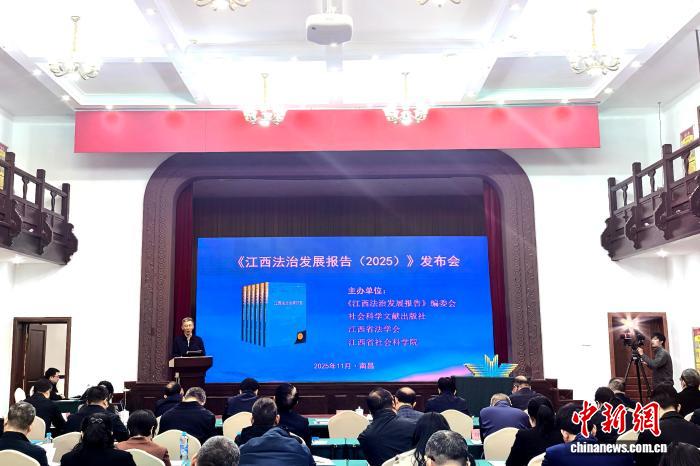
《江西法治发展报告(2025)》发布 系江西首部省级法治蓝皮书
Zhong Guo Xin Wen Wang· 2025-11-21 09:15
Core Insights - The "Jiangxi Legal Development Report (2025)" is the first provincial-level legal blue book in Jiangxi, showcasing the province's legal construction practices and future outlook based on 2024 data [1][2][3] Summary by Sections General Report - The general report provides a panoramic view of Jiangxi's comprehensive rule of law practices and future prospects [1][3] Sub-reports - Six sub-reports systematically summarize the achievements in core areas such as legislation, law enforcement, and judiciary [1][2] Thematic Reports - Ten thematic reports focus on key issues in the construction of a rule-of-law Jiangxi [1][2] Case Studies - Seven typical case studies delve into innovative grassroots governance experiences [1][2] Appendices - The appendices include an annual chronicle of significant events and new regulations [1][2]

学习贯彻习近平总书记重要指示精神 严格落实党政机关习惯过紧日子要求部署社会救助和经济稳增长等工作
Xi An Ri Bao· 2025-11-21 03:02
Group 1 - The meeting emphasized the importance of deeply studying and implementing Xi Jinping's legal thought to accelerate the establishment of a scientific and complete legal system in the city [2] - The meeting highlighted the need to integrate and leverage Xi'an's cultural, tourism, education, and cultural relic resources to innovate cultural exchanges and enhance international communication [2] - The meeting stressed the necessity of adhering to the requirement for party and government agencies to live frugally, reinforcing institutional constraints and promoting good habits [2] Group 2 - The meeting called for a people-centered development approach, focusing on improving the social governance system and conducting thorough investigations of special difficult groups [2] - The meeting underscored the importance of effectively managing petition work, enhancing problem tracking, and ensuring coordinated responses from various departments [2] - The meeting outlined the need for practical and efficient measures to stabilize economic growth, focusing on real enterprise needs and optimizing service methods [3]
党员、干部以法治思维和法治方式破解难题
Ren Min Ri Bao· 2025-11-21 02:33
Group 1 - The core viewpoint emphasizes the importance of advancing the rule of law in national governance and addressing challenges through legal thinking and methods [1][2][20] - The construction of a socialist rule of law state is a key goal for the 14th Five-Year Plan, highlighting the need for comprehensive legal governance [1][3] - The introduction of the Private Economy Promotion Law aims to eliminate barriers to private sector development and ensure fair market competition [2][3] Group 2 - The National Development Planning Law draft emphasizes public participation and the necessity of adhering to legal procedures in the formulation and implementation of national development plans [4][5] - The law aims to ensure a stable and predictable environment for economic and social development through legal frameworks [5][6] - The establishment of a legal basis for the Hainan Free Trade Port reflects the integration of reform and legal governance [6][7] Group 3 - The implementation of the revised Supervision Law enhances the legal framework for anti-corruption efforts and the accountability of public officials [6][7] - The focus on grassroots governance through legal education and the promotion of "legal literate" individuals in rural areas aims to resolve local disputes effectively [9][10] - The exploration of ecological compensation mechanisms demonstrates the application of legal frameworks to address environmental issues [10][11] Group 4 - The emphasis on urban governance through legal means aims to address long-standing issues, such as inadequate sanitation facilities in urban areas [11][12] - The introduction of tailored occupational injury protections for new employment forms reflects the adaptation of legal frameworks to modern labor market challenges [12][13] - The integration of socialist core values into legal construction aims to enhance societal norms and legal compliance [14][15] Group 5 - The need for leadership to enhance their ability to apply legal thinking in governance is highlighted as crucial for effective law-based governance [15][16] - The implementation of new regulations aims to prevent corruption and ensure fair enforcement of laws [19][20] - The overall approach emphasizes the necessity of using legal frameworks to address complex governance challenges and enhance national stability [19][20]
一周“纪”事丨以高质量监督执纪执法服务保障党和国家工作大局
Zhong Yang Ji Wei Guo Jia Jian Wei Wang Zhan· 2025-11-21 00:34
Group 1 - The core political task of the disciplinary inspection and supervision organs is to integrate the study and implementation of Xi Jinping's thoughts with the spirit of the 20th National Congress, focusing on high-quality supervision to support the "14th Five-Year Plan" for economic and social development [1][2] - Xi Jinping emphasized the importance of party style as the party's image, which affects public sentiment and the party's survival, urging leaders to maintain integrity and resist corruption [1][2] - The disciplinary inspection and supervision organs must enhance political awareness and ensure the implementation of Xi Jinping's directives to promote the development of new productive forces tailored to local conditions [4][5] Group 2 - The effectiveness of party governance directly correlates with the strength of economic and social development, necessitating a commitment to Xi Jinping's requirements for improving party conduct [2][3] - The publication of Xi Jinping's legal thoughts and the convening of the Central Comprehensive Rule of Law Work Conference aim to guide the implementation of the rule of law across various sectors [2][3] - Continuous learning and implementation of the spirit of the 20th National Congress is a long-term political task for the disciplinary inspection and supervision organs, which must enhance their role in ensuring high-quality development [5][6]
“国家治理的一场深刻变革”
Ren Min Ri Bao· 2025-11-20 22:21
Group 1 - The core viewpoint emphasizes the importance of advancing the rule of law in national governance as a profound transformation, with a focus on legalizing various aspects of state work and ensuring that all departments act in accordance with the law [1][2] - The 20th Central Committee's Fourth Plenary Session included significant deployments for achieving a higher level of socialist rule of law during the 14th Five-Year Plan period, highlighting the necessity of overcoming challenges through scientific methods and enhancing the ability to manage complex situations [1][2] - The emphasis on the rule of law as a fundamental way of thinking and working is crucial for fostering a legal environment conducive to development, particularly in addressing deep-seated issues in economic and social development [2][3] Group 2 - The introduction of the Private Economy Promotion Law marks a significant step in supporting the private sector, explicitly incorporating the principle of "two unwavering" into law, which aims to ensure fair competition and equal access to resources for private enterprises [3][4] - The law aims to eliminate policies that hinder a unified national market and fair competition, thereby providing a solid foundation for the sustainable and high-quality development of the private economy [3][4] Group 3 - The National Development Planning Law draft is under review, which aims to establish a legal framework for the scientific formulation and effective implementation of national development plans, ensuring that adjustments to these plans follow legal procedures [5][7] - The law emphasizes public participation in the planning process, encouraging social input and transparency in gathering opinions from various stakeholders [6][7] Group 4 - The ongoing reforms are seen as key measures to address deep-seated economic and social issues, with a focus on integrating legal thinking and methods throughout the reform process [8] - The construction of the Hainan Free Trade Port is highlighted as a significant initiative, with a call for a phased approach to developing a policy system that aligns with high-level free trade standards [8] Group 5 - The emphasis on using legal thinking and methods to address issues related to people's livelihoods is crucial, with a focus on ensuring that the rule of law serves the interests of the people [10][11] - The establishment of "legal literate" individuals in rural areas has proven effective in resolving disputes and enhancing grassroots governance through legal means [11] Group 6 - The exploration of ecological protection compensation mechanisms aims to address environmental issues through legal frameworks, ensuring that compensation standards and responsibilities are clearly defined [12] - The implementation of the Ecological Protection Compensation Regulations is intended to enhance the legal basis for environmental protection efforts [12] Group 7 - The integration of legal thinking into urban governance is emphasized, with successful initiatives in Shanghai addressing long-standing issues such as inadequate sanitation facilities [13] - The approach taken in urban development reflects a commitment to legal governance, ensuring that residents' rights are respected and that their voices are heard in decision-making processes [13] Group 8 - The introduction of tailored occupational injury protection for new employment forms, such as delivery workers, reflects a proactive approach to addressing the unique challenges faced by this workforce [14][15] - The focus on expanding protections for flexible employment highlights the need for innovative legal solutions to safeguard workers' rights in emerging job markets [15] Group 9 - The combination of legal and moral governance is underscored, with recent judicial measures aimed at resolving disputes related to marriage and family, particularly concerning dowries [17] - The legal framework aims to enhance awareness of rights and responsibilities, promoting a culture of legal compliance and moral integrity [17] Group 10 - The enhancement of leadership capabilities in applying legal thinking and methods is identified as essential for effective governance, with a focus on addressing issues such as corruption and administrative misconduct [18][21] - The emphasis on legal frameworks to regulate administrative actions aims to prevent abuses of power and ensure accountability within government operations [21][22]
为强国建设、民族复兴伟业提供有力法治保障——习近平总书记对全面依法治国工作作出的重要指示引发热烈反响
Yang Guang Wang· 2025-11-20 07:05
Core Viewpoint - The important instructions from General Secretary Xi Jinping on comprehensively governing the country by law have sparked enthusiastic responses among cadres and the public, emphasizing the need to deeply learn and implement Xi Jinping's legal thought to create a new situation in the construction of a law-based China [1][2]. Group 1: Achievements and Goals - The construction of a law-based China has achieved breakthrough, systematic, and overall results under the guidance of Xi Jinping's legal thought [2]. - The instructions from Xi Jinping clarify the strategic, overall, and directional issues of comprehensively governing the country by law, deepening the understanding of the laws governing socialist legal construction [1][2]. Group 2: Implementation and Practices - Various departments, including the Supreme People's Court and the Supreme People's Procuratorate, are committed to upholding legal supervision responsibilities and ensuring fairness and justice in every judicial case [2][3]. - The focus is on promoting scientific legislation, strict law enforcement, fair justice, and ensuring that the public adheres to the law, contributing positively to the new situation in law-based China construction [1][2]. Group 3: Community and Grassroots Engagement - The emphasis on grassroots legal construction is highlighted, with a focus on integrating legal governance with social stability and development, ensuring that the law benefits the public [3][4]. - Local governance initiatives, such as the "Fengqiao Experience," are being developed to enhance community participation in legal processes and improve the quality of legislation based on public input [3][4].
吹响新时代新征程推进全面依法治国的号角——合力开创法治中国建设新局面
Xin Hua She· 2025-11-20 03:21
Core Points - The Central Conference on Comprehensive Law-based Governance was held in Beijing on November 17-18, emphasizing the importance of Xi Jinping's instructions on law-based governance [1][3][7] - The conference marks the second such meeting since the first in November 2020, highlighting the significance of Xi Jinping's legal thought as the guiding ideology for comprehensive law-based governance [2][3] - The meeting occurs at a critical juncture as the "14th Five-Year Plan" concludes and the "15th Five-Year Plan" is being formulated, with a focus on achieving a higher level of socialist rule of law in the next five years [3] Summary by Sections Emphasis on Law and Governance - Xi Jinping's instructions stress the importance of law as a guarantee for Chinese-style modernization, focusing on building a more complete socialist legal system and a higher level of socialist rule of law [3] - The instructions highlight the need for law to be coordinated with reform, development, and stability, especially in the context of complex domestic and international environments [3] Social Justice and Fairness - The conference underscores the necessity of ensuring social fairness and justice as the lifeline of the rule of law, with the ultimate goal of safeguarding people's rights [4] - There is a growing demand from the public for better living standards and increased expectations for democracy, law, fairness, justice, safety, and environmental protection [4] Comprehensive Advancement of Legal Framework - Xi Jinping's directives call for comprehensive advancement in scientific legislation, strict law enforcement, fair justice, and public adherence to the law, promoting the rule of law across all aspects of governance [5] - The integration of legislation, enforcement, justice, and public compliance is essential for achieving new results in comprehensive law-based governance [5] Collaborative Efforts for Law-based Governance - The call for "joint efforts to create a new situation in the construction of a law-based China" emphasizes the need for collaboration among various sectors and levels of society [6] - Responsibilities are placed on local party committees and law enforcement agencies to lead by example, while the public is encouraged to respect and uphold the law [6] Future Outlook - The meeting signals a new era in advancing comprehensive law-based governance, with the belief that the path of socialist rule of law with Chinese characteristics will continue to expand [7]
新华社评论员:合力开创法治中国建设新局面
Xin Hua She· 2025-11-19 16:25
Core Viewpoint - The recent directives from General Secretary Xi Jinping emphasize the importance of advancing the rule of law in China, highlighting significant achievements since the 18th National Congress and providing a clear direction for future efforts in legal governance [1][2]. Group 1: Legal Framework and Governance - The construction of a socialist legal system with Chinese characteristics is identified as the central task in promoting the rule of law [3]. - The integration of the leadership of the Party, the people's role in governance, and the rule of law is recognized as a fundamental experience in socialist legal construction [2][3]. - The 14th Five-Year Plan includes the goal of achieving a higher level of socialist rule of law, emphasizing the creation of a market-oriented, law-based, and international business environment [4]. Group 2: Implementation and Education - The publication of authoritative materials such as "Selected Works of Xi Jinping on the Rule of Law" aims to deepen the understanding and implementation of Xi Jinping's legal thought [2]. - There is a focus on enhancing the legal awareness and literacy of the public, particularly among key leadership figures, to foster a strong collective effort in advancing the rule of law [3]. Group 3: Societal Impact and Development - The rule of law is positioned as a fundamental guarantee for high-quality development, social fairness, and justice, with an emphasis on protecting people's rights and improving their well-being [4]. - The importance of maintaining national security and social stability through a robust legal framework is underscored, particularly in the context of external challenges [4].
11月19日晚间央视新闻联播要闻集锦
Yang Shi Xin Wen Ke Hu Duan· 2025-11-19 14:07
Group 1 - The construction of the Guangdong-Hong Kong-Macao Greater Bay Area is a major national strategy personally planned, deployed, and promoted by General Secretary Xi Jinping, aiming to create a vibrant and internationally competitive world-class city cluster [2] - The three regions of Guangdong, Hong Kong, and Macao are deepening cooperation and accelerating the connectivity of various elements to achieve coordinated regional development [2] Group 2 - General Secretary Xi Jinping's recent important instructions on the comprehensive rule of law emphasize the unity of the Party's leadership, the people's mastery, and the rule of law, aiming to create a new situation in the construction of a rule-of-law China [3] - The instructions have sparked enthusiastic responses across various sectors, highlighting their political, ideological, and guiding significance for advancing the rule of law in the new journey [3] Group 3 - The China-ASEAN trade cooperation has shown fruitful results, with a 9.1% increase in imports and exports in the first ten months of this year, and China and ASEAN have been each other's largest trading partners for five consecutive years [9]
总书记为新征程上推进全面依法治国指明前进方向
Xin Hua She· 2025-11-19 07:03
Core Points - The Central Comprehensive Law-based Governance Work Conference was held in Beijing on November 17-18, where important instructions from General Secretary Xi Jinping regarding comprehensive law-based governance were conveyed [3] - The conference marks the second such meeting since the first one in November 2020, emphasizing the significance of Xi Jinping's legal thought as the guiding ideology for comprehensive law-based governance [4] - The "14th Five-Year Plan" and the upcoming "15th Five-Year Plan" outline the main goals for economic and social development, including the construction of a higher-level socialist rule of law [4] Group 1 - Xi Jinping proposed two key focuses: "greater emphasis on the synergy between law, reform, development, and stability" and "greater emphasis on safeguarding and promoting social fairness and justice" [5] - The importance of law as a guarantee for Chinese-style modernization is highlighted, with a call for law-based thinking and methods to advance reform, safeguard development, and maintain stability [5][6] - The ultimate goal of advancing comprehensive law-based governance is to protect the rights and interests of the people, reflecting their growing demands for democracy, law, fairness, justice, safety, and environmental protection [6] Group 2 - Xi Jinping emphasized the need for "comprehensive promotion of scientific legislation, strict law enforcement, impartial justice, and universal law observance" [7] - The interconnectedness of legislation, law enforcement, judicial processes, and public adherence to the law is crucial for achieving new results in comprehensive law-based governance [7] - The integration of law-based governance and party regulations is essential for supporting high-quality economic and social development [7] Group 3 - A call for collective efforts to create a new landscape for law-based governance in China was made, emphasizing the need for collaboration across various levels and sectors [8][10] - The responsibility of local party committees and the active participation of the public are vital for building a solid foundation for law-based governance [10] - The advancement of the socialist rule of law in China is seen as a pathway to national prosperity and strength [11]