
Consumer spending

Search documents
How Back-to-School Shopping Influences Retailers and Consumers
The Wall Street Journal· 2025-08-28 15:00
Back-to-School Season Importance - Back-to-school season is second only to the holiday season in importance for retailers [1] - Performance during the back-to-school season is highly correlated with performance during the holiday season [3] Competitive Landscape - Retailers are engaging in promotional activities to capture consumer spending early [1][2] - Competition extends beyond apparel to encompass overall consumer spending [3] Investment Strategy - Focus on retailers like Urban Outfitters, Hollister (Abercrombie), and Tapestry (Coach) that demonstrate strong consumer demand and willingness to pay full price [4] - Capitalize on momentum from back-to-school to holiday, favoring stocks of companies with positive trends [5] - Avoid investing in struggling companies simply because they appear cheap [5][6]

AI bubble concerns, Tanger CEO talks retail and strength of the consumer
Yahoo Finance· 2025-08-25 21:51
Retail & Consumer Trends - Tanger 观察到客流量自四月初以来持续增长,并在八月未停止,表明消费者具有韧性 [4][5] - Tanger 的奥特莱斯购物中心主要面向寻求以最优惠价格购买喜爱品牌的消费者 [5][6] - Sephora 和 Ulta 等品牌开始进驻 Tanger 的购物中心,以接触更多顾客 [7] - Tanger 提早于六月开始返校促销活动,以应对潜在的关税影响,并成功带动了客流量 [8][9][10] - Tanger 从去年 11 月 1 日开始圣诞促销活动,旨在将黑色星期五的优惠日常化 [12][13] - 零售商正在混合承担和转嫁关税成本,Tanger 观察到品牌早在第二季度就开始试探性提价 [13][14] - Tanger 正在增加餐饮、娱乐和会员忠诚度计划,以吸引顾客到实体店消费 [18][19][20] Market & Economic Analysis - 市场出现板块轮动,能源和通信服务板块领涨,而必需消费品、医疗保健和公用事业板块下跌 [21][22][23] - 美元指数上涨,此前美联储对降息的预期导致美元大幅下跌 [25][26] - 比特币价格下跌,创下六到七周以来的最低价格,此前出现虚假突破 [28][29][30] - 由于美元走强,钯金下跌 3%,铂金下跌 2%,白银下跌 1%,黄金下跌约 0.25%,原油价格小幅上涨 [32][33] Artificial Intelligence (AI) - Appion 认为人工智能本身具有价值,但需要更好地应用,不认为目前存在泡沫 [35][36] - MIT 的报告指出,95% 的组织在人工智能投资中没有获得回报,表明人工智能的应用方式存在问题 [39][43] - Appion 认为人工智能应应用于核心工作流程,以创造真正的价值 [44][45] - Appion 通过将人工智能融入工作流程,为流程增加超过 25% 的价值 [50]

Recession risks are really high, says Moody's Mark Zandi
CNBC Television· 2025-08-18 16:06
Recession Risks - Moody's Analytics认为美国经济衰退的风险非常高,就业是关键 [1] - 如果三个月移动平均失业率上升超过 0.5 个百分点,历史上预示着经济衰退 [3] - 由于移民政策等因素,失业率可能无法完全反映经济疲软 [4] - 负面的就业数据将是经济衰退的明确信号,历史上,当就业数据转为负值时,通常是经济衰退开始的月份 [2][6] - 要确认经济衰退,需要看到一系列持续的经济活动下降,而不仅仅是一两个月的负面数据 [6][7] Labor Market Dynamics - 稳定失业率所需的每月新增就业人数约为 2550 人 [5] - 由于数据测量问题等因素,潜在的就业增长可能接近该水平 [5] - 移民对劳动力增长至关重要,但更严格的移民政策导致外国出生的劳动力增长下降,甚至开始下降 [8][9][10] - 由于外国出生劳动力减少,整体劳动力规模低于年初水平,从而压低了失业率 [10][11] - 劳动力增长放缓会降低经济的潜在增长率,并可能导致通胀压力 [11][12] Consumer Spending - 今年总体实际消费支出停滞不前,部分原因可能是移民政策的影响 [12][13]
Data Will Matter More Than Fed Meeting: 3-Minute MLIV
Bloomberg Television· 2025-07-30 08:13
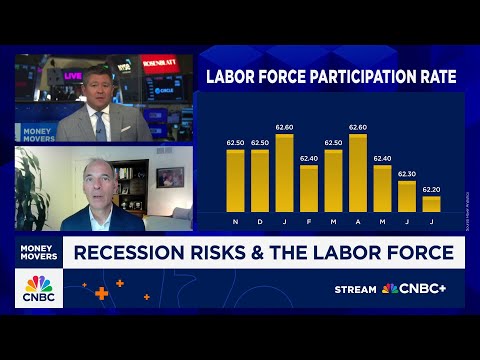
Market Performance & Outlook - European equity market futures are uninspiring despite news and data releases [1] - Equities are expected to nudge slightly higher this week, surviving scheduled catalysts [2] - August is anticipated to be a volatile month with differentiation between countries [9] Key Economic Drivers - The Fed's path depends on tariffs' impact on consumer and economy, not dissent [4] - US earnings season has been relatively good, while Europe's is mixed, favoring US stocks [5] - US Q2 GDP data is crucial to compensate for a weak Q1 due to tariff front-loading [6] - Consumer spending remains strong, as indicated by retail sales and GDP data [5] Trade Deals & Global Impact - Trade deals with Brazil, Mexico, and Canada have deadlines coming on Friday [7] - Negative shocks are expected next week as countries without deals suffer competitive disadvantages [8] - The world is diversified, with winners and losers emerging over the next month [9] Currency Trends - The dollar is expected to continue to rally in the short term [10] - Longer term, dollar depreciation is still expected, but a reduced bounce is possible in the short term [10]
Chipotle: Expensive Burritos, Expensive Stock
Seeking Alpha· 2025-07-27 11:18
Group 1 - The stock market is currently at all-time highs, but there are mixed signals from the macroeconomy, particularly regarding consumer spending [1] Group 2 - Gary Alexander has extensive experience in technology companies and has been a contributor to Seeking Alpha since 2017, providing insights into industry trends [2]

The consumer is 'getting to the end of their rope', says Cameron Mitchell
CNBC Television· 2025-07-25 12:57
Consumer Behavior & Market Trends - Chipotle experienced a decline in instore traffic for two consecutive quarters [1] - Cameron Mitchell Restaurants observed a potential shift towards more cautious consumer spending based on sales data [1] - The restaurant industry is facing challenges in maintaining profitability [5][6] - Consumers are starting to spend slightly less, potentially ordering fewer desserts or appetizers [9] - There's cautious optimism with recent same-store sales increases [3][9] Cost & Pricing Pressures - Cameron Mitchell Restaurants is approaching the limit of price increases it can implement in the market [3] - Rising meat prices are significantly impacting the company's profit and loss (P&L), potentially forcing price adjustments in the second half of the year [4] - Increased costs across labor, food, construction materials, and interest rates are impacting profitability [6] - Labor costs are up, but turnover is at an all-time low [7][8] Restaurant Industry Challenges - Many restaurant closures are occurring, particularly affecting independent restaurants with fewer resources [6][7] - Inflation and persistently high prices are making the restaurant business tougher [7]
Don't try to time the market, says Neuberger Berman's Holly Newman Kroft
CNBC Television· 2025-07-16 15:41
Market Volatility & Uncertainty - The market faces continued uncertainty stemming from administration policies, tariffs, and geopolitical factors [2][3] - Despite volatility, the market hit a new high in June, and historically, markets tend to be positive 12 months after hitting a new high [3][4] - The best and worst trading days of the year occurred within four days of each other, making market timing extremely difficult [6] Investment Strategy - Advises clients to review their strategic asset allocation to meet long-term goals and tolerate volatility [5] - Recommends against trying to time the market, emphasizing the importance of reviewing investments and allocations with advisors [6] Economic Outlook - The consumer remains strong and has absorbed tariffs without significant pause, continuing to spend [8][10] - Economic data is strong, and it's important to differentiate between stock market volatility and the overall economy [8] - Inflation data shows prices of consumer goods are ticking up, with August suggested as a potential peak [9]
Tariffs are unlikely to cause as much consumer disruption as feared, says PNC's Yung-Yu Ma
CNBC Television· 2025-07-02 15:38
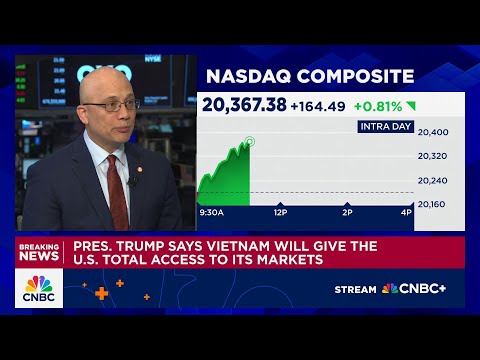
Trade Deal & Tariffs - A trade deal with Vietnam was announced, including 20% tariffs on Vietnamese goods entering the US market, which could impact importers like retailers [2] - No tariffs are imposed on US goods entering the Vietnamese market [2] - The market views the deal as a step in the right direction, but the 20% tariff rate is higher than desired [3][4] - The market anticipates further trade deals before the July 9th deadline [3] - A 20% tariff across the board with other countries could cause concerns about a slowdown in consumer spending [5][6] - The 20% tariff is better than the originally announced 46% on Vietnam and 95% on Cambodia [6] - Trans-shipping detail with 40% tariffs is a direct hit to China [7] Inflation & Consumer Impact - Tariffs will bring in revenue but may also raise prices [7] - There hasn't been a great deal of tariff pass-through to consumers so far [8] - If tariff rates are higher than 10-15%, the market will pause to see how well consumers hold up [9] Market Reaction - Stocks moved up in the morning following the trade deal announcement, but the reaction wasn't significant [2] - The market wants to see progress on trade deals [3]
花旗:美国经济_服务业支出放缓,核心个人消费支出(PCE)低迷预示美联储将降息
花旗· 2025-07-01 00:40
Investment Rating - The report suggests a dovish outlook for the Federal Reserve, indicating potential rate cuts in September due to weak consumer spending and subdued core PCE inflation [1][8]. Core Insights - Consumer spending has shown signs of persistent weakness, particularly in services, with a nominal increase of only 0.1% MoM and flat real terms, leading to an overall decline in personal spending [5][7]. - Core PCE inflation increased by 0.179% MoM, slightly above expectations, but still subdued enough to support the case for rate cuts [4][8]. - The report highlights a significant decline in travel-related spending, particularly in air travel and hotel accommodations, which have seen declines every month this year [7][8]. Summary by Sections Consumer Spending - Personal spending fell by 0.1% MoM in nominal terms and 0.3% in real terms, with goods spending declining by 0.8% MoM [5]. - Services spending showed unexpected weakness, with a nominal increase of only 0.1% MoM and flat in real terms, indicating a broader trend of reduced consumer demand [5][7]. Inflation Metrics - Core PCE inflation was reported at 0.179% MoM, slightly stronger than consensus but still indicative of a soft inflation environment [4][8]. - The report suggests that weak consumer demand limits the ability of firms to pass through tariff price increases, reducing the risk of broad-based inflation [8]. Employment Implications - The report indicates that weaker consumer demand could lead to softer hiring, raising downside risks to the Federal Reserve's employment mandate [8].

X @CNN Breaking News
CNN Breaking News· 2025-06-27 13:44
Consumer Spending Trends - Consumer spending slowed more than expected last month [1] - Americans reined in their purchases [1]