
不良资产证券化

Search documents
2025年NPL市场回顾与展望:市场持续扩容,未来回收表现有待持续关注
Lian He Zi Xin· 2026-02-12 11:16
Market Overview - The NPL product market continued to expand in 2025, with a total issuance scale of 820.57 billion yuan, representing a year-on-year growth of 61.32%[4] - The cumulative issuance scale of NPL products from 2016 to 2025 reached 3285.88 billion yuan, indicating a sustained growth trend over six consecutive years[4] Asset Securitization - In 2025, commercial banks disposed of a total of 519.11 billion yuan of non-performing loans (NPLs) through asset securitization, with principal accounting for 90.53% of this amount, marking a 62.80% increase from 2024[5] - As of September 2025, the balance of non-performing loans in commercial banks was 3522.48 billion yuan, with 349.45 billion yuan disposed of through securitization, accounting for 10.28% of the median balance of non-performing loans[7] Issuance Characteristics - Large state-owned commercial banks remained the main issuers in the NPL market, with the top three institutions (Industrial and Commercial Bank of China, China Construction Bank, and Bank of China) accounting for 39.92% of the total issuance in 2025[9] - The types of NPL products issued have diversified, including personal housing mortgage NPLs and small micro-enterprise NPLs, reflecting a trend towards greater variety in product offerings[9] Recovery Rates and Valuation - The expected recovery rate for credit card NPL products ranged from 4.09% to 16.15%, with a weighted average recovery rate of 9.68%[22] - Personal housing mortgage NPL products had a higher expected recovery rate of 31.44% to 50.02%, with a weighted average recovery rate of 42.30%, although this represents a decline from 50.08% in 2024[31] Small Micro-Enterprise Loans - In 2025, 44 small micro-enterprise NPL products were issued, with a total issuance scale of 224.01 billion yuan, accounting for 27.03% of the total issuance[36] - The expected recovery rate for small micro-enterprise NPLs varied significantly, ranging from 11.58% to 57.20%, depending on the type of collateral involved[37]



信贷资产证券化 2025 年度运营报告与 2026 年度展望:信贷 ABS 发行规模止跌回稳,NPL 成为发行及交易主力;产品发行利率走势出现分化;零售资产拖欠率高位波动;需对消费信贷及行业政策保持关注
Zhong Cheng Xin Guo Ji· 2026-01-23 06:25
1. Report's Industry Investment Rating - The document does not mention the industry investment rating. 2. Core Viewpoints of the Report - In 2025, influenced by the significant increase in NPL product issuance, the number and scale of credit - asset - backed securities issuances rebounded. The secondary - market trading volume also rebounded, with NPL products and sub - grade securities becoming the main trading components. The spreads of normal - class products continued to decline, while those of NPL products showed differentiation. Retail asset delinquency rates fluctuated at high levels, and the real recovery of NPL products continued to decline [6][7][55]. - In 2026, the credit asset securitization market is expected to be dominated by NPL products. The issuance spreads of other product types are expected to remain low, and the trading proportion of NPL and sub - grade securities in the secondary market is expected to further increase. Retail asset performance is unlikely to improve significantly in the short term, and the actual recovery of NPL products will continue to face pressure. Attention should be paid to the impact of consumer credit and industry policies [6][55]. 3. Summary by Relevant Catalogs 3.1 Issuance - In 2025, a total of 238 credit - asset - backed securities were issued, with a total issuance scale of 291.522 billion yuan, representing a year - on - year increase of 23.96% in the number of issuances and 7.82% in scale. NPL products accounted for 74.79% of the issuance number and 28.15% of the scale, both reaching historical highs [6][7]. - Auto ABS: 32 issues were issued, with a total scale of 118.543 billion yuan, a year - on - year decrease of 8.58% in scale. Green Auto ABS accounted for 17.62% of the total Auto ABS issuance scale, a decrease of 8.67 percentage points compared to 2024 [10]. - NPL: 178 issues were issued, with a total scale of 82.057 billion yuan, a year - on - year increase of 36.92% in the number of issuances and 61.32% in scale, and a cumulative disposal of 519.086 billion yuan in non - performing assets [10]. - Micro - enterprise loan ABS: 10 issues were issued, with a total scale of 58.645 billion yuan, a year - on - year decrease of 23.08% in the number of issuances and 10.49% in scale [12]. - Personal consumption - loan ABS: 18 issues were issued, with a total scale of 32.277 billion yuan, a year - on - year increase of 5.88% in the number of issuances and 32.70% in scale [13]. 3.2 Issuance Interest Rate - In 2025, the issuance interest rate of normal - class asset credit ABS remained low, while the NPL product issuance interest rate deviated from the benchmark interest rate at the end of the year. The issuance interest rates of Auto ABS, personal consumption - loan ABS, and micro - enterprise loan ABS decreased in the first half of the year and then remained stable, while the NPL issuance interest rate increased significantly in the fourth quarter [17]. - The average spread of AAAsf - rated products and the benchmark interest rate was 56bp, and that of AA + sf - rated products was 48bp, a decrease of 2bp and 18bp respectively compared to 2024. The spreads of different types of products all declined to varying degrees, with NPL products still at a relatively high level [20]. 3.3 Secondary Market - By the end of 2025, the credit - asset - backed securities' outstanding scale decreased by 11.85% to 435.812 billion yuan. The trading volume increased by 4.38% to 130.514 billion yuan, the number of transactions increased by 27.90% to 2,388, and the turnover rate increased by 8.83 percentage points to 28.06% [23][25][26]. - NPL products were the main trading variety, with a trading volume of 53.206 billion yuan, accounting for 40.77% of the total trading volume. Auto ABS trading volume was 48.574 billion yuan, accounting for 37.22% of the total trading volume [28]. 3.4 Credit Performance - Auto ABS: The cumulative default rate of recently issued products increased significantly, the delinquency rate increased, and the prepayment rate showed a slow upward trend, with the fluctuation center between 8% - 10% [31][33][35]. - Personal consumption - loan ABS: The performance was significantly differentiated, the delinquency rate fluctuated, and the prepayment rate continued to rise [38][40][43]. - RMBS: The cumulative default rate remained low, the delinquency rate first increased and then decreased, and the prepayment rate fluctuated to a high level and then returned to stability [45][47][49]. - NPL: The real recovery situation declined year by year, and 11 issues of priority - class asset - backed securities failed to be fully redeemed by the expected maturity date [52].
百亿资产转让频现 银行加速甩包袱
Bei Jing Shang Bao· 2025-10-12 23:36
Core Insights - The banking sector is accelerating the disposal of historical burdens, with two significant debt asset transfer cases exceeding 100 billion yuan, aimed at optimizing asset structure and improving capital adequacy ratios [1][2][3] Group 1: Major Asset Transfers - Bohai Bank plans to publicly transfer debt assets totaling approximately 700 billion yuan, including principal, interest, and penalties, with a minimum price set at about 488.83 billion yuan, reflecting a discount of around 30% [2] - Guangzhou Rural Commercial Bank has approved a plan to transfer a credit asset package worth approximately 189.28 billion yuan, which includes a principal amount of 149.78 billion yuan and has incurred significant tax losses [3] Group 2: Market Trends in Non-Performing Loans - The transfer of small, dispersed non-performing loans has become a regular occurrence, with various banks listing personal consumption loans and credit card overdrafts on the bad loan transfer platform [4][5] - The trend of transferring small-scale non-performing loans is supported by a growing number of banks participating in the market, enhancing their willingness and ability to dispose of such assets [5][6] Group 3: Evolving Asset Management Strategies - The banking industry is transitioning from a traditional "sell-off" model to a more market-oriented and diversified approach for managing non-performing assets, including asset-backed securities (ABS) [7][8] - Financial institutions are encouraged to adopt a comprehensive approach to non-performing asset management, utilizing various methods such as cash recovery, self-write-offs, and asset securitization to enhance efficiency [8]
千亿信达证券董监高“换血”
Xin Lang Cai Jing· 2025-10-01 02:09
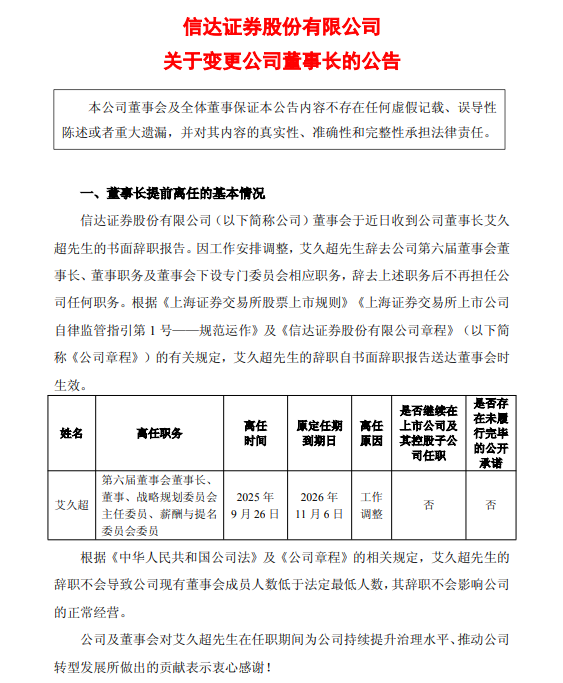
Core Viewpoint - The recent leadership changes at Xinda Securities, including the resignation of Chairman Ai Jiuchao and the appointment of Lin Zhizhong, signal a strategic shift within the company following its integration into the Central Huijin Investment Co., Ltd. system, indicating a focus on governance and operational alignment [1][4][15]. Management Changes - Ai Jiuchao officially stepped down as Chairman on September 26, with Lin Zhizhong taking over the role, also serving as the head of the Strategic Planning Committee [1][4]. - This leadership transition follows the resignation of three key executives since August, including General Manager Zhu Ruimin and Director Liu Liyi, all attributed to "work arrangement adjustments" [3][8]. - Lin Zhizhong, the new chairman, has extensive experience within the China Cinda system, having held various positions in different branches, which aligns with the company's strategic direction [7][15]. Company Performance - Xinda Securities has seen significant growth under Ai Jiuchao's leadership, with total assets surpassing 100 billion and net profit increasing from 856 million in 2020 to 1.415 billion by the end of 2024, marking a 65.3% increase [5]. - The company successfully listed on the Shanghai Stock Exchange on February 1, 2023, with a stock price increase of 48% from its initial listing price [5]. - As of September 29, 2025, the stock closed at 19.35 yuan, with a market capitalization of 627.52 billion [6]. Financial Highlights - As of mid-2025, Xinda Securities managed total assets of 1.214 trillion, a year-on-year increase of over 57%, with a revenue of 2.037 billion, reflecting a 27.66% increase [18]. - The net profit for the first half of 2025 reached 1.032 billion, a 64.86% year-on-year growth, positioning the company favorably within the industry [18]. - Investment income has become a significant revenue source, reaching 1.045 billion, a 143.59% increase compared to the previous year, accounting for 51.3% of total revenue [19]. Challenges and Strategic Focus - Despite the overall growth, the company faces challenges in its investment banking segment, with a 17.61% decline in investment banking revenue due to a lack of IPO projects [23]. - The company has not had any new IPO projects since 2021, which could impact future revenue streams if not addressed [23]. - The new leadership team, under Lin Zhizhong, is tasked with enhancing the company's competitive edge in investment banking and asset management to navigate the competitive market landscape [23].


沦为一场“表演”?不良资产证券化原理和作用详解
数说者· 2025-09-24 23:50
Core Viewpoint - The article argues that securitization is not an effective method for disposing of non-performing loans, despite being a financing tool [2][10]. Summary by Sections Securitization Example - Postal Savings Bank issued a securitized product based on personal credit non-performing consumer loans on October 18, 2022, with the asset pool being finalized on May 18, 2022 [2][4]. - The total amount of non-performing loans included in the securitization was 1.11 billion yuan, with an expected recovery of 237.33 million yuan over 33 months [3][4]. Asset Characteristics - The asset pool consisted of 18,529 loans from 8,675 borrowers, with a total principal amount of 1.11 billion yuan and interest and fees amounting to 90.91 million yuan [3]. - The average outstanding balance per borrower was 138,400 yuan, and the average expected recovery amount was 27,400 yuan [3]. Issuance Details - The securitized product had a total issuance size of 182 million yuan, with 142 million yuan in senior tranches and 40 million yuan in junior tranches [4][5]. - The senior tranche had a fixed interest rate of 2.38% and was rated AAAsf by China Chengxin International [5]. Recovery and Investor Interest - The expected recovery amount of 237.33 million yuan was gross and included costs associated with recovery efforts [7]. - Investors were willing to purchase the securitized product due to the potential for profit, as the expected recovery exceeded the amount invested [8]. Bank's Perspective on Securitization - The bank benefits from securitization by reducing its non-performing loan balance and receiving upfront cash, which can enhance profits if the loans are fully provisioned [9]. - The bank retains the role of loan servicer, allowing it to earn service fees from the recovery process [9]. Critique of Securitization - The article highlights that the cash received from securitization may be less than what could be recovered without it, as evidenced by the actual recovery amounts [11][14]. - The "transition period" during which cash flows are restricted limits the bank's ability to utilize funds effectively [15]. Long-term Implications - Over a longer time frame, the advantages of receiving cash upfront diminish, especially if the bank engages in rolling securitizations [18][19]. - The article argues that traditional methods of write-offs and recoveries could achieve similar results without the drawbacks of securitization [20][26]. Conclusion - Securitization is portrayed as a financing method that may not effectively address the underlying issues of non-performing loans, potentially leading to negative impacts on bank profitability and loan management [26].


发行全国首单 交易所不良资产证券化产品
Jin Rong Shi Bao· 2025-08-08 07:52
Core Insights - The "Great Wall Changzheng No.1 Asset-Backed Special Plan (Renewable ABS)" has been successfully established on the Shenzhen Stock Exchange, marking a significant milestone for China Great Wall Asset Management in the field of non-performing asset securitization [1] - This product is the first of its kind issued by a financial asset management company in the exchange market, with an issuance scale of 1.77 billion yuan, including a priority scale of 1.75 billion yuan and an expected yield of 2.15% [1] - The product attracted diverse investors, including bank wealth management, public funds, and securities firms, achieving subscription multiples and priority issuance rates that exceeded expectations [1] Summary by Sections Product Details - The issuance scale of the product is 17.7 billion yuan, with a priority scale of 17.5 billion yuan and a maturity of 1 year, offering an expected yield of 2.15% [1] - The project is managed by招商证券 (招商证券), with joint sales by 长城国瑞证券, 中金公司, and 国泰海通证券 [1] Market Impact - This issuance represents a breakthrough in utilizing innovative financial tools to revitalize non-performing assets, contributing to the development of a multi-tiered capital market [1] - The successful design of transaction terms, strict asset selection standards, and precise valuation and cash flow modeling were key factors in attracting a wide range of investors [1] Future Plans - China Great Wall Asset Management plans to continue advancing the "Changzheng" series of asset securitization products and deepen cooperation with exchanges and investors [1]