
专守防卫原则

Search documents
高市“危机动员”能催出自民党选票吗
Xin Lang Cai Jing· 2026-02-01 17:15
Core Viewpoint - The upcoming Japanese House of Representatives election on February 8, 2024, is critical for Prime Minister Sanna Takichi, who has threatened to resign if her ruling coalition fails to secure a majority. The election is marked by declining public support for her government and the emergence of a new party, the "Center Reform Coalition," which poses a challenge to the ruling alliance [1][2]. Group 1: Public Support and Political Scandals - Prime Minister Takichi's approval ratings have significantly dropped, with a 10% decrease to 57% according to the Mainichi Shimbun, and an 8-point decline to 67% as per the Nikkei [1][2]. - A majority of voters, approximately 41%, disapprove of Takichi's decision to dissolve the House of Representatives, indicating public dissatisfaction with her focus on party interests over citizen welfare [1]. - The Liberal Democratic Party (LDP) has faced backlash due to a political funding scandal, with around 80% of respondents believing the party has not resolved issues related to "politics and money" [2]. Group 2: Election Dynamics and Party Strategies - The newly formed "Center Reform Coalition," comprising the Constitutional Democratic Party and Komeito, aims to challenge the ruling coalition by focusing on rational and realistic policies, contrasting with the conservative stance of Takichi's government [3][4]. - The LDP's campaign includes promises to enhance national defense, with plans to revise security documents and increase defense spending to over 2% of GDP, while the Japan Innovation Party supports even more aggressive defense policies [3]. - The LDP's support rate stands at 42%, which is not sufficient to guarantee a majority in the upcoming election, as historical data suggests that high cabinet approval ratings do not necessarily translate into party support [6][7]. Group 3: Voter Behavior and Election Outcomes - The election landscape shows that 40% of respondents support the ruling coalition, while 22.8% back the opposition, with a significant 34.9% undecided, indicating a competitive electoral environment [7]. - The Constitutional Democratic Party has gained traction among middle voters, increasing its seats from 99 to 148, while the LDP lost 56 seats, marking a significant shift in the political landscape [7]. - Takichi's strategy of threatening resignation in case of electoral failure is seen as an attempt to galvanize support for the LDP amidst rising competition from the opposition [7].
日本防卫预算再创新高遭批
Xin Lang Cai Jing· 2025-12-28 01:56
Core Viewpoint - The Japanese government has approved a record-high defense budget of approximately 9.04 trillion yen (about 405.3 billion yuan) for the fiscal year 2026, raising concerns among the public and experts regarding a departure from the "defensive posture" principle and neglect of civilian welfare [1] Group 1 - The defense budget has reached a historical high, indicating a significant increase in military spending [1] - Concerns have been raised by Japanese media and experts about the implications of this budget on national defense policy and civilian priorities [1] - The budget approval reflects a shift in Japan's defense strategy, moving away from its traditional stance [1]
日政府“穷兵黩武”引强烈抗议 旅游业者称面临“存亡危机”
Yang Shi Xin Wen· 2025-12-16 23:18
Group 1: Defense Spending and Military Deployment - The Japanese Senate approved a supplementary budget that raises defense spending for the fiscal year 2025 to approximately 11 trillion yen (about 500 billion RMB), marking a record high and sparking strong opposition from various sectors [2][3] - The Japanese Defense Ministry plans to deploy upgraded Type 12 anti-ship missiles in Kumamoto City, with expansion to Shizuoka Prefecture by 2027, which is seen as a shift from the "defensive" principles of the pacifist constitution [2] - The Defense Ministry signed a land lease agreement in Okinawa for radar deployment, with construction expected to begin after the New Year in 2026, raising local concerns about potential missile deployments [3][4] Group 2: Impact on Tourism Industry - The increase in defense spending and regional tensions have led to significant cancellations of flights between Japan and China, with 72 routes and 904 flights cut, equating to approximately 156,000 seats lost [5][6] - Japanese tourism operators are facing a "survival crisis" due to the cancellations, particularly during the peak travel season from the end of the year to the Spring Festival [5][6] - If the current situation persists, it is predicted that Japan's tourism revenue could decrease by about 2.2 trillion yen (approximately 100 billion RMB), negatively impacting the country's GDP by 0.36% [6]
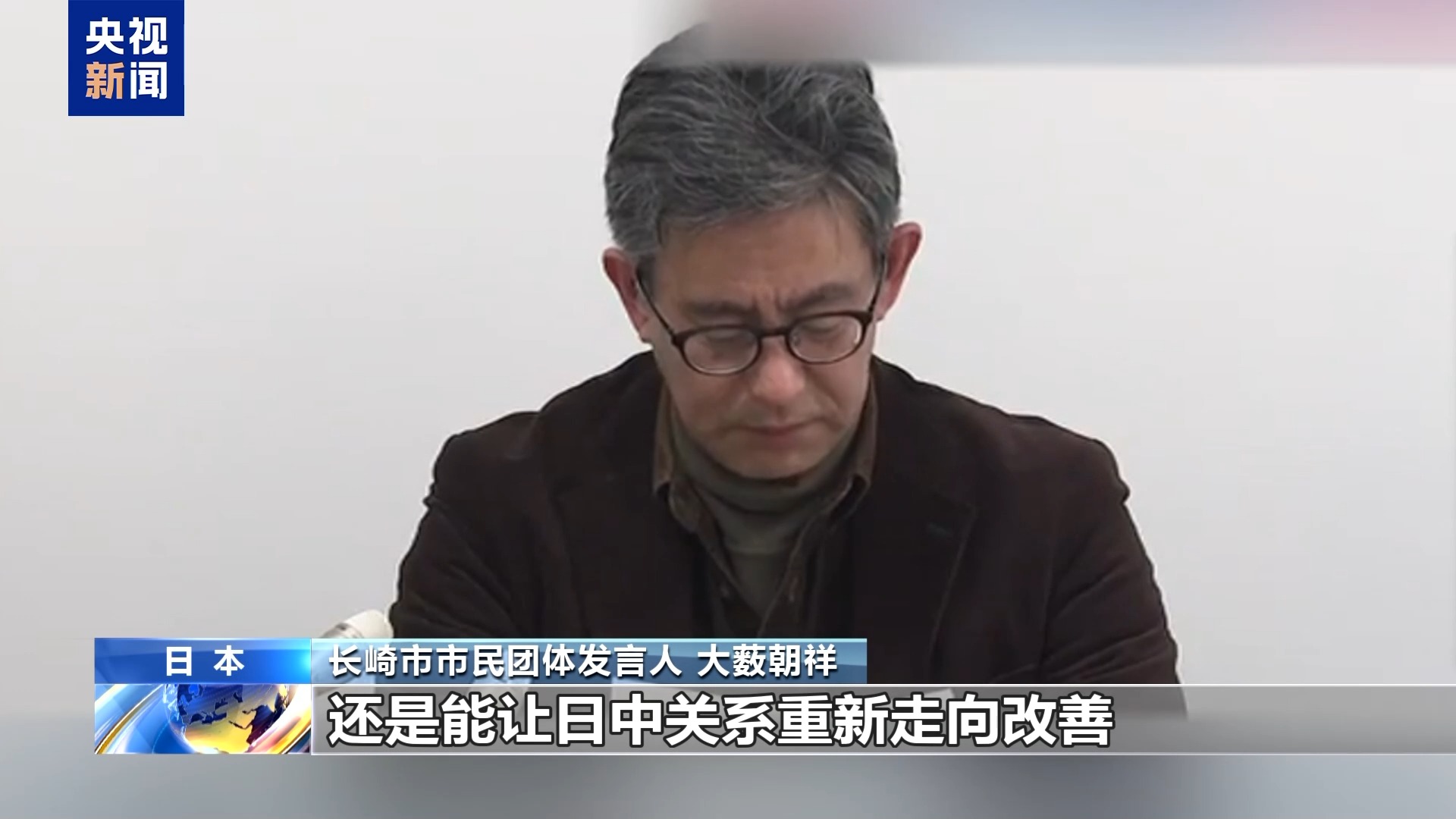
日本长崎市民团体要求高市撤回涉台错误言论
Yang Shi Xin Wen Ke Hu Duan· 2025-12-10 00:40
Core Viewpoint - The Japanese government's military expansion plans and controversial remarks by Prime Minister Sanna Takashi regarding Taiwan have sparked significant domestic criticism and protests from various civic groups [1][3][4]. Group 1: Civic Response - Civic groups in Nagasaki have sent protest statements to Prime Minister Sanna Takashi and other cabinet officials, demanding the retraction of his remarks related to Taiwan [1][3]. - In Kumamoto, multiple civic groups held gatherings opposing the government's plan to deploy long-range missiles, indicating widespread public dissent against military expansion [4][6]. Group 2: Military Expansion Plans - The Japanese Defense Ministry plans to deploy upgraded Type 12 surface-to-ship missiles in Kumamoto, with the first ground troops expected to be stationed by the end of March 2026 [6][10]. - The upgraded Type 12 missiles will have an extended range of approximately 1,000 kilometers, raising concerns about regional security and Japan's adherence to its pacifist constitution [6][10]. Group 3: Public Sentiment - Civic group representatives express fears that missile deployment could lead to civilian casualties in the event of conflict, emphasizing the need to oppose actions perceived as harmful [8]. - There is a prevailing public sentiment that Japan's military buildup contradicts its constitutional commitment to self-defense and could destabilize regional security dynamics [10].

日本战争准备曝光
Zhong Guo Ji Jin Bao· 2025-12-03 05:57
Group 1 - Japan is increasing its defense spending significantly, with a projected total of approximately 11 trillion yen (about 498.2 billion RMB) for the fiscal year 2025, marking a 13-year consecutive increase in defense budget [1] - The new security policy emphasizes the need to fundamentally strengthen defense capabilities and includes the controversial "capability to attack enemy bases," which undermines Japan's principle of "defensive defense" [2] - The Japanese government is investing in various military preparations, including the development of "universal plasma" and the conversion of civilian ports for dual-use purposes [1] Group 2 - China's Ministry of Foreign Affairs has expressed strong opposition to Japan's militaristic tendencies, highlighting concerns over Japan's historical revisionism and its increasing military capabilities [3] - The Chinese government has reiterated its stance against Japan's actions that challenge post-war international order and has called for Japan to reflect on its past and fulfill its obligations as a defeated nation [3]
外交部:如日方拒不撤回涉台错误言论 中方将不得不采取严厉坚决的反制措施
Xin Lang Cai Jing· 2025-11-20 15:23
Group 1 - The core viewpoint of the article emphasizes that Japanese Prime Minister Fumio Kishida's remarks regarding Taiwan have fundamentally harmed the political foundation of China-Japan relations, provoking strong public outrage in China [1] - The Chinese government has issued a stern warning to Japan, urging it to retract its erroneous statements and to cease creating incidents related to China, indicating that failure to do so will result in severe countermeasures from China [1] - The spokesperson highlighted that Japan's historical use of the concept of "survival crisis" as a pretext for military aggression is a dangerous precedent that must not be repeated, referencing past events such as the Mukden Incident and the Pacific War [3] Group 2 - The article mentions that China has suspended imports of Japanese seafood due to Japan's failure to provide promised technical materials ensuring product safety, which is a prerequisite for such exports [3] - The spokesperson noted that the current political climate, exacerbated by Kishida's controversial statements, has led to a lack of market for Japanese seafood in China, regardless of its quality [3]
国际社会必须高度警惕、坚决阻击任何复活军国主义的图谋
Ren Min Ri Bao· 2025-11-19 22:20
Core Points - The spokesperson of the Ministry of Foreign Affairs, Mao Ning, emphasized that Japan's use of "existential crisis" and "self-defense" as justifications for external aggression is a common tactic of militarism [1][2] - Mao Ning highlighted that Japan's historical actions, such as the invasion of Northeast China in 1931 and the declaration of the "Greater East Asia Co-Prosperity Sphere," were framed as matters of national survival, leading to significant military conflicts [2] Summary by Sections - **Japan's Militaristic Tactics** - Japan has historically invoked "existential crisis" to justify military aggression, as seen in events like the Mukden Incident in 1931 and the Pacific War [2] - The international community must remain vigilant against any resurgence of militarism from Japan [2] - **Legal and Historical Context** - The concept of "collective self-defense" was established under the UN Charter to maintain international security and prevent the resurgence of fascism [1] - Post-World War II, Japan was restricted from exercising this right, as outlined in the Potsdam Declaration and its own constitution, which commits to renouncing war and military threats [1]
中方:以所谓“存亡危机”发动对外侵略是日本军国主义惯用伎俩
Zhong Guo Xin Wen Wang· 2025-11-19 08:11
Core Viewpoint - The Chinese government criticizes Japan's potential military intervention in the Taiwan Strait, linking it to historical patterns of Japanese militarism and aggression under the guise of "self-defense" and "survival crisis" [1][2]. Group 1: Historical Context - Japan has historically used the concept of "survival crisis" to justify military aggression, such as the invasion of Northeast China in 1931 and the broader conflicts during World War II [2]. - The notion of "self-defense" has been manipulated by Japan to initiate conflicts, as seen in the lead-up to the Pacific War [2]. Group 2: Legal Framework - The Chinese government emphasizes that Japan's post-World War II constitution prohibits the use of military force for resolving international disputes and mandates a principle of self-defense [1]. - The United Nations Charter's provision for "collective self-defense" was established to maintain international security and prevent the resurgence of fascism, which Japan is seen as violating by considering military actions in the Taiwan Strait [1].
国防部:敦促日方深刻汲取历史教训,停止对华抹黑指责
news flash· 2025-07-16 04:36
Core Viewpoint - The Chinese Ministry of Defense expresses strong dissatisfaction and opposition to Japan's 2025 Defense White Paper, accusing Japan of fabricating narratives to justify military expansion and portraying a "China threat" [1] Group 1: Japan's Military Actions - Japan is significantly increasing its defense budget and loosening restrictions on arms exports, which raises concerns about militarization and regional stability [1] - The Japanese government is forming military alliances and engaging in confrontational tactics, which are seen as a revival of militarism that could threaten peace in the Asia-Pacific region [1] Group 2: Historical Context and Implications - The year marks the 80th anniversary of the victory in the Chinese People's Anti-Japanese War and the World Anti-Fascist War, emphasizing the historical significance of Taiwan's return to China in 1945 as part of post-war international order [1] - The Chinese government urges Japan to learn from historical lessons and adhere to commitments made in the four political documents between China and Japan, particularly regarding Taiwan [1]