军国主义复活

Search documents
川普和日本协议还没落地,王毅外长就亲自出手,给高市一个警告
Sou Hu Cai Jing· 2026-02-18 07:34
Group 1 - The core investment agreement between Trump and Japan, amounting to 550 billion USD, has not yet officially come into effect, but it reflects underlying tensions and warnings from China regarding Japan's political situation [1][3] - The agreement is seen as a direct exchange of benefits between Trump and Japanese Prime Minister Kishi, with Japan's compliance being a significant factor in Kishi's recent electoral success [3][4] - The differing narratives surrounding the agreement highlight the motivations of both parties, with the U.S. aiming to extract benefits while Japan presents the deal as an energy cooperation initiative [4] Group 2 - Wang Yi, China's Foreign Minister, issued a warning at the Munich Security Conference, addressing Japan's recent provocative statements regarding Taiwan, which he views as a challenge to China's sovereignty [5][8] - Wang Yi compared Japan's post-war handling of its history unfavorably to Germany's, emphasizing the need for Japan to confront its militaristic past to ensure regional peace [6] - The implications of Japan's alignment with the U.S. under Kishi's leadership may lead to increased economic burdens on the Japanese populace, as the country may have to incur debt to fulfill investment commitments [7][10] Group 3 - The potential for inflation in Japan due to external pressures and the U.S. tariff policies poses a long-term risk to the Japanese economy, particularly affecting the automotive sector [10][12] - Kishi's pro-U.S. policies may result in Japan losing its diplomatic autonomy, leading to a cycle of dependency that could exacerbate economic challenges for the Japanese people [12] - The overarching theme suggests that Japan must prioritize peace and independence over reliance on the U.S. to secure a stable future, as continued alignment with U.S. interests may lead to detrimental outcomes [12]

王毅警示日本:如果要走回头路,那是自取灭亡
Xin Lang Cai Jing· 2026-02-15 02:08
Group 1 - The core viewpoint emphasizes that Japan should not be misled by extreme right forces and ideologies, highlighting the importance of peace in Asia and China's role in maintaining stability [1][2] - Wang Yi, a senior Chinese official, asserts that the recent statements by Japan's Prime Minister regarding Taiwan represent a significant challenge to China's sovereignty and the post-war international order [1] - The comparison between Japan and Germany's post-war handling of fascism is made, noting that Japan continues to honor war criminals, which is seen as a root cause of ongoing tensions [1] Group 2 - Wang Yi criticizes Japan's leadership for its remarks on Taiwan, suggesting they reveal lingering militaristic ambitions and a potential revival of militarism in Japan [2] - A warning is issued to the Japanese people to be cautious of extreme right ideologies, with a broader message to peace-loving nations about the dangers of Japan reverting to past aggressive behaviors [2] - The statement implies that if Japan continues down this path, it risks self-destruction and greater losses in the future [2]
王毅就中日关系重申严正立场
第一财经· 2026-02-14 13:31
Core Viewpoint - The article discusses the remarks made by Wang Yi, China's Foreign Minister, at the Munich Security Conference, emphasizing China's role as a stabilizing force in Asia and expressing concerns over Japan's recent statements regarding Taiwan, which are seen as a challenge to China's sovereignty [3][4]. Group 1: China's Role in Regional Stability - Wang Yi asserts that Asia remains largely peaceful compared to other regions, despite recent localized conflicts, such as the one at the Cambodia-Thailand border, which were resolved quickly with China's involvement [3]. - He positions China as a key player in maintaining peace and stability in Asia, highlighting its constructive role in regional affairs [3]. Group 2: Concerns Over Japan's Statements - Wang Yi criticizes the Japanese Prime Minister's comments regarding Taiwan, interpreting them as a revival of militarism and a challenge to China's sovereignty, marking a significant shift in Japan's post-war stance [4]. - He draws a historical parallel between Japan's current rhetoric and its past aggressive actions, warning that such attitudes could lead to dangerous consequences if not addressed [4]. Group 3: Historical Context and Warnings - The article contrasts Japan's post-war handling of its militaristic past with Germany's approach, noting Japan's continued veneration of war criminals, which Wang Yi argues is a root cause of current tensions [4]. - Wang Yi calls for vigilance among peace-loving nations and warns Japan against being swayed by extreme right forces, suggesting that a return to militarism would lead to self-destruction [4].

与“援助”经费同步增长的,是高市的战略野心!
Xin Lang Cai Jing· 2026-01-24 23:42
Group 1: Budget Overview - The Japanese Ministry of Foreign Affairs has announced a budget proposal for the fiscal year 2026, with the "Government Security Capability Enhancement Support" (OSA) plan seeing funding increase from 8.1 billion yen in 2025 to 18.1 billion yen in 2026, more than doubling [1][2] - The budget for the "Official Development Assistance" (ODA) project has reached an impressive 449.7 billion yen, with a notable 21.6% increase in the budget allocated for "information warfare" against foreign entities [1][5] Group 2: OSA Plan Details - The primary objective of the OSA plan is to provide defense equipment and related materials to "like-minded" countries, thereby strengthening Japan's "Indo-Pacific maritime situational awareness partnerships" [2] - The OSA plan's budget has seen rapid growth, starting from 2 billion yen in 2023, doubling to 5 billion yen in 2024, increasing to 8.1 billion yen in 2025, and soaring to 18.1 billion yen in 2026 [2] - New aid recipients include Thailand, Sri Lanka, and Timor-Leste, alongside existing partners like the Philippines, Indonesia, and Malaysia, creating a strategic arc around China [2] Group 3: ODA Plan Insights - The ODA budget for fiscal year 2026 is heavily focused on enhancing data governance and improving the livelihoods of recipient countries [4][5] - The ODA project serves as a crucial component of Japan's foreign aid system, primarily through non-repayable financial assistance, repayable financial assistance, and technical cooperation [2][5] Group 4: Strategic Implications - Japan's increased military aid reflects its aggressive foreign expansion ambitions, with a clear focus on countering China's influence in the region [1][3][10] - The government aims to leverage OSA and ODA to build alliances and exert influence over Southeast Asia and Pacific island nations, aligning with U.S. strategic interests [11][13] - The revival of Japan's military industry is seen as a means to stimulate economic growth and reduce reliance on international order constraints, with a focus on military exports [14][15]

高市要求撤回“对日两用物项出口管制” 中方:坚决反对,不予接受!
21世纪经济报道· 2026-01-15 08:39
Core Viewpoint - The Chinese Ministry of Commerce firmly opposes the recent statements made by Japanese Prime Minister Sanae Takaichi, emphasizing that the export control measures imposed by China are a legitimate response to Japan's actions and are aimed at preventing militarization and nuclear ambitions [1]. Group 1 - The Chinese government has implemented export control measures specifically targeting Japan, which it claims are justified due to the "erroneous words and actions" of Prime Minister Takaichi [1]. - The spokesperson for the Ministry of Commerce, He Yongqian, stated that export controls are a common international practice aimed at maintaining world peace and fulfilling non-proliferation obligations [1]. - China prohibits the export of dual-use items to Japanese military users and any entities that contribute to enhancing Japan's military capabilities, asserting that these measures are reasonable and lawful [1]. Group 2 - The Chinese government criticized Japan for not addressing the root causes of the issue and accused Japan of fabricating claims of "economic coercion" against China [1]. - The Ministry of Commerce urged Japan to reflect on its actions and correct its mistakes to avoid further escalation of tensions [1].
高市要求撤回“对日两用物项出口管制” 中方:坚决反对,不予接受!
Yang Shi Xin Wen Ke Hu Duan· 2026-01-15 07:37
Core Viewpoint - The Chinese Ministry of Commerce firmly opposes the recent statements made by Japanese Prime Minister Sanae Takaichi, attributing the measures taken by China to her erroneous remarks and actions [1] Group 1: Export Control Measures - Export control is an internationally accepted practice aimed at maintaining world peace and fulfilling non-proliferation obligations [1] - China, as a responsible major power, actively fulfills its non-proliferation obligations by legally prohibiting the export of dual-use items to Japanese military users and any entities enhancing Japan's military capabilities [1] - The purpose of these measures is to prevent Japan's re-militarization and nuclear ambitions, which are deemed completely justified and legal by China [1] Group 2: Response to Japan's Accusations - Japan's failure to acknowledge the root of the problem and its accusations of "economic coercion" against China are characterized as a distortion of facts and unreasonable arguments [1] - The rhetoric and actions from Japan raise concerns about the revival of militarism [1] - China urges Japan to reflect on its actions, correct its mistakes, and avoid further escalation down the wrong path [1]
日本民众举行集会反对高市早苗错误言论
Yang Guang Wang· 2026-01-04 01:22
Core Viewpoint - The article highlights public opposition in Japan against the remarks made by Minister of State for Economic Security, Sanae Takaichi, and the perceived dangers of reviving militarism in Japan [1] Group 1: Public Sentiment - Participants in the rally expressed concerns that the Takaichi administration aims to lead Japan back to a militaristic path by promoting the notion of "Taiwan-related issues" [1] - There is a strong belief among the public that the Takaichi government, characterized as a right-wing regime, is escalating military spending, which is contributing to heightened tensions in the region [1] Group 2: Academic and Political Perspectives - Political analysts, including a professor from Sophia University, argue that Takaichi's statements are unimaginable from a constitutional perspective and call for the administration to resign before the situation worsens [1] - A member of the House of Representatives, Tomoko Tamura, emphasized that Takaichi's remarks have detrimental effects on Japan-China relations and that the ongoing military expansion contradicts the Japanese constitution [1]
日本民众集会抗议高市早苗错误言论——“坚决反对日本重蹈历史覆辙”
Ren Min Ri Bao· 2025-12-30 07:00
Core Viewpoint - Japan is accelerating its military expansion despite widespread opposition, with recent provocative statements from government officials and plans to revise defense policies, raising concerns about regional stability and peace [1][2][3]. Group 1: Government Actions - Japan's Prime Minister, Fumio Kishida, has made controversial statements regarding Taiwan, which are seen as a deliberate provocation against regional peace [1]. - The Japanese government is planning to amend the "Three Principles on Defense Equipment Transfer" and remove restrictions on five types of weapon exports, indicating a shift towards a more militarized stance [1][2]. - The defense budget for the fiscal year 2026 has been approved at approximately 9.04 trillion yen (about 410 billion RMB), marking a historical high and reflecting the government's commitment to military expansion [2]. Group 2: Public Response - Large protests have erupted in Japan, with citizens demanding the Prime Minister retract his statements and cease efforts to relax weapon export restrictions, emphasizing a desire for peaceful diplomacy [1][2]. - Activists and representatives from peace organizations express deep concern over the government's actions, viewing them as a threat to Japan's pacifist constitution and a potential revival of militarism [2][3]. - There is a growing worry among the public regarding the historical education of younger generations, with fears that a lack of understanding about Japan's wartime past could lead to a resurgence of militaristic ideologies [3].
“坚决反对日本重蹈历史覆辙”
Ren Min Ri Bao· 2025-12-30 00:39
Core Viewpoint - Japan is accelerating its military expansion despite widespread opposition, with recent provocative statements from Prime Minister Fumio Kishida and plans to revise defense policies, raising concerns about regional stability and peace [1][2]. Group 1: Military Expansion and Policy Changes - Japan's government is moving to amend the "Three Principles on Defense Equipment Transfer" and is considering changes to its "Non-Nuclear Principles," which could lead to increased military capabilities and weapon exports [1][2]. - The defense budget for fiscal year 2026 has been approved at approximately 9.04 trillion yen (about 410 billion RMB), marking a historical high and indicating a shift towards militarization [2]. Group 2: Public Response and Opposition - Large protests have erupted in Japan, with citizens demanding the withdrawal of Kishida's controversial statements and opposing the government's efforts to relax weapon export restrictions [1][2]. - Activists and citizens express deep concern over the potential revival of militarism and the government's attempts to downplay Japan's historical role as a wartime aggressor, emphasizing the need for historical education and accountability [3].
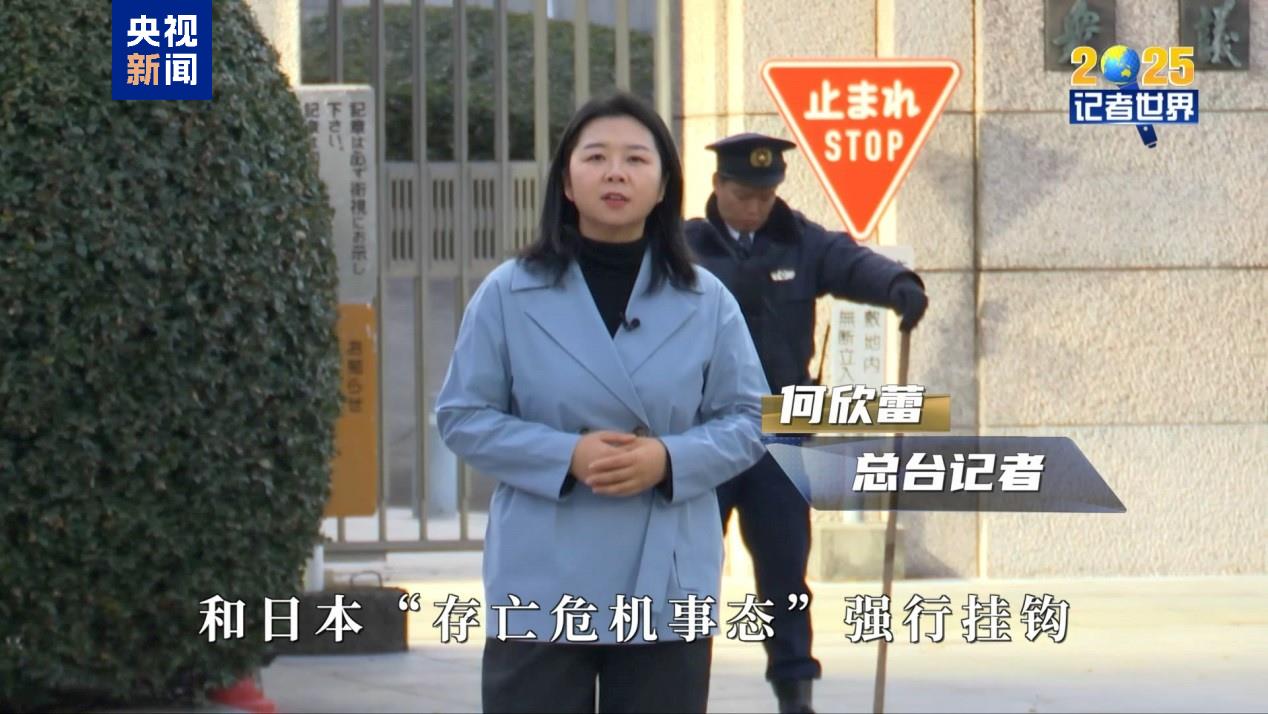
记者世界·2025丨危险的转向
Yang Shi Xin Wen· 2025-12-29 19:16
Core Viewpoint - The article discusses the alarming shift in Japanese politics under Prime Minister Kishi Sanae, highlighting her controversial statements linking Taiwan's situation to Japan's survival crisis, which has sparked domestic and international backlash [1][4][39]. Political Context - Kishi Sanae's remarks in the Japanese Diet suggest a potential military intervention in the Taiwan Strait, violating the principles of four political documents between Japan and China, leading to widespread criticism [4][39]. - The political landscape in Japan is shifting rightward, with Kishi's government supported by factions that advocate for a stronger security stance, following the resignation of former LDP president Ishiba Shigeru [19][39]. Public Reaction - There have been significant public protests against Kishi's government, with demonstrators expressing concerns over militarism and calling for the impeachment of Kishi for her statements regarding Taiwan [10][14][39]. - Prominent figures, including former Prime Minister Yukio Hatoyama, have criticized Kishi's stance, asserting that Taiwan is a domestic issue for China and Japan should not interfere [6][39]. Historical Background - The article notes that Japan has not fully reconciled with its militaristic past, with extreme right-wing sentiments resurfacing, which poses a risk to regional stability [23][39]. - The lack of genuine reflection on Japan's wartime actions has allowed nationalist ideologies to gain traction, further complicating Japan's political climate [25][39]. Economic Implications - Japan's economy is facing challenges, including a depreciating yen, rising import prices, and a decline in tourism from China, which has led to significant financial strain on the hospitality sector [34][35][39]. - The government's military expansion is increasing fiscal pressure, contributing to rising national debt and economic instability [35][39]. Conclusion - The article concludes that Japan's current trajectory under Kishi Sanae could lead to further domestic division and international tension, with potential long-term consequences for both Japan and East Asia [39].