中国创新药BD交易

Search documents
荣昌生物频获跨国巨头追捧
2 1 Shi Ji Jing Ji Bao Dao· 2026-01-13 23:08
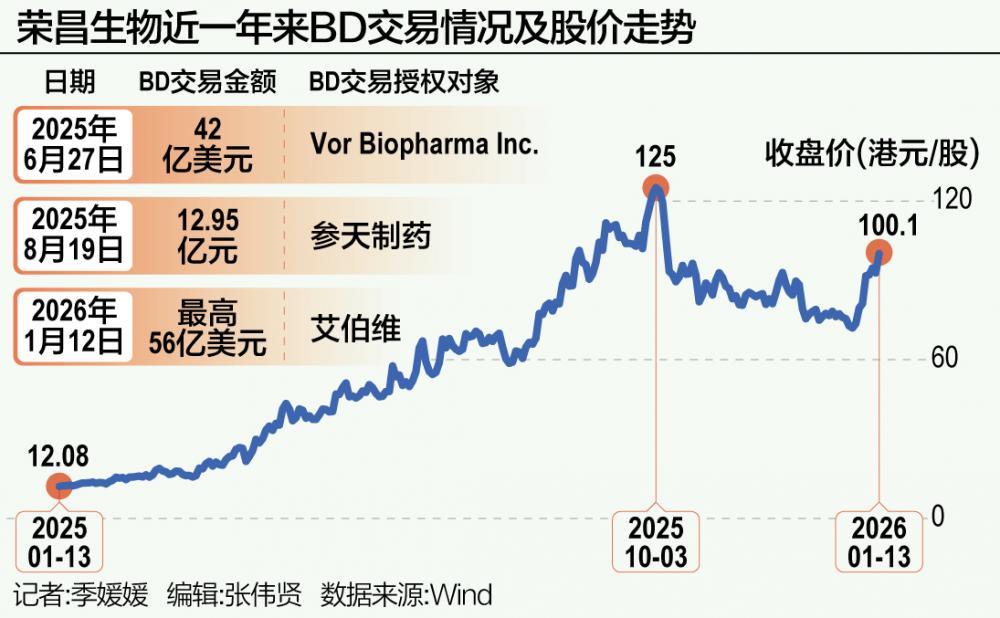
Core Insights - The collaboration between AbbVie and Rongchang Biopharma marks a significant shift in the global oncology treatment landscape, focusing on the development of the bispecific antibody RC148 targeting PD-1 and VEGF [1][2] Group 1: Collaboration Details - AbbVie and Rongchang Biopharma signed an exclusive licensing agreement for RC148, granting AbbVie rights outside Greater China for development, production, and commercialization [1] - Rongchang Biopharma will receive an upfront payment of $650 million and is eligible for up to $4.95 billion in milestone payments, along with a tiered royalty on net sales outside Greater China [1][2] Group 2: Market Implications - This deal exemplifies the "China innovation + global market" model, providing Rongchang Biopharma with substantial cash flow to accelerate clinical trials for RC148 and support other pipeline developments [2] - The partnership with a top-tier oncology company like AbbVie enhances Rongchang Biopharma's brand and bargaining power in international markets, while AbbVie benefits from expanding its immuno-oncology product portfolio [2] Group 3: Bispecific Antibody Landscape - RC148 represents a new class of cancer therapies aimed at simultaneously blocking PD-1 and VEGF, potentially overcoming tumor resistance mechanisms [5] - The PD-1/VEGF bispecific antibody field is gaining traction, with several Chinese companies, including Kangfang Biopharma and Junshi Biosciences, making significant advancements and entering clinical trials [6][7] Group 4: Industry Trends - The Chinese innovative drug sector is experiencing a surge in licensing deals, with over $130 billion in total transaction value in 2025, surpassing the U.S. for the first time [10] - Factors driving this trend include the impending patent cliff for major drugs and declining R&D efficiency among multinational pharmaceutical companies, leading them to seek external innovations [10][11] Group 5: Future Outlook - The Chinese pharmaceutical industry is transitioning from a follower to a leader in innovation, with a clear direction for future development [14] - Companies are focusing on building a comprehensive value creation logic recognized by international partners, enhancing their negotiation power in licensing agreements [12][13]


BD交易剑指千亿美元!中国创新药迈入“价值驱动”阶段,全球化仍有提升空间
Zheng Quan Shi Bao Wang· 2025-12-10 10:53
Group 1 - The core viewpoint is that by the end of 2025, the transaction volume of innovative drug BD in China is expected to exceed $100 billion, marking a significant shift towards value-driven innovation in the pharmaceutical industry [1][2] - The 2025 China Pharmaceutical Innovation Index evaluates the comprehensive innovation capabilities of local pharmaceutical companies based on new drug development, technology transfer, and commercialization [1][2] - The release of the China Innovation Drug Index serves as an international benchmark tool for Chinese innovative drug companies, helping them understand their positioning in global competition [2] Group 2 - In the first half of 2025, BD transactions involving China contributed nearly 50% of the global transaction volume, indicating a significant role in the global market [2] - The approval of 43 innovative drugs by the National Medical Products Administration in the first half of this year represents a 59% year-on-year increase, showcasing the continuous improvement in original innovation capabilities [2][3] - The shift from being global followers to value co-creators is evidenced by record-breaking collaborations, such as those between 3SBio and Pfizer, and Innovent Biologics and Takeda [2] Group 3 - Challenges remain, including the need for original innovation and improved commercialization capabilities, as many new drugs are merely process improvements rather than true novel discoveries [4] - The establishment of a multi-dimensional value pricing and payment policy for innovative drugs is suggested to facilitate quicker access to effective medications [5] - The future is expected to see more First-in-Class products emerging, with potential for new drugs to achieve annual sales exceeding $1 billion [6] Group 4 - The necessity for Chinese innovative drugs to enter international markets is emphasized, with a focus on maximizing product value and meeting international market demands [7] - The ongoing wave of BD transactions is anticipated to continue, with a shift in focus from oncology drugs to non-oncology areas by 2026 [7] - Despite significant advancements, Chinese innovative drug companies still face challenges in competing with multinational corporations on a global scale [7] Group 5 - The importance of building a deep integration global cooperation ecosystem is highlighted, with companies encouraged to leverage unique technological platforms for international collaboration [8] - The goal is to define new therapies through a combination of Chinese innovation and global resources, ultimately benefiting a wider patient population [8]
是什么让国资LP“追着”给钱?
Hu Xiu· 2025-09-01 10:25
Core Viewpoint - The Chinese innovative pharmaceutical sector has transformed from being overlooked to becoming highly sought after, driven by a surge in business development (BD) transactions that have led investors to reassess the value of innovative drugs in China [1][8]. Group 1: BD Transactions and Market Dynamics - The recent surge in BD transactions, such as the $60.5 billion collaboration between 3SBio and Pfizer, and the $120 billion deal between Hengrui Medicine and GlaxoSmithKline, has significantly influenced investor perceptions and valuations in the innovative drug sector [1][9]. - In the first half of 2025, there have been over 50 BD transactions in China's innovative drug sector, with a total value exceeding $48 billion [9]. - The excitement around BD transactions has revitalized both the secondary and primary markets, leading to a resurgence of investor confidence in the pharmaceutical sector [2][4]. Group 2: IPO Activity and Investor Sentiment - The hot secondary market has prompted investors to actively seek IPO opportunities, with over 50 pharmaceutical companies applying for listings in Hong Kong in the first half of 2025 [11]. - Many innovative drug companies are currently looking for cornerstone investors as they prepare for IPOs, indicating a strong desire to capitalize on the favorable market conditions [11][12]. - The increase in BD transactions and the resulting stock price surges have created a favorable environment for investors to exit their investments, thereby enhancing their credibility with limited partners (LPs) [14]. Group 3: Valuation Trends and Investment Strategies - The valuation of innovative drug companies has adjusted to more reasonable levels, with companies completing Phase II clinical trials now valued between $1 billion and $1.5 billion, compared to previous valuations of $2 billion to $5 billion [20]. - Some innovative drug companies have already begun to raise their valuations in response to the improving market conditions, reflecting a competitive investment landscape [21]. - Investment firms are expanding their teams to capture opportunities in the recovering pharmaceutical market, with some actively recruiting analysts and vice presidents in the healthcare sector [22].
行情刚好点,创始人立马涨估值
投中网· 2025-09-01 08:08
Core Viewpoint - The Chinese innovative drug sector has transformed from being overlooked to becoming a hot investment area, driven by significant business development (BD) deals that have reshaped investor perceptions and valuations of companies in this field [2][4]. Group 1: Business Development (BD) Transactions - Major BD transactions have occurred, such as the $60.5 billion collaboration between 3SBio and Pfizer, and a $120 billion deal between Hengrui Medicine and GlaxoSmithKline, highlighting the immense wealth potential in the sector [2][4]. - In the first half of 2025, over 50 BD transactions in China's innovative drug sector were recorded, with a total value exceeding $48 billion [5][6]. - The surge in BD transactions has led to a significant increase in stock prices for many biopharmaceutical companies, with some stocks experiencing over tenfold increases [6][10]. Group 2: Market Dynamics and Investor Sentiment - The secondary market for biopharmaceuticals has become increasingly active, with investors eager to share insights on stock investments, indicating a shift in focus towards this sector [5][6]. - The positive momentum in the biopharmaceutical market has encouraged many companies to pursue IPOs, with over 50 companies applying for listings in Hong Kong in the first half of 2025 [7][8]. - Investors are actively pushing for their portfolio companies to go public, recognizing the current favorable market conditions for IPOs [8][10]. Group 3: Investment Trends and Fundraising - There is a growing willingness among limited partners (LPs) to invest in biopharmaceutical funds, with national and provincial funds becoming more active in this space [11][12]. - Notable fundraising activities include the completion of over 7 billion yuan for a healthcare merger fund and 5 billion yuan for a Shanghai biopharmaceutical fund [11][12]. - The trend of increasing valuations for biopharmaceutical companies is evident, with some companies raising their valuations during fundraising efforts due to improved market conditions [15][16]. Group 4: Future Outlook - The ongoing BD transaction boom and the acceleration of IPOs are expected to provide exit opportunities for investors, enhancing their ability to demonstrate performance to LPs [10][11]. - The biopharmaceutical sector is witnessing a resurgence, with many investors returning to the market and expanding their investment teams to capitalize on emerging opportunities [16].