
中国航天发展

Search documents
中国航天,2026年日程排满
中国基金报· 2026-01-01 14:14
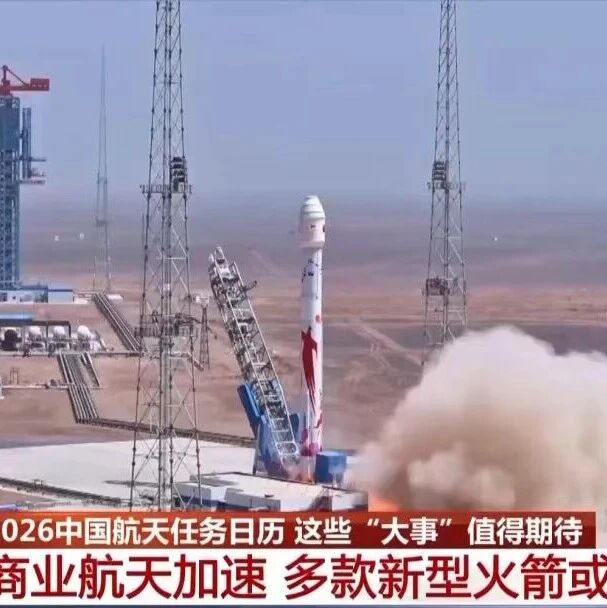
Group 1 - In 2026, China's manned space program will see the launch of Shenzhou 23 and Shenzhou 24 missions, with astronauts departing from the Jiuquan Satellite Launch Center to the Chinese space station [2][4] - The Tianzhou 10 cargo spacecraft will also be launched, and one astronaut from the Shenzhou 23 crew will conduct a long-term stay experiment lasting over one year [4] - The new generation crewed spacecraft "Dream Boat" will make its maiden flight, designed for near-Earth space station operations and manned lunar exploration missions [4] Group 2 - The Chang'e 7 probe will be launched to the Moon's south pole for surface environment surveys and water ice detection, potentially making China the first country to discover water on the Moon [6] - The Tianwen 2 probe is set to reach asteroid 2016 HO3 for exploration and sample collection, with a return to Earth expected by the end of 2027 [6] - The next five years are anticipated to bring unprecedented development opportunities for China's space industry, contributing more Chinese wisdom to the peaceful use of space [9] Group 3 - 2026 will mark a year of accelerated development for China's commercial space sector, with the establishment of the Commercial Space Administration leading to more active launch activities [8] - The progress of new rockets such as Lijian 2, Tianlong 3, and Double Curve 3 is highly anticipated [8]

“日程排满”!2026年中国航天这些大事值得期待
Xin Lang Cai Jing· 2026-01-01 08:29
Core Viewpoint - The year 2026 is set to be a significant milestone for China's space industry, with numerous planned missions and advancements in technology [3][5][10]. Group 1: Manned Space Missions - In 2026, the Shenzhou 23 and Shenzhou 24 missions will launch astronauts to the Chinese space station from the Jiuquan Satellite Launch Center [3]. - The Tianzhou 10 cargo spacecraft will also be launched, and one astronaut from the Shenzhou 23 crew will conduct a long-term stay experiment lasting over a year [5]. - The new generation crewed spacecraft "Dream Boat" is expected to make its maiden flight, designed for near-Earth space station operations and crewed lunar exploration [6]. Group 2: Lunar and Deep Space Exploration - The Chang'e 7 probe is scheduled for launch in 2026, targeting the lunar south pole for key scientific tasks such as lunar surface environment surveys and water ice detection [8]. - The Tianwen 2 probe will reach asteroid 2016 HO3 for exploration, sampling, and returning to Earth, with a landing expected by the end of 2027 [8]. Group 3: Commercial Space Development - 2026 will mark a year of accelerated development in China's commercial space sector, with the establishment of the Commercial Space Administration [10]. - New rocket developments, including Lijian 2, Tianlong 3, and Hyperbola 3, are gaining attention, indicating a vibrant future for commercial space launches [10]. - The next five years are anticipated to present unprecedented opportunities for China's space industry, contributing significantly to the peaceful use of space [10].
“天宫烧烤”背后的发展跃迁(纵横)
Ren Min Ri Bao· 2025-11-17 22:40
Core Insights - The article highlights the advancements in China's space food technology, showcasing the evolution from basic space rations to gourmet meals like barbecued chicken wings and grilled steak in the Tiangong space station [1][2]. Group 1: Space Food Development - The unique space environment imposes strict requirements on food, necessitating that it be easy to consume without liquids or crumbs, and that it occupies minimal space due to limited rocket payload capacity [1]. - China's space food has evolved significantly, with milestones including the introduction of instant food in 2003, heated meals in 2005, and a diverse menu with over a hundred options by 2016 [1]. Group 2: Technological Innovations - The development of a hot air oven capable of heating food to 190 degrees Celsius and collecting residue represents a significant technological breakthrough, allowing for a more enjoyable dining experience in space [1]. - The cultivation of plants in space, such as lettuce and cherry tomatoes, since the Shenzhou 16 mission demonstrates China's commitment to advancing agricultural technology in space [2]. Group 3: Societal Impact - The integration of technology and daily life is emphasized, as the advancements in space food reflect broader improvements in living standards and the focus on people's needs [2]. - The success of the "Tiangong barbecue" symbolizes China's rapid progress in space exploration and its potential to enhance the quality of life for its citizens [2].
四个坐标看中国航天(纵横)
Ren Min Ri Bao· 2025-11-06 22:11
Core Insights - The successful launch of the Shenzhou 21 manned spacecraft marks a significant milestone in China's space exploration journey, showcasing advancements in technology and operational efficiency [1][2]. Group 1: Current Achievements - The Shenzhou 21 mission is the sixth manned flight during the space station application and development phase, and the 37th flight in the manned space program, highlighting China's continuous progress in space technology [1]. - The mission features a groundbreaking 3.5-hour autonomous rapid rendezvous and docking, significantly reducing the waiting time for astronauts inside the spacecraft, reflecting China's commitment to innovation and excellence in space exploration [1]. Group 2: Future Aspirations - By 2026, astronauts from Hong Kong and Macau are expected to participate in their first space missions, symbolizing a historic moment for the regions and enhancing their integration into China's broader development strategy [1]. - The upcoming Dream Boat 1 mission is part of China's ongoing lunar exploration efforts, with the nation poised to continue its deep space exploration initiatives, building on the success of previous lunar missions [2]. Group 3: Long-term Vision - The chief scientist of China's lunar exploration program emphasizes the nation's ambition to explore further into space, reinforcing the idea that China's space endeavors are aimed at benefiting humanity and fostering international cooperation [2]. - The diverse age representation among the Shenzhou 21 crew, including astronauts from the 70s, 80s, and 90s, symbolizes the generational continuity and talent in China's space program, indicating a bright future for ongoing exploration [2].