中小基金公司突围

Search documents
中小基金公司的困与变
Xin Lang Cai Jing· 2026-02-27 10:00
Core Insights - The public fund industry is entering a deep reshuffle period in 2026, with some companies thriving while others exit quietly [1][10] Group 1: Industry Overview - The public fund total scale continues to reach new highs, while small fund companies are beginning to clear out [3][10] - The top 50 public funds account for nearly 90% of the total scale, while the remaining 100 companies account for less than 10% [6][13] - There are 35 public funds with a scale of less than 10 billion, and 58 funds below 300 billion [6][13] Group 2: Case Study of Huachen Future Fund - Huachen Future Fund is set to change its management to Fuguo Fund, marking the end of its development after over a decade [3][10] - The company faced a chronic decline over two years, with net assets falling below 50 million, leading to regulatory penalties and a halt in product registration [5][11] - By the end of Q3 2025, the company's equity was -3.8863 million, indicating insolvency [5][11] Group 3: Challenges for Small Fund Companies - Small fund companies are trapped in a cycle of increasing costs and decreasing revenues, making it difficult to achieve sustainable operations [6][13] - The industry has significant economies of scale, requiring a certain size to reach a sustainable operating safety line [6][13] Group 4: Strategies for Survival - New and small fund companies are shifting focus to mixed and index funds, with several recent entrants successfully launching these products [7][14] - Companies like Huaxi Fund and Huayin Fund have achieved rapid growth through differentiated product design and leveraging channel resources [7][14] - Huaxi Fund grew from 3.69 billion to 39.04 billion in management scale, a growth rate of 958% over two years [7][14]


今年ETF新品,多点开花
中国基金报· 2026-01-25 10:28
Core Viewpoint - The ETF market in China is experiencing robust growth in 2026, with a diverse range of new products being launched and a steady increase in scale, indicating a strong market potential and competitive landscape [2][4]. Group 1: New ETF Launches - As of January 24, 2026, a total of 17 new ETFs have been established, with an issuance scale nearing 10 billion yuan, accounting for 22.37% of new fund launches and 14.69% of the total issuance scale [2]. - The newly established ETFs cover various sectors including non-ferrous metals, chips, artificial intelligence, biotechnology, food, batteries, and public utilities [2]. Group 2: Market Growth Drivers - Industry experts are optimistic about the growth potential of the ETF market, driven by long-term capital inflows and evolving investor demands [5]. - Institutional investors, such as insurance companies, are increasingly seeking long-term allocations in the domestic equity market, while individual investors are becoming more accepting of passive index products due to their low fees and high transparency [5]. - There remains significant room for innovation in ETF products, particularly in niche sectors and strategies, as the demand for diversified investment portfolios continues to grow [5]. Group 3: Competitive Landscape - The ETF market is characterized by a concentration of leading firms, posing challenges for smaller fund companies. However, differentiation and refined operations are seen as key strategies for smaller firms to carve out a niche [7]. - Smaller fund companies are encouraged to focus on underrepresented sectors and themes where larger firms have not established a strong presence, thereby building expertise and brand influence [7][8]. - There is a need for smaller firms to innovate in product offerings, such as Smart Beta and ESG-focused ETFs, to meet the diverse asset allocation needs of investors [8]. Group 4: Challenges in the ETF Market - Despite growth opportunities, the ETF market faces challenges such as insufficient investor understanding and operational pressures on certain products [9]. - Some individual investors lack a deep understanding of ETFs, leading to impulsive trading behaviors, which can negatively impact their investment outcomes [9]. - Certain ETFs are experiencing issues with small scale and high operational costs, which can erode investor returns and affect trading efficiency due to low liquidity and high bid-ask spreads [9].

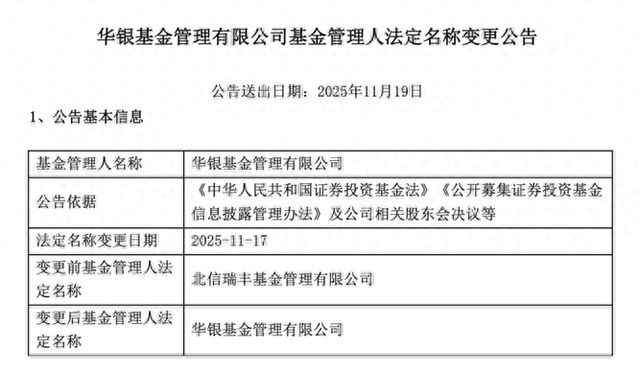
北信瑞丰基金更名华银基金,银行系资源助力规模逆袭
Guan Cha Zhe Wang· 2025-11-19 13:41
Core Viewpoint - The recent renaming of Beixin Ruifeng Fund Management Co., Ltd. to Huayin Fund Management Co., Ltd. is interpreted as a move towards aligning with "bank-affiliated" fund companies, following significant challenges including management turnover, scale reduction, and talent loss [1][2] Company Overview - Huayin Fund, formerly known as Beixin Ruifeng Fund, was established on March 17, 2014, with a registered capital of 170 million yuan, co-founded by Beijing International Trust Co., Ltd. and Laizhou Ruihai Investment Co., Ltd. [2] - The company experienced a dramatic turnaround in 2025, with public fund management scale increasing from 2.706 billion yuan at the end of Q2 to over 20 billion yuan by the end of Q3, marking an increase of nearly 800% [1][2] Challenges Faced - The company faced significant challenges, including a reduction in public fund management scale from a peak of 13 billion yuan in 2020 to 2.706 billion yuan by mid-2025, ranking low among licensed institutions [2][3] - Employee numbers dropped from 88 in July 2024 to 52 in 2025, indicating a personnel loss rate exceeding 40% [3] - A collective departure of fund managers occurred in October 2024, further destabilizing the company [3] Product Line Issues - The company has a limited product line, primarily consisting of fixed-income products, lacking impactful equity or mixed-asset products, which weakens its market position and risk resilience [4] - The lack of standout products and managers led to a decline in investor interest, particularly during the volatile equity market from 2021 to 2024 [4] Industry Context - The challenges faced by Huayin Fund reflect broader issues within the industry, where smaller fund companies struggle to survive amid increasing market concentration, with the top 20 firms controlling about 70% of the market [4] - The growth of Huayin Fund is seen as part of a trend where bank-affiliated fund companies leverage parent bank resources to rapidly scale, though this often leads to over-reliance on shareholder support and insufficient market competitiveness [5][6] Growth Drivers - The significant growth in fund scale is primarily driven by the Beixin Ruifeng Ding Sheng Short-Duration Bond Fund, which dominates the company's total scale [5] - Support from the parent company, Huaxia Bank, has been crucial, with enhanced management and resource allocation contributing to the rapid scale increase [5][6] Future Outlook - The company is undergoing systematic governance adjustments, with a focus on internal governance and product line restructuring, aiming to strengthen its position in the fixed-income sector [6] - The case of Huayin Fund highlights the importance of leadership with resource integration capabilities for small fund companies, raising questions about the sustainability and replicability of its growth model [6]

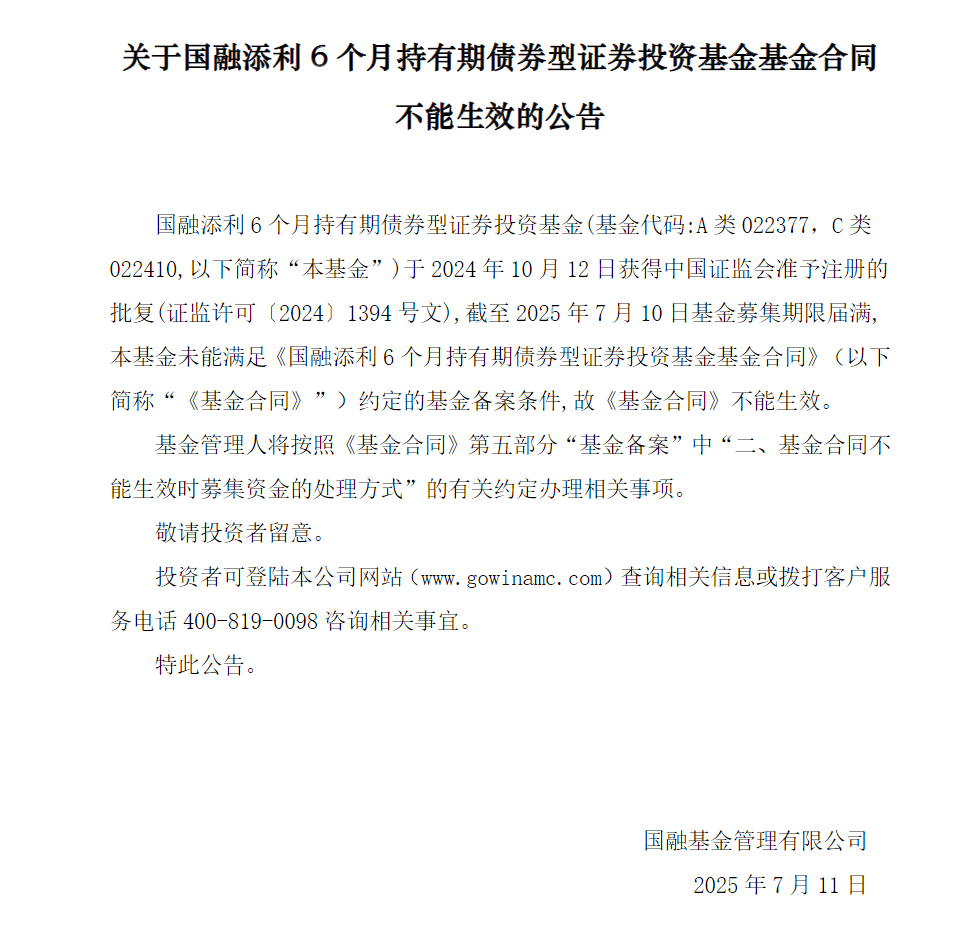
国融基金:历经三个月募集,国融添利6个月持有期债券型基金发行失败!
Sou Hu Cai Jing· 2025-07-15 04:21
Core Insights - The fund "Guorong Tianli 6-Month Holding Period Bond Fund" failed to meet the registration requirements after a three-month fundraising period, marking the fourth failed public fund issuance since 2025 and the second failed bond fund in 2023 [3][4] - The fund had a fundraising target of 5 billion yuan but did not achieve the necessary conditions for registration [3] - Efforts to increase distribution channels by adding sales agencies were unsuccessful, indicating ongoing challenges for Guorong Fund in launching new products [4] Fund Performance and Management - The two proposed fund managers, Li Qinghua and Jia Yuxuan, are under pressure due to performance and scale issues, with Li managing only 683 million yuan and Jia managing 464 million yuan as of the end of Q1 2025 [5][7] - Both managers have previously managed funds with a maximum scale of around 4 billion yuan [8] Historical Context - The failure of the Guorong Tianli fund is part of a broader trend of poor performance in new product launches by Guorong Fund, which has only successfully launched one fund in 2025, raising 266 million yuan [10] - Over the past five years, Guorong Fund has launched only four new funds, with a total scale of less than 1 billion yuan [11] Company Financials - As of the end of Q1 2025, Guorong Fund's total management scale was 2.965 billion yuan, a decrease of 206 million yuan from the previous year [12] - The company's scale has fluctuated around 3 billion yuan since its inception, briefly exceeding 5 billion yuan in mid-2024 [13] Market Trends - The overall fund issuance market in 2025 is characterized by a "strong equity, weak bond, and passive dominance" trend, with index funds leading equity product issuance [14] Corporate Actions - In response to its challenges, Guorong Fund's shareholders have increased capital twice in 2023, raising a total of 5 million yuan, increasing the registered capital from 150 million yuan to 200 million yuan [15] - A potential change in control is on the horizon, as Western Securities plans to acquire a majority stake in Guorong Securities, which holds a 53% stake in Guorong Fund [16]