
ETF产品创新

Search documents
今年ETF新品,多点开花
中国基金报· 2026-01-25 10:28
Core Viewpoint - The ETF market in China is experiencing robust growth in 2026, with a diverse range of new products being launched and a steady increase in scale, indicating a strong market potential and competitive landscape [2][4]. Group 1: New ETF Launches - As of January 24, 2026, a total of 17 new ETFs have been established, with an issuance scale nearing 10 billion yuan, accounting for 22.37% of new fund launches and 14.69% of the total issuance scale [2]. - The newly established ETFs cover various sectors including non-ferrous metals, chips, artificial intelligence, biotechnology, food, batteries, and public utilities [2]. Group 2: Market Growth Drivers - Industry experts are optimistic about the growth potential of the ETF market, driven by long-term capital inflows and evolving investor demands [5]. - Institutional investors, such as insurance companies, are increasingly seeking long-term allocations in the domestic equity market, while individual investors are becoming more accepting of passive index products due to their low fees and high transparency [5]. - There remains significant room for innovation in ETF products, particularly in niche sectors and strategies, as the demand for diversified investment portfolios continues to grow [5]. Group 3: Competitive Landscape - The ETF market is characterized by a concentration of leading firms, posing challenges for smaller fund companies. However, differentiation and refined operations are seen as key strategies for smaller firms to carve out a niche [7]. - Smaller fund companies are encouraged to focus on underrepresented sectors and themes where larger firms have not established a strong presence, thereby building expertise and brand influence [7][8]. - There is a need for smaller firms to innovate in product offerings, such as Smart Beta and ESG-focused ETFs, to meet the diverse asset allocation needs of investors [8]. Group 4: Challenges in the ETF Market - Despite growth opportunities, the ETF market faces challenges such as insufficient investor understanding and operational pressures on certain products [9]. - Some individual investors lack a deep understanding of ETFs, leading to impulsive trading behaviors, which can negatively impact their investment outcomes [9]. - Certain ETFs are experiencing issues with small scale and high operational costs, which can erode investor returns and affect trading efficiency due to low liquidity and high bid-ask spreads [9].


ETF总规模突破6万亿元 产品矩阵持续丰富
Shang Hai Zheng Quan Bao· 2025-12-28 23:41
Core Insights - The total scale of ETFs in China has reached a historic record of 6.02 trillion yuan as of December 26, marking the first time it has surpassed the 6 trillion yuan threshold, with an increase of over 2.2 trillion yuan compared to the end of 2024 [1] Group 1: ETF Market Growth - The ETF market has expanded significantly since its inception in 2004, with the total scale surpassing 1 trillion yuan for the first time in October 2020, and reaching 2 trillion yuan in August 2023. The growth accelerated, with the scale hitting 3 trillion yuan in September 2024, 4 trillion yuan in April 2025, and 5 trillion yuan by August 25, 2025 [2] - As of December 26, 2024, there are over 120 ETFs with a scale exceeding 100 billion yuan, up from 66 such ETFs at the end of 2024 [2] Group 2: Factors Driving Growth - The rapid growth of ETF scale is attributed to multiple factors, including regulatory reforms, fee structure optimization, and the establishment of fast-track approval channels for ETFs, which have created favorable conditions for high-quality industry development [3] - In a low-interest-rate and complex market environment, investors are increasingly favoring transparent, low-fee, and tool-oriented ETFs. Continuous product innovation has also responded to market demands, offering a diverse range of ETFs from broad-based to thematic and cross-border options [3] Group 3: Product Diversification - The domestic ETF market is witnessing a rich variety of innovative products, with stock ETFs remaining the dominant category, surpassing 3.8 trillion yuan in scale [4] - The stock ETF product layout shows two main characteristics: the enhancement of broad-based ETF product lines, including the launch of the first batch of Sci-Tech Innovation Board ETFs, and the deepening of niche sectors with thematic ETFs targeting emerging industries [5] - Bond ETFs have also seen unprecedented expansion, with 53 bond ETFs established and a scale approaching 800 billion yuan as of December 26, compared to only 21 bond ETFs with a total scale of 180 billion yuan at the end of last year [5] Group 4: Future Outlook - The future development space for the ETF industry is considered vast, with ETF remaining a key focus for fund companies. As of December 28, there are currently 6 ETFs in the issuance process and 7 more with confirmed issuance dates, targeting a variety of sectors including semiconductor and shipbuilding ETFs [6]
【招银研究|资本市场专题】全球ETF发展趋势及境外ETF发展特色
招商银行研究· 2025-11-24 09:31
Global ETF Development Trends - The global ETF market has seen continuous growth, with assets reaching approximately $14.8 trillion by the end of 2024, reflecting an annual compound growth rate of 18.4% over the past 15 years [5][10] - In the first half of 2025, the global ETF market maintained a strong growth momentum, with net inflows exceeding $849 billion, bringing total assets to over $16.7 trillion [5][10] - ETFs now account for over 15% of the total public fund market globally, with a notable increase in the share of equity ETFs [10][19] Factors Driving Global ETF Growth - On the funding side, market demand and policy encouragement have driven significant inflows into ETFs, as investors shift towards risk-balanced strategies [19][20] - Performance advantages of passive funds over active funds have also contributed to this trend, particularly in the U.S. market where active funds have struggled to outperform benchmarks [19][20] - Technological advancements and supportive policies have facilitated product innovation and expansion within the ETF market [20][21] Characteristics of Offshore ETF Markets - In the U.S., there has been a significant shift of funds from active to passive management, with passive fund assets increasing by nearly $2.9 trillion from 2015 to 2024 [31][36] - The European ETF market, while slower in its transition to passive management, leads globally in ESG ETF offerings due to a robust regulatory framework [40][41] - Japan's ETF market is characterized by a high proportion of equity ETFs, largely driven by central bank purchases, with REITs ETFs also showing significant growth [47][48] China's ETF Market Dynamics - China's ETF market has grown rapidly since its inception in 2004, with assets increasing from 159.6 billion yuan in 2013 to 3.7 trillion yuan by the end of 2024, achieving a compound annual growth rate of 33% [22][27] - As of mid-2025, equity ETFs accounted for 70.4% of the total ETF market in China, with cross-border and fixed-income ETFs also gaining traction [22][27] - The low-interest-rate environment is expected to further drive the demand for ETFs as a low-cost investment tool [27] Lessons from Offshore ETF Development - The dual-driven model of active and passive funds in China is likely to differ from the U.S. trend of continuous fund migration from active to passive [57] - The diverse product matrix seen in offshore markets, particularly in areas like dividend and bond ETFs, presents opportunities for growth in China's ETF offerings [58][59] - Recommendations for enhancing ETF business include collaborating with fund managers to introduce innovative products that cater to market demands [59]


正式加入“激战”!刚刚,这一基金巨头出手了
Zhong Guo Ji Jin Bao· 2025-09-25 14:17
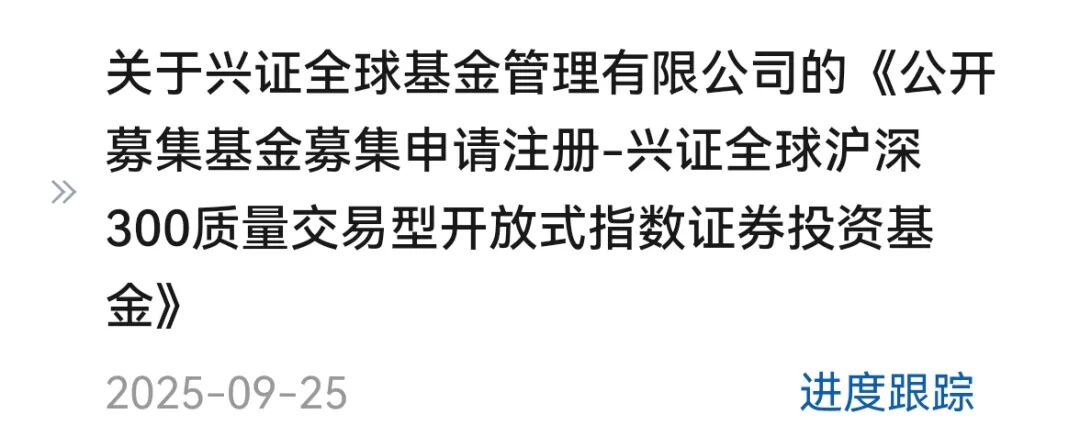
Core Insights - Xingsheng Global Fund has officially entered the ETF market by submitting its first ETF product, the Xingsheng Global CSI 300 Quality ETF, signaling its ambition in the 5.4 trillion yuan ETF market [1][2] Group 1: Company Developments - The Xingsheng Global CSI 300 Quality ETF was submitted to the China Securities Regulatory Commission on September 25 and is currently in the material acceptance stage [2] - If approved, this will be the first ETF product for Xingsheng Global Fund, which has been established for nearly 22 years [2] - The ETF aims to track the CSI 300 Quality Index, which was launched on March 18 of this year and includes 50 companies selected for their stable operations and strong profitability [4] Group 2: Market Context - As of September 24, the total scale of 1,318 ETF products in the market reached 5.46 trillion yuan, reflecting a 46.4% increase compared to the end of last year [6] - The rapid growth of the ETF market has attracted numerous public fund companies to actively participate [5] - The trend of developing ETFs has been supported by favorable policies aimed at enhancing market liquidity and promoting the growth of stock and bond ETFs [10] Group 3: Competitive Landscape - The ETF market is becoming increasingly competitive, with major fund companies leveraging their financial strength and sales channels to gain market share [1][4] - There is a notable increase in participation in "phenomenal" ETF categories, with over 30 public funds entering the CSI A500 ETF space [9] - The market is shifting from "scale expansion" to "quality enhancement," suggesting that precise targeting of niche demands may provide opportunities for smaller players to succeed [10]
这类产品,大爆发!
Zhong Guo Ji Jin Bao· 2025-07-13 06:12
Core Insights - The number and scale of newly established ETFs in 2023 have surpassed the total for the entire year of 2022, indicating a robust growth trend in the ETF market [2][3][5] ETF Market Overview - As of July 11, 2023, a total of 184 new ETFs have been established, raising approximately 146.47 billion yuan, exceeding the total figures for 2022 [3] - Among these, stock ETFs dominate with 164 newly issued, accounting for about 65% of the total, while bond ETFs have also seen significant growth with 18 newly issued, representing 34.61% [3] - Notably, 10 new science and technology innovation bond ETFs have been launched, making up nearly 57% of the bond ETF issuance [3] Diversification and Specialization - The ETF issuance this year reflects a trend towards diversification and specialization, with a notable increase in TMT (Technology, Media, Telecommunications) and healthcare-related ETFs [4] - Smart Beta ETFs, particularly those focusing on free cash flow, have also seen a surge, indicating a shift in market investment logic towards high-quality factors [4] Factors Driving Growth - Multiple factors are contributing to the booming ETF market, including supportive policies from regulatory bodies and a strong demand for fixed-income instruments [6] - The issuance of technology innovation bonds has provided ample underlying assets for ETFs, while institutional investors are increasingly seeking stable returns through bond ETFs [6] - The promotion of systematic investment strategies using ETFs by exchanges has further catalyzed the allocation of funds into these products [6] Future Trends - The ETF market is expected to continue evolving, with an emphasis on multi-asset ETFs and innovative product offerings to meet diverse investor needs [9][10] - Regulatory support for the development of low-volatility and asset allocation products is anticipated to enhance the ETF landscape [9] - The ongoing optimization of index systems will be crucial for the rapid development of various ETF categories, including bond, mixed, commodity, and cross-border ETFs [9][10]
年内ETF净流入额约2500亿元 股票型ETF占据半壁江山
Zheng Quan Ri Bao· 2025-05-08 16:13
Group 1 - The ETF market has seen significant inflows this year, with a net inflow of over 249.3 billion yuan as of May 7, 2023, of which stock ETFs accounted for 132.3 billion yuan, representing over 50% of the total [1] - A total of 440 stock ETFs have been launched this year, with an overall scale of approximately 59 billion yuan [1] - Thirteen ETFs have attracted over 10 billion yuan in net inflows, with five broad-based ETFs tracking major indices like CSI 300 and SSE 50 being particularly favored [1][2] Group 2 - Among the 53 stock ETFs, 13 track core indices such as CSI 300 and ChiNext Composite, while 40 focus on industry or thematic indices like robotics and AI [2] - The newly established stock ETFs this year have a total scale of 590.8 billion yuan, with a significant number of broad-based products launched [2] - The industry is witnessing a trend of launching thematic ETFs, with new products tracking indices related to AI, aviation, and other sectors [2] Group 3 - The industry faces challenges of homogenization, with overlapping index constituents reducing differentiation among industry and thematic ETFs [3] - Fund companies are encouraged to innovate through three strategies: creating differentiated products, utilizing technology for investment decisions, and optimizing market positioning to improve liquidity [3] - Smaller public fund institutions are leveraging their research capabilities to create thematic and industry ETFs, combining active management with passive investment strategies [3]