主观投资

Search documents
2025年私募基金收益TOP20揭晓!今通、波粒二象等居前!
Sou Hu Cai Jing· 2026-02-02 08:28
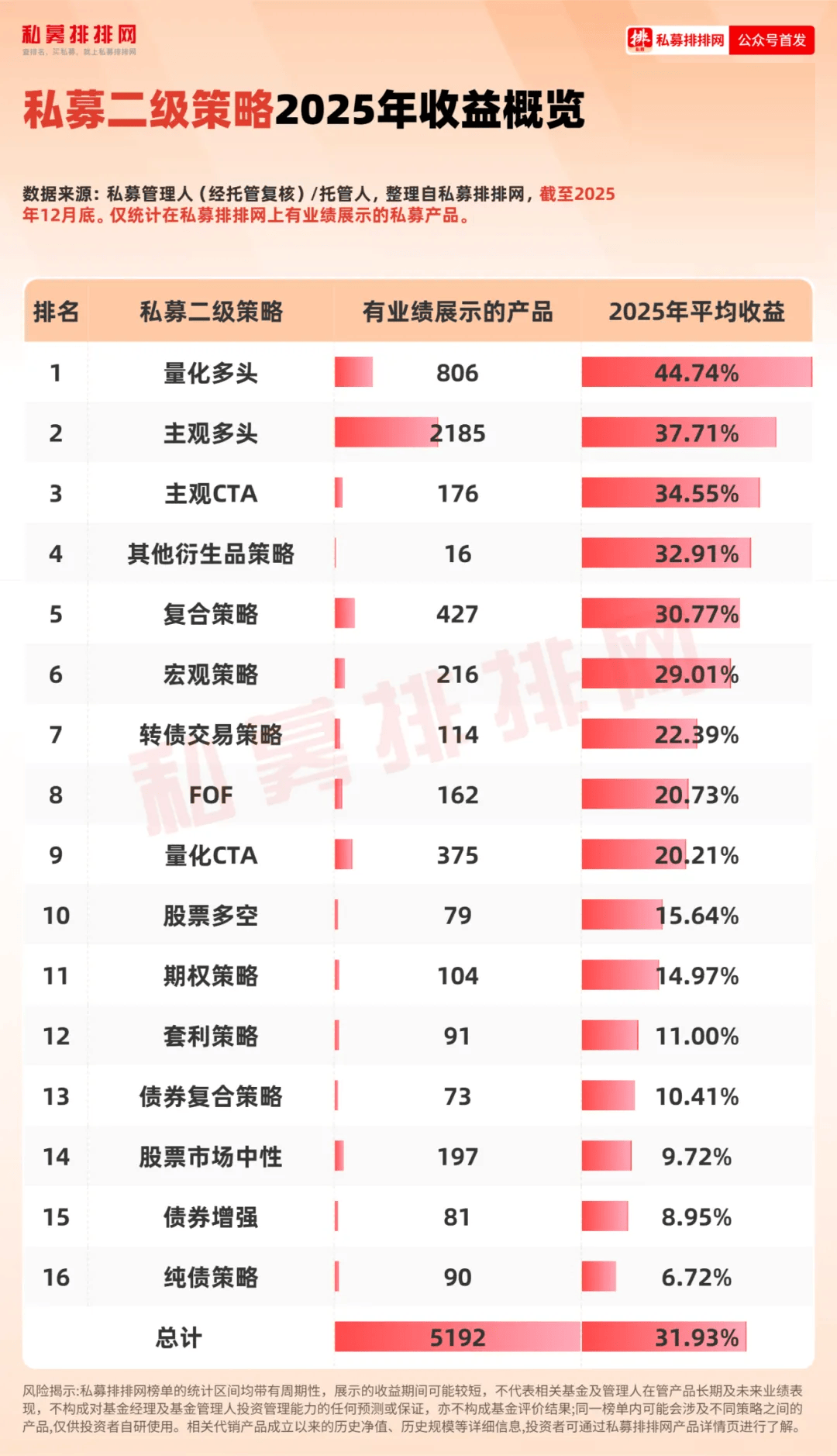
Market Overview - In 2025, the A-share market experienced an overall upward trend, with major indices recording significant gains, including an increase of over 18% in the Shanghai Composite Index and over 49% in the ChiNext Index [1] - The commodity market showed notable differentiation, with precious metals driven by safe-haven attributes and macroeconomic logic, achieving a cumulative annual increase of over 81% [1] Private Fund Performance - By the end of 2025, among 5,192 private funds displayed on the Private Fund Ranking website, the average annual return reached 31.93% [1] - Quantitative long and subjective long strategies performed particularly well, with average returns of 44.74% and 37.71%, respectively [1] - The active rotation in sectors such as consumption, technology, and high-end manufacturing created substantial structural opportunities for equity strategy funds, supported by active market trading and sustained liquidity [1] Strategy Performance Quantitative Long Strategy - The top-performing quantitative long products included 806 funds with an average return of 44.74% [3] - Notable products in this category included Gaia Qingke, Jintong Investment, and Hanrong Investment [4] Subjective Long Strategy - The subjective long strategy had 2,185 funds with an average return of 37.71%, with the highest entry threshold for the top 20 products [4][9] - Leading products in this category came from companies like Nengjing Investment Holdings and Shanghai Ge Ru Private Equity [10] Composite Strategy - The composite strategy saw 427 funds with an average return of 30.77%, with top products from Shuohe Asset and Tianhui Investment [12][15] Macro Strategy - The macro strategy included 133 funds, with the top products from companies like Jiuqi Investment and Luyuan Private Equity [16][18] - Notably, Luyuan Private Equity's product achieved significant returns, highlighting the effectiveness of macro strategies [20] Subjective CTA Strategy - The subjective CTA strategy had 78 funds, with top products from Yizu Investment and Chiying Private Equity [21][24] Quantitative CTA Strategy - The quantitative CTA strategy included 185 funds, with Hua Cheng Private Equity leading with significant returns [25][27] Private FOF Strategy - The private FOF strategy had 56 funds, with an average return of 20.55%, and top products from Shanghai Taiying and Qingdao Hongyun Ruiheng Private Equity [29][31] - The FOF strategy focuses on selecting and allocating multiple private funds to achieve diversified investment [29]

爆款频现,私募发行迎“开门红”!百亿阵营加速洗牌
券商中国· 2026-01-20 06:10
Core Viewpoint - The private equity market is experiencing a significant resurgence at the beginning of 2026, with a notable increase in fundraising activities and the emergence of "explosive" products [1][3]. Fundraising Activities - A series of products from Chengqi Asset raised a total of 1.647 billion yuan, with all channels fully subscribed [2][3]. - Shanghai Fusheng Asset completed a 1 billion yuan fundraising in a single day, indicating a strong return of confidence in active equity strategies [4][5]. Market Dynamics - The number of billion-yuan private equity firms has reached 114, reflecting a slight increase from the end of 2025, with ongoing structural changes within the industry [2][9]. - The fundraising surge is attributed to a positive feedback loop of market recovery, net value restoration, and increased issuance activity [7]. Investor Behavior - The shift in investor structure, with a higher proportion of funds from private banks and institutions, indicates a longer investment duration and lower tolerance for drawdowns [8]. - The ability of private equity managers to deliver excess returns amid rapid scale expansion will be crucial for assessing their long-term investment capabilities [8]. Industry Structure - The quantitative private equity sector remains dominant, with 55 out of 114 billion-yuan firms classified as quantitative, accounting for 48.25% of the total [10]. - The entry of insurance capital into the private equity sector is driven by the search for low-volatility, long-duration investment tools in a low-interest-rate environment [10].

2025年百强私募榜出炉!翰荣、幻方跻身量化10强!新晋百亿国源信达位居主观前列
私募排排网· 2026-01-16 07:01
Core Viewpoint - The A-share market in 2025 is characterized by "high volatility + structural bull" trends, allowing both subjective and quantitative private equity funds to find their respective Alpha sources [2] Group 1: Quantitative Private Equity - Quantitative private equity funds leverage "speed, breadth, and discipline" to thrive in a highly active market with rapid industry shifts and significant pricing discrepancies in small-cap stocks, leading to both scale and performance growth [2] - Among the top 100 quantitative private equity funds, the threshold for ranking in 2025 was set at ***% [3] - The top 10 quantitative private equity funds include Tianhui Investment, Hainan Gaia Qingke Private Equity, Lingjun Investment, Longyin Huaxiao, Hanrong Investment, Yunqi Quantitative, Ningbo Huanfang Quantitative, Zhixin Rongke, Xinhong Tianhe, and Xiangmu Asset [3][6] Group 2: Subjective Private Equity - Subjective private equity funds are characterized by "patience, depth, and timing," with a multi-line rotation in 2025 across sectors such as technology, new consumption, pharmaceuticals, and cyclical stocks, resulting in standout stocks like Shangwei New Materials, Tianpu Co., and Shenghong Technology [2] - The top 100 subjective private equity funds had a ranking threshold of ***% for 2025 [13] - The top 10 subjective private equity funds include Beijing Xiyue Private Equity, Qiantou Investment, Fuyuan Capital, Luyuan Private Equity, Zhihua Asset Management, Jingyan Private Equity, Beiheng Fund, Rongshu Investment, Nengjing Investment Holdings, and Yuanwei Investment [13][14]
梁文锋旗下幻方量化,去年收益率56.6%,规模已超700亿元
Mei Ri Jing Ji Xin Wen· 2026-01-14 23:20
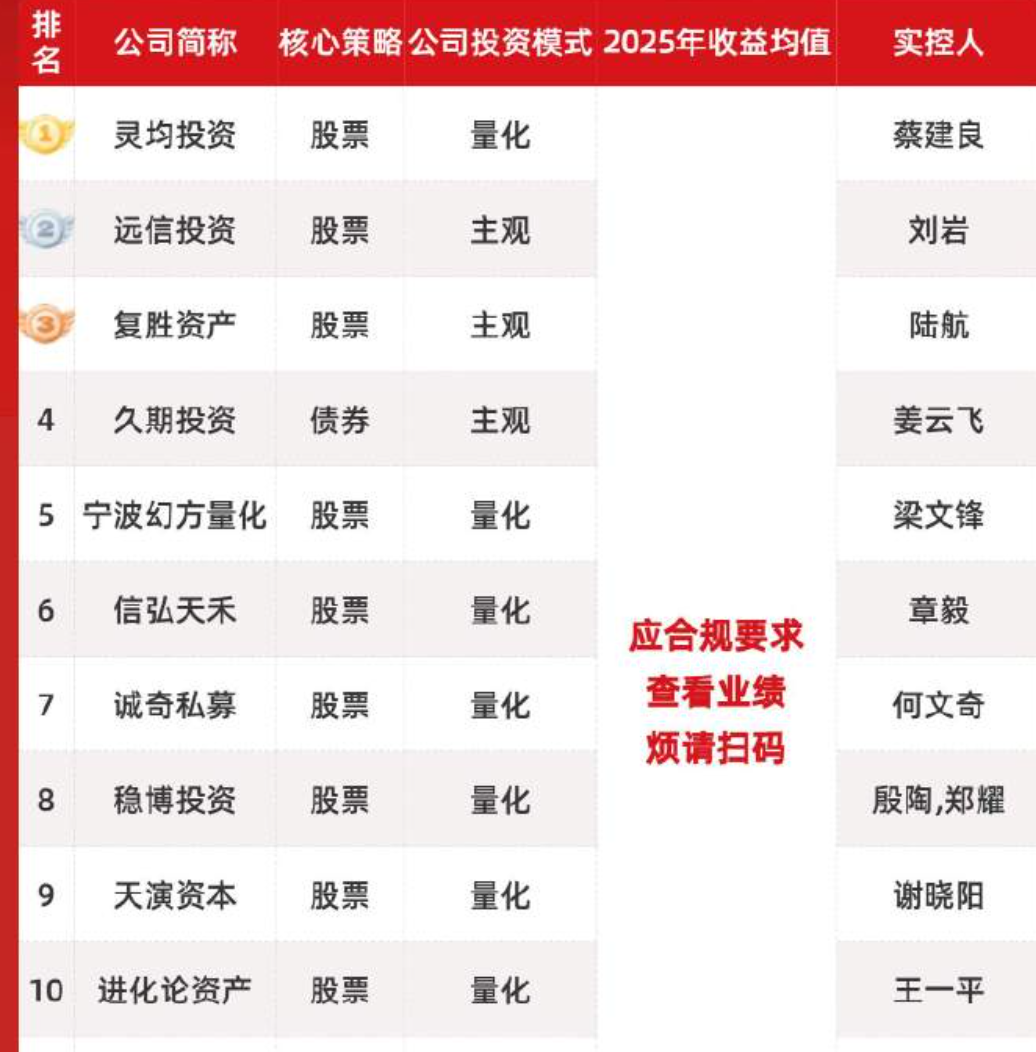
Core Insights - The A-share market in 2025 has shown significant performance, with the top three private equity firms achieving annual returns exceeding 70% [1][4][10] - Quantitative private equity firms have outperformed subjective strategies, with an average return of 37.61% compared to 25.80% for subjective firms [4][11] Performance Summary - The top three private equity firms in 2025 are Lingjun Investment with a return of 73.51%, Yuanshin Investment at 72.05%, and Fusheng Asset at 70.57% [1][4] - The average return for 75 private equity firms with reported performance was 32.77%, with 74 firms achieving positive returns, representing a positive return rate of 98.67% [4][10] - Among the 45 quantitative private equity firms, all achieved positive returns, while 22 out of 23 subjective firms also reported positive returns [4][11] Notable Firms - Huanfang Quantitative, led by Liang Wenfeng, achieved a return of 56.55%, ranking fifth among firms with over 100 billion in assets [1][5] - Huanfang Quantitative has shown strong long-term performance, with a three-year average return of 85.15% and a five-year average return of 114.35% [5][6] Market Dynamics - The bull market that began on September 24, 2024, has significantly enhanced the profitability of private equity firms, particularly in the context of a hot A-share market in 2025 [4][10] - The performance disparity among private equity firms is notable, with some firms like Lin Yuan Investment reporting a loss of 6.46%, making it the only firm with negative performance among the 75 firms [10][11] Strategy Analysis - Quantitative strategies have shown a clear advantage due to their adaptability to market conditions, leveraging AI technology for rapid trading and risk management [11] - Subjective strategies face challenges due to slower decision-making processes and limited coverage, which hinder their performance in fast-moving markets [11]
梁文锋旗下幻方量化,去年收益率56.6%,规模已超700亿元!林园旗下产品业绩亏损,但斌收益跑输大盘
Mei Ri Jing Ji Xin Wen· 2026-01-14 15:01
Core Insights - The A-share market in 2025 has shown strong performance, with the top three private equity firms achieving annual returns exceeding 70% [1][3] - Quantitative private equity firms have significantly outperformed subjective strategies, with an average return of 37.61% compared to 25.80% for subjective firms [4][8] Group 1: Performance of Private Equity Firms - Lingjun Investment topped the list with a return of 73.51%, followed by Yuanshin Investment at 72.05% and Fusheng Asset at 70.57% [1][4] - The average return for 75 billion private equity firms was 32.77%, with 74 firms achieving positive returns, representing over 98% [3][4] - Among the quantitative private equity firms, Huanfang Quantitative achieved a return of 56.55%, ranking fifth overall [1][4] Group 2: Strategy Analysis - Quantitative strategies have shown a clear advantage, with all 45 billion quantitative private equity firms achieving positive returns [4][8] - In contrast, 23 subjective private equity firms had an average return of 25.80%, with only 4 firms exceeding 50% returns [4][7] - The performance disparity is attributed to the adaptability of quantitative strategies to market conditions, allowing for rapid adjustments and efficient short-term trading [8][9] Group 3: Notable Firms and Trends - Huanfang Quantitative, founded by Liang Wenfeng, has rapidly grown to manage over 700 billion, leveraging AI technology as a core competitive advantage [5][6] - The market environment in 2025, characterized by fast-paced rotations and active small-cap stocks, favored quantitative strategies [8][9] - Some notable firms, such as Lin Yuan Investment, reported losses, highlighting the challenges faced by subjective strategies in a volatile market [7][8]
百强量化、百强主观、百强“小而美”私募揭晓!量化上榜“门槛”竟低于主观?
私募排排网· 2025-12-17 07:37
Core Viewpoint - The A-share market has shown significant performance in 2025, with major indices like the Shanghai Composite Index up over 16%, the Shenzhen Component Index up over 24%, and the ChiNext Index up over 42% as of November 2025. However, there is notable sector divergence, with strong performances in banking, electronics, telecommunications, non-ferrous metals, and power equipment, while sectors like liquor and real estate lag behind [2][3]. Group 1: Top Quantitative Private Equity - A total of 36 private equity firms with over 10 billion in assets made it to the top quantitative private equity list, with firms like Lingjun Investment, Ningbo Huanfang Quantitative, and Stable Investment ranking in the top 10 [3][5]. - The average yield for the top quantitative private equity firms from January to November 2025 is close to ***%, with 76 firms employing stock strategies, 11 using multi-asset strategies, 10 focusing on futures and derivatives, 2 on bonds, and 1 on combination funds [2][5]. - The top 10 private equity firms by yield include Huacheng Private Equity, Longyin Huxiao, and Tianhui (Shanghai) Private Equity, among others [3][5]. Group 2: Top Subjective Private Equity - The threshold for the top subjective private equity firms is higher than that of quantitative firms, with an average yield close to ***% for the top firms from January to November 2025 [9][11]. - 85 firms in the subjective strategy category dominated the top 20, with only 7 firms with over 10 billion in assets making the list, including Yuanxin Investment and Fusheng Asset [9][11]. - The top 10 subjective private equity firms by yield include Beijing Xiyue Private Equity, Luyuan Private Equity, and Qiantou Investment, among others [9][11]. Group 3: "Small but Beautiful" Private Equity - The "Small but Beautiful" category features 79 firms using stock strategies, with the average yield threshold exceeding ***% [13][15]. - The top three firms in this category are Longhuixiang Investment, Jingying Zhito, and Moku Asset [13][15]. - The top 10 firms in this category include Longhuixiang Investment, Moku Asset, and Jingying Zhito, among others [13][15].

随“集”而变——量化投资2026年度展望
2025-12-04 02:21
Summary of the Conference Call Industry Overview - The discussion revolves around the **quantitative investment** landscape and its performance relative to **active investment** strategies, particularly in the context of market conditions from 2017 to 2026 [1][3][6]. Key Insights and Arguments - **Market Conditions**: The performance of quantitative versus active investment is closely tied to market patterns. Divergent markets (frequent sector rotations) favor quantitative strategies, while consensus markets (high sector concentration) favor active strategies [1][3]. - **Historical Performance**: From 2013 to 2017, quantitative investment significantly outperformed active investment, driven by the strong performance of small-cap factors. However, from 2017 to 2021, quantitative investment underperformed due to market phenomena like the "beautiful 50" and the concentration in sectors like renewable energy and semiconductors. Since 2022, quantitative strategies have regained an edge [3][6]. - **Capital Concentration**: The concentration of capital is a key indicator for determining market patterns. High concentration indicates a consensus market, where cognitive alpha (industry trend predictions, in-depth stock analysis) is advantageous. Low concentration indicates a divergent market, where trading alpha (capturing behavioral biases, price-volume relationships) is more beneficial [4][6]. - **Future Outlook for 2026**: A structural market is anticipated in 2026, with a high probability that quantitative investment will outperform active investment. The recent rise in capital concentration, driven by sectors like AI and technology, may face challenges as valuations become high, potentially weakening the "herding" effect [6][8]. - **Institutional Preferences**: There are notable differences in asset allocation among institutions. Public funds favor technology sectors, while foreign and insurance companies lean towards dividend and value sectors. This suggests a potential shift in market focus between technology growth and traditional industry recovery [6][8]. Additional Important Points - **Short-term Market Sentiment**: The sentiment towards the stock market is optimistic, with a shift in investment style from growth to value since September. The current market shows a balanced approach between large-cap and small-cap stocks, with a slight preference for small-cap value [7][8]. - **Performance Metrics**: Historical data indicates that the narrow win rate for recommended styles is approximately 40%, while the broad win rate is around 80% [7]. - **Investment Recommendations**: There is a recommendation for a small-cap value style in the short term, alongside a suggestion to monitor the performance of models and strategies over the long term [2][7]. This summary encapsulates the key points discussed in the conference call, providing insights into the quantitative investment landscape and its future trajectory.
最新百强私募榜出炉!量化巨头明汯、幻方登榜!京盈智投夺得“小而美”百强亚军!
私募排排网· 2025-11-20 03:31
Market Overview - In October, the A-share market is characterized by a "slow bull market" with indices fluctuating upwards, rapid sector rotation, and increasing trading volume [2] - The number of private equity firms with assets exceeding 10 billion reached 18 in October, setting a new monthly record for the year [2] Performance of Private Equity Firms - The average return of private equity products from January to October has shown significant changes in rankings among different investment modes [2] - Among private equity firms managing over 500 million, a list of the top 100 subjective and quantitative private equity firms based on returns has been compiled [2] Quantitative Private Equity Rankings - In the top 100 quantitative private equity firms, 36 firms have over 10 billion in assets, with 22 of them ranking in the top 50 [3] - The average return threshold for firms to be included in the top 100 was set at ***% [3][11] Subjective Private Equity Rankings - In the top 100 subjective private equity firms, the average return also surpassed that of the top quantitative firms [11] - The majority of subjective private equity firms are in the 500 million to 1 billion range, with Shenzhen having the highest number of firms [12] Small and Beautiful Private Equity Rankings - Among the "small and beautiful" private equity firms with assets between 0-2 billion, there are 457 firms that meet the ranking criteria [20] - The majority of these firms are subjective private equity, with significant representation from Shanghai and Shenzhen [20] Notable Firms and Strategies - Huacheng Private Equity achieved the highest average return among quantitative firms, focusing on derivatives trading [6] - Yongshu Investment, ranked 9th among subjective firms, emphasizes a balanced approach to risk and return, focusing on sectors like semiconductors and new energy [19][24]

私募年内平均收益超24%,量化多头大赚36.76%
Guo Ji Jin Rong Bao· 2025-11-14 13:53
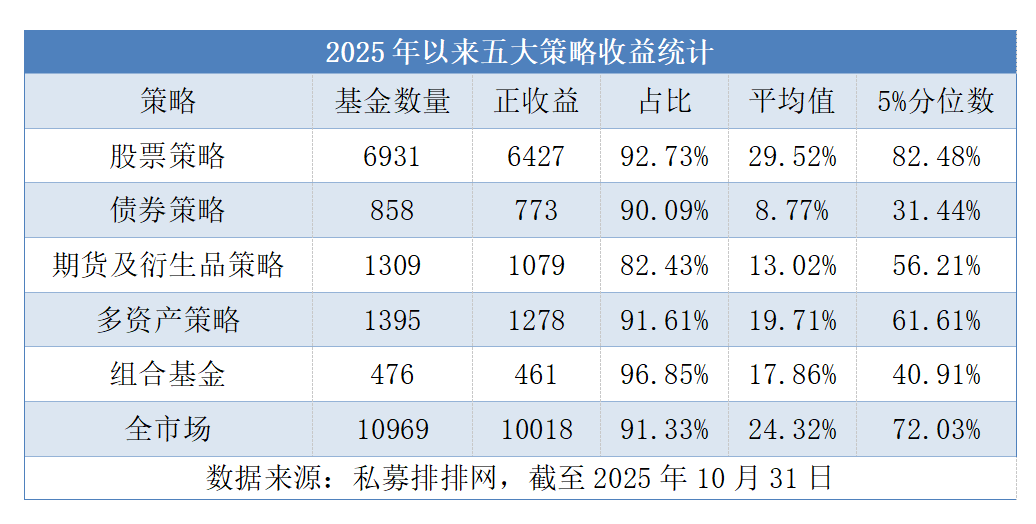
Core Insights - As of October 31, 2025, 91.33% of the 10,969 private equity funds achieved positive returns, with an average return rate of 24.32% [1][3] - The top 5% of funds yielded an impressive return of 72.03%, indicating a strong performance across the market [1][3] Strategy Performance - **Equity Strategy**: Leading with an average return of 29.52%, 92.73% of equity funds reported positive returns. Among 6,931 funds, 6,427 were profitable, with the top 5% achieving a return of 82.48% [1][3] - **Multi-Asset Strategy**: Ranked second with an average return of 19.71% and a positive return rate of 91.61%. This strategy effectively captured equity market gains while diversifying risks through bonds and commodities [1][3] - **Combination Funds**: Showed strong stability with 96.85% of funds in positive territory, although the average return of 17.86% was slightly lower than that of multi-asset strategies [1][3] - **Bond Strategy**: Maintained a conservative approach with an average return of 8.77%, but 90.09% of funds achieved positive returns, highlighting its risk-averse nature [2][3] - **Futures and Derivatives Strategy**: Experienced moderate performance with an average return of 13.02% and 82.43% of funds in positive territory, affected by volatile commodity prices [2][3] Sub-Strategy Insights - **Quantitative Long Strategy**: Emerged as the top performer within equity strategies, boasting an average return of 36.76% and a positive return rate of 96.52%, significantly outperforming subjective long strategies [3][5] - **Subjective Long Strategy**: Achieved a return of 29.72%, with a notable 5% percentile return of 86.45%, indicating strong performance in specific sectors like technology [4][5] - **Market Neutral and Long-Short Strategies**: Reported lower average returns of 9.22% and 18.29%, respectively, due to their hedging mechanisms limiting upside potential [4][5] Market Dynamics - The performance of quantitative strategies has been attributed to several factors, including rapid sector rotation in technology and high trading volumes in the A-share market, which support high-frequency trading [6]
主观、量化、“小而美”私募百强全名单!梁宏旗下2家私募上榜!500亿量化新贵居前!
私募排排网· 2025-10-27 10:00
Market Overview - In September, the A-share market showed an overall upward trend, with the Shanghai Composite Index rising by 0.64% and the Shenzhen Component Index increasing by approximately 6.54% [2] - The ChiNext Index and the STAR 50 Index performed particularly well, with increases of about 12.04% and 11.48%, respectively [2] - The bond market continued its adjustment from August, with overall rising yields and a decline in bond indices, including a drop of 0.41% in the China Bond Index [2] - Commodity prices, particularly gold, surged due to multiple factors, including the onset of a Federal Reserve rate cut cycle and global central bank gold purchases, with the Nanhua Precious Metals Index rising over 13% in a month [2] Private Fund Performance - Private equity funds achieved good returns, especially in stock long and macro strategy products, with an average return of approximately 28.72% for 5,051 products recorded from January to September [2] - The proportion of products with positive returns increased to 95.41%, up from 94.43% in the previous month [2] - Among secondary strategies, quantitative long, subjective long, and macro strategy products had average returns of 39.85%, 37.63%, and 26.43%, respectively, ranking as the top three [3] Rankings of Private Funds - The top subjective private funds, with an average return of 48.28%, included firms like Beijing Xiyue Private Fund and Fuyuan Capital, with a total product scale of approximately 853.28 billion yuan [4] - The threshold for the subjective private fund rankings was set at a specific percentage return, with the top ten funds achieving significant returns [4] - The top quantitative private funds, with an average return of 31.17%, included firms like Longyin Tiger Roar and Lingjun Investment, with a total product scale of about 810.04 billion yuan [15] Small and Beautiful Private Funds - The "small and beautiful" private fund rankings featured firms with an average return of 68.06%, with the top ten including Longhui Xiang Investment and Jingying Zhito [26] - The threshold for this ranking was also based on a specific percentage return, highlighting the performance of smaller funds [26] Notable Fund Managers - Lu Yuan Private Fund, established in November 2023, quickly rose to the top three in the subjective private fund rankings, with a product scale of approximately 7.94 billion yuan and impressive returns [9] - The founder, Lu Wentao, has nearly 20 years of experience and has adjusted holdings towards gold and military sectors based on market changes [9] - Dayou Investment, a top private fund, has consistently achieved positive returns over five years, showcasing its ability to navigate market cycles effectively [14]