
宏观策略产品

Search documents
一天跌近50%,怎么回事?
Xin Lang Cai Jing· 2026-02-08 01:44
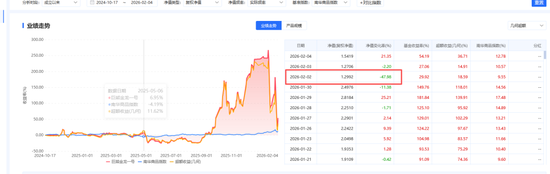
Core Insights - The recent performance of CTA strategies, particularly those based on commodity futures, has experienced significant volatility, with some funds reporting net value declines of nearly 50% [1][2][8] - The fluctuations are attributed to rapid price reversals in commodities like gold and silver, which have been at high levels, leading to substantial net value changes for trend-following CTA strategies [1][4][11] Performance Analysis - On February 2, the "Giant Bear Golden Dragon No. 1" private equity fund, a subjective CTA strategy product, reported a net value decline of 47.98% [2][9] - As of February 4, this fund had a year-to-date return in negative territory, with a maximum drawdown of 54.73% [4][11] - Other funds, such as "ZTE Steady No. 1" and "Shark Deep Sea Quantitative Fund," also reported significant declines of 33% and 19.78% respectively on the same day [4][11] Market Context - The volatility in CTA strategies is primarily driven by the rapid correction in precious metals after a strong upward trend, influenced by market concerns over potential changes in interest rate policies [4][11] - The market's reaction to news regarding potential appointments at the Federal Reserve has altered interest rate expectations, contributing to increased volatility in commodity prices [4][11] Long-term Value Proposition - Despite recent performance challenges, industry experts believe that CTA strategies still hold significant asset allocation value due to their low correlation with traditional stock and bond assets [6][12] - Factors such as the anticipated easing of global liquidity and domestic policy changes are expected to enhance the overall activity in the commodity market, supporting the long-term viability of CTA strategies [6][12] Investor Guidance - Investors are advised to view CTA strategies as a means to enhance portfolio stability rather than seeking high returns, suggesting a cautious approach to allocation [7][13] - It is recommended that investors maintain a long-term perspective and not react impulsively to short-term performance fluctuations, as the true value of CTA strategies is realized over complete market cycles [7][14]

2025年私募基金收益TOP20揭晓!今通、波粒二象等居前!
Sou Hu Cai Jing· 2026-02-02 08:28
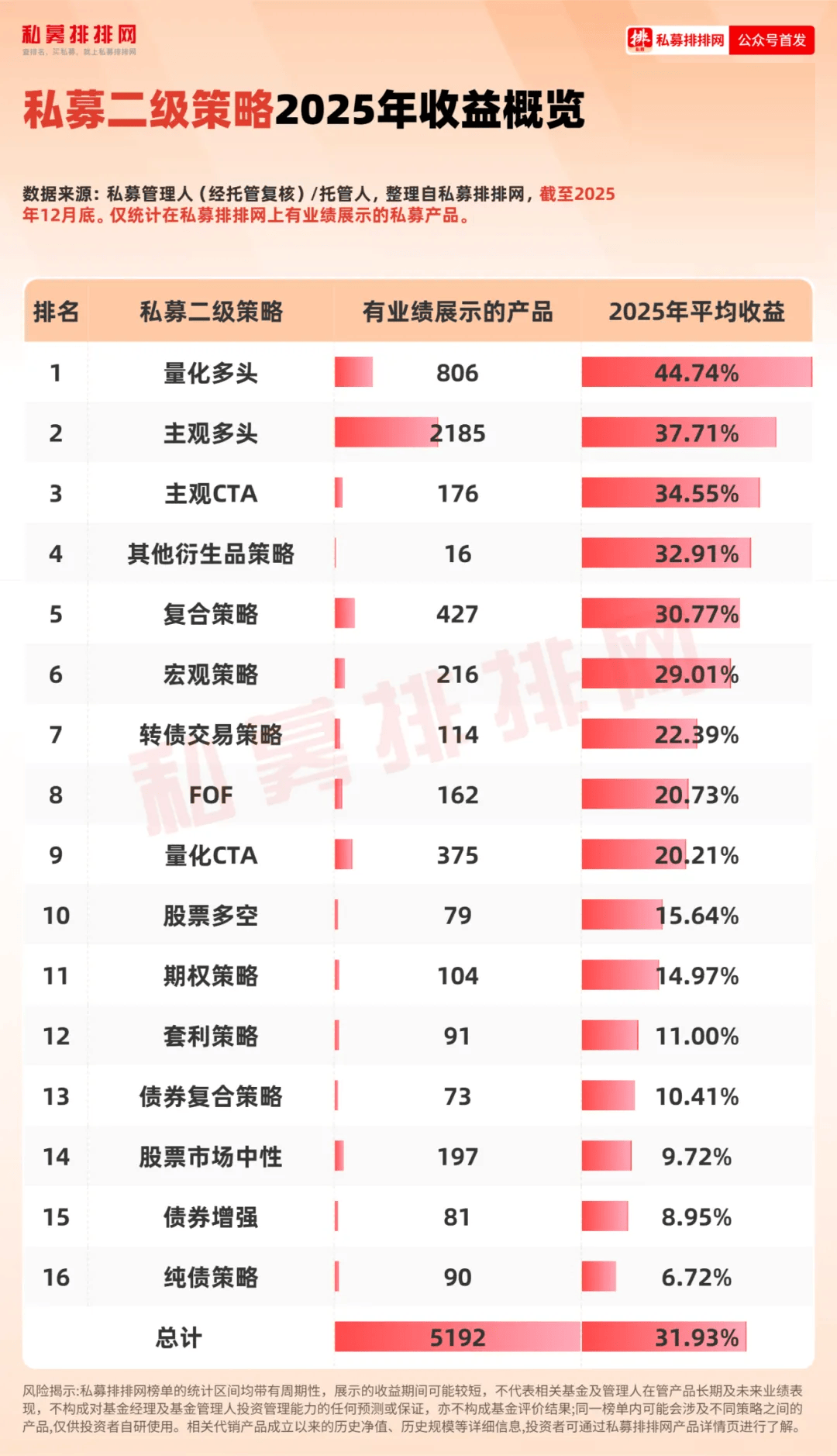
Market Overview - In 2025, the A-share market experienced an overall upward trend, with major indices recording significant gains, including an increase of over 18% in the Shanghai Composite Index and over 49% in the ChiNext Index [1] - The commodity market showed notable differentiation, with precious metals driven by safe-haven attributes and macroeconomic logic, achieving a cumulative annual increase of over 81% [1] Private Fund Performance - By the end of 2025, among 5,192 private funds displayed on the Private Fund Ranking website, the average annual return reached 31.93% [1] - Quantitative long and subjective long strategies performed particularly well, with average returns of 44.74% and 37.71%, respectively [1] - The active rotation in sectors such as consumption, technology, and high-end manufacturing created substantial structural opportunities for equity strategy funds, supported by active market trading and sustained liquidity [1] Strategy Performance Quantitative Long Strategy - The top-performing quantitative long products included 806 funds with an average return of 44.74% [3] - Notable products in this category included Gaia Qingke, Jintong Investment, and Hanrong Investment [4] Subjective Long Strategy - The subjective long strategy had 2,185 funds with an average return of 37.71%, with the highest entry threshold for the top 20 products [4][9] - Leading products in this category came from companies like Nengjing Investment Holdings and Shanghai Ge Ru Private Equity [10] Composite Strategy - The composite strategy saw 427 funds with an average return of 30.77%, with top products from Shuohe Asset and Tianhui Investment [12][15] Macro Strategy - The macro strategy included 133 funds, with the top products from companies like Jiuqi Investment and Luyuan Private Equity [16][18] - Notably, Luyuan Private Equity's product achieved significant returns, highlighting the effectiveness of macro strategies [20] Subjective CTA Strategy - The subjective CTA strategy had 78 funds, with top products from Yizu Investment and Chiying Private Equity [21][24] Quantitative CTA Strategy - The quantitative CTA strategy included 185 funds, with Hua Cheng Private Equity leading with significant returns [25][27] Private FOF Strategy - The private FOF strategy had 56 funds, with an average return of 20.55%, and top products from Shanghai Taiying and Qingdao Hongyun Ruiheng Private Equity [29][31] - The FOF strategy focuses on selecting and allocating multiple private funds to achieve diversified investment [29]
中信证券:多资产策略兼顾不同市场间的收益,同时具备Alpha和Beta端获益潜力
Xin Lang Cai Jing· 2026-01-31 03:25
Group 1 - The core viewpoint of the report indicates that the private equity market will see significant performance improvements due to a better equity market environment in 2025, with a projected industry scale rising to approximately 7.2 trillion yuan [1] - The leading positions among fund managers remain stable, with a notable increase in the share of quantitative products compared to the beginning of the year [1] - The stock strategy is expected to outperform in a fluctuating market in 2025, with products linked to high market correlation, macro strategies, multi-strategies, and FoF/MoM also yielding substantial returns [1] Group 2 - The current A-share market is active, and private equity managers exhibit strong confidence in the market, with increased consensus among investors [1] - Attention is drawn to the accelerated short-term rotations in high-risk and low-risk assets, while the commodity market experiences increased volatility, making subjective CTA products more valuable due to their flexibility [1] - Multi-asset strategies are highlighted for their ability to balance returns across different markets, possessing potential for both Alpha and Beta gains [1]

2025年私募基金收益TOP20揭晓!今通、乾图、硕和、路远、波粒二象等居前!
私募排排网· 2026-01-28 12:00
Core Viewpoint - The A-share market experienced a significant upward trend in 2025, with major indices showing considerable gains, including an over 18% increase in the Shanghai Composite Index and a more than 49% rise in the ChiNext Index. Precious metals, driven by their safe-haven properties and macroeconomic logic, saw an impressive annual increase of over 81% [3]. Private Fund Performance - By the end of 2025, the average return for 5,192 private funds displayed on the Private Fund Ranking Network reached 31.93%. Notably, quantitative long and subjective long strategies performed exceptionally well, with average returns of 44.74% and 37.71%, respectively [3][5]. - The active rotation in sectors such as consumption, technology, and high-end manufacturing created substantial structural opportunities for equity strategy funds, further enhanced by active market trading and sustained liquidity [3]. Strategy Performance - Multi-asset strategies, including composite and macro strategies, also performed well, with average returns exceeding 29%. Other mainstream strategies, such as CTA and FOF strategies, achieved average returns above 20% [3]. - The top-performing strategies in 2025 included: - Quantitative Long: Average return of 44.74% - Subjective Long: Average return of 37.71% - Composite Strategy: Average return of 30.77% - Macro Strategy: Average return of 29.01% [5][6][11]. Top Funds by Strategy - The top 20 quantitative long products included firms such as Gaia Qingke, Jintong Investment, and Hanrong Investment, with the top threshold for returns being notably high [6][7]. - The leading subjective long products were from firms like Nengjing Investment Holdings and Shanghai Geryu Private Equity, with a high entry threshold for returns [11][13]. - In the composite strategy category, Shuohe Asset led the performance, followed by Tianhui Investment and Ningbo Shufa Private Equity [17][18]. - For macro strategies, notable performers included Jiuqi Investment and Luyuan Private Equity, with a significant number of products achieving high returns [20][21]. Private Fund of Funds (FOF) - The average return for private FOF products in 2025 was 20.55%, with the top ten funds including Shanghai Taiying and Qingdao Hongyun Ruiheng Private Equity [35][36]. - The leading FOF product, managed by Li Chunyu of Rongzhi Investment, achieved a notable return, emphasizing a focus on diversified asset allocation and risk management [40].

房贷还在、铁饭碗没了,我开始重新思考“安全感”这件事
雪球· 2026-01-21 08:34
Core Insights - The article discusses the journey of a private equity investor transitioning from a stable job in a state-owned enterprise to actively managing investments in private equity funds, highlighting the importance of effective communication with investment advisors [3][4]. Investment Motivation - The investor's initial motivation for choosing private equity was to achieve returns that exceed loan interest rates while ensuring effective communication with advisors, which was lacking in previous experiences with banks [5][6]. Initial Investment Experience - The first private equity product purchased was a Fund of Funds (FOF) from Fidelity, which provided an annual return that covered the loan interest rate of 3.15%, fulfilling the investor's initial financial goals [9]. Product Selection Criteria - Key factors considered when selecting private equity products include attending roadshows to understand the underlying logic, reviewing past performance, and assessing how the product performs in extreme market conditions [10][11]. Redemption and Reallocation Strategy - The decision to redeem or increase investment in a product is based on its performance relative to expectations and comparisons with similar strategies. If a product underperforms significantly, the investor considers reallocating funds to better-performing options [12][13]. Portfolio Composition - The investor maintains a diversified portfolio that includes various strategies such as macro, quantitative, and fixed income, aiming for a balanced approach to enhance returns while managing risk [16][17]. Learning and Adaptation - The investor acknowledges a gradual increase in risk tolerance and understanding of quantitative products, reflecting on missed opportunities due to initial reluctance to embrace higher-risk investments [18][20]. Advice for New Investors - New investors are advised to manage expectations regarding risk and returns, start with smaller investments in lower-risk strategies, and view investing as a positive experience to share with family [21][22].

宏观策略基金和全天候是什么?手把手教你看明白
雪球· 2025-12-28 05:25
Core Viewpoint - The article explains the concept of macro strategy in investment, focusing on the components of returns: Beta (systematic returns) and Alpha (trading ability). It emphasizes that macro strategy's Beta is derived from a diversified asset allocation that captures systematic returns without the need for market timing or predictions [3][51]. Group 1: Understanding Beta - Macro strategy's Beta is defined as a diversified asset allocation across various asset classes, such as stocks, bonds, and commodities, without the need for market timing [7][19]. - A simple diversified portfolio consisting of 33% A-share index, 33% bond index, and 33% commodity and gold index achieved an annualized return of 10% with a maximum drawdown of 31%, compared to a 71% drawdown for the broader market [7][11]. - The article highlights that the long-term source of macro strategy's Beta returns is systematic dividends, which are derived from economic growth and monetary expansion [19][47]. Group 2: Sources of Asset Returns - Asset returns can be categorized into four main sources: earning from economic growth, earning from monetary expansion, earning from counterparties, and earning from risk-taking [12][16]. - Systematic returns (economic growth and monetary expansion) allow all participants to benefit simultaneously, while competitive returns (from counterparties) are limited and require outperforming others [17][18]. - The article concludes that the primary sources of asset returns are the first three categories, with systematic returns being the most sustainable and scalable [17][20]. Group 3: All-Weather Strategy - The All-Weather strategy aims to optimize asset allocation to capture long-term systematic dividends while smoothing out short-term cyclical volatility [26][28]. - This strategy categorizes macro environments into four scenarios based on economic growth and inflation levels, ensuring that assets are allocated to benefit from each scenario [28][29]. - The article emphasizes that true diversification should focus on risk parity rather than equal capital allocation, allowing for a balanced risk exposure across different assets [29][31]. Group 4: Evolution of Beta - The evolution from Beta 1.0 (simple asset allocation) to Beta 2.0 (All-Weather strategy) and finally to Beta 3.0 (factor diversification) reflects a deeper understanding of asset returns and their underlying factors [36][43]. - Beta 3.0 incorporates additional factors beyond growth and inflation, allowing for a more nuanced approach to risk diversification [41][43]. - The article stresses that constructing a macro strategy Beta portfolio is complex and requires a profound understanding of underlying asset characteristics and risk management [45][46].

千禧年、世坤、Two Sigma等全球顶级量化,走出了哪些中国量化大佬?(附美股持仓)
私募排排网· 2025-11-21 03:36
Core Insights - The rapid development of artificial intelligence technology has made quantitative trading an essential investment tool in major overseas capital markets, with over 70% of U.S. stock trading driven by algorithms, a figure that continues to rise [2] - Major global quantitative trading firms, such as Millennium, WorldQuant, Two Sigma, Citadel, D.E. Shaw, and Bridgewater, are expanding at an unprecedented pace, with their latest holdings in U.S. stocks for Q3 now disclosed [3][4] Group 1: Millennium - Millennium Management, founded in 1989, has achieved an impressive record of positive returns in 33 out of 34 years, with only one loss during the 2008 financial crisis [3][4] - The firm employs strict drawdown management, reducing allocated funds by half after a 5% drawdown and liquidating strategies after a cumulative 10% drawdown [3] - Millennium is recognized as a "Huangpu Military Academy" for Chinese quantitative private equity, with many prominent fund managers in China having previously worked there [4] Group 2: WorldQuant - WorldQuant, a major player in global quantitative hedge funds, was established in 2007 as a spin-off from Millennium, focusing on global quantitative analysis [7] - The firm has developed a central knowledge base containing 4 million "alphas" to industrialize the generation of excess returns [7][8] - Several notable Chinese fund managers, including the founders of Jiukun Investment, have previously worked at WorldQuant [8] Group 3: Two Sigma - Two Sigma, founded in 2001, is known for its application of data science and advanced technology in investment, managing assets between $50 billion and $100 billion [11] - The firm has established a wholly-owned subsidiary in Shanghai and has been instrumental in training numerous quantitative talents in China [11][12] - Two Sigma's Q3 holdings reached $67.17 billion, a growth of 18.95% from the previous quarter, with major positions in S&P 500 ETF, Financial ETF, and Consumer Discretionary ETF [13][14] Group 4: Citadel - Citadel, founded in 1990, has become the most profitable hedge fund globally, with cumulative net returns exceeding $65.9 billion [15] - The firm processes approximately $410 billion in trades daily, covering over 11,000 U.S. listed securities [15] - Citadel's Q3 holdings amounted to $657.15 billion, reflecting a 14.09% increase from the previous quarter, with significant positions in S&P 500 ETF and Nasdaq 100 ETF [17][21] Group 5: AQR Capital Management - AQR, established in 1998, integrates academic research with quantitative investment strategies, managing $159.2 billion [23][24] - The firm focuses on a diverse range of investment strategies, emphasizing systematic methods and diversification [23] - AQR's Q3 holdings reached $155.99 billion, a 29.05% increase from the previous quarter, with major investments in Nvidia, Microsoft, and Apple [24][28] Group 6: Renaissance Technologies - Renaissance, founded in 1982 by mathematician James Simons, is renowned for its quantitative trading success, managing over $65 billion [30][31] - The firm has consistently achieved high returns, including significant profits during market downturns [30] - Renaissance's Q3 holdings totaled $75.75 billion, with major positions in Palantir, Nvidia, and Roblox, and a notable increase in Google shares [31][35]




主观、量化、“小而美”私募百强全名单!梁宏旗下2家私募上榜!500亿量化新贵居前!
私募排排网· 2025-10-27 10:00
Market Overview - In September, the A-share market showed an overall upward trend, with the Shanghai Composite Index rising by 0.64% and the Shenzhen Component Index increasing by approximately 6.54% [2] - The ChiNext Index and the STAR 50 Index performed particularly well, with increases of about 12.04% and 11.48%, respectively [2] - The bond market continued its adjustment from August, with overall rising yields and a decline in bond indices, including a drop of 0.41% in the China Bond Index [2] - Commodity prices, particularly gold, surged due to multiple factors, including the onset of a Federal Reserve rate cut cycle and global central bank gold purchases, with the Nanhua Precious Metals Index rising over 13% in a month [2] Private Fund Performance - Private equity funds achieved good returns, especially in stock long and macro strategy products, with an average return of approximately 28.72% for 5,051 products recorded from January to September [2] - The proportion of products with positive returns increased to 95.41%, up from 94.43% in the previous month [2] - Among secondary strategies, quantitative long, subjective long, and macro strategy products had average returns of 39.85%, 37.63%, and 26.43%, respectively, ranking as the top three [3] Rankings of Private Funds - The top subjective private funds, with an average return of 48.28%, included firms like Beijing Xiyue Private Fund and Fuyuan Capital, with a total product scale of approximately 853.28 billion yuan [4] - The threshold for the subjective private fund rankings was set at a specific percentage return, with the top ten funds achieving significant returns [4] - The top quantitative private funds, with an average return of 31.17%, included firms like Longyin Tiger Roar and Lingjun Investment, with a total product scale of about 810.04 billion yuan [15] Small and Beautiful Private Funds - The "small and beautiful" private fund rankings featured firms with an average return of 68.06%, with the top ten including Longhui Xiang Investment and Jingying Zhito [26] - The threshold for this ranking was also based on a specific percentage return, highlighting the performance of smaller funds [26] Notable Fund Managers - Lu Yuan Private Fund, established in November 2023, quickly rose to the top three in the subjective private fund rankings, with a product scale of approximately 7.94 billion yuan and impressive returns [9] - The founder, Lu Wentao, has nearly 20 years of experience and has adjusted holdings towards gold and military sectors based on market changes [9] - Dayou Investment, a top private fund, has consistently achieved positive returns over five years, showcasing its ability to navigate market cycles effectively [14]
今年大赚近25%,私募杀入这一赛道
中国基金报· 2025-10-17 03:34
Core Viewpoint - Macro strategies have gained significant attention from private equity firms, with an average return of 24.54% in the first three quarters of the year, particularly strong in August and September [2][4]. Group 1: Performance of Macro Strategies - As of September 30, 272 macro strategy products recorded an average return of 24.54%, with 92.65% achieving positive returns [4]. - Monthly performance showed positive returns in all months except January, with August and September averaging returns of 5.18% and 4.70% respectively [4]. Group 2: Market Environment and Strategy Adoption - The current low interest rate environment has led to a narrowing of credit spreads and limited yield in pure bond strategies, prompting private equity firms to adopt macro strategies for flexible asset allocation [4][5]. - Macro strategies are seen as suitable for the current volatile market, providing diversified multi-asset products to meet clients' needs for stable returns [5]. Group 3: Diverse Macro Models - Different private equity firms have developed unique macro analysis frameworks based on their research backgrounds, combining systematic and active management approaches [6]. - Strategies include dynamic asset weight adjustments to balance risks and optimize returns based on various economic factors [6][7]. Group 4: Investment Outlook - The outlook for the next 6 to 12 months emphasizes the importance of monitoring Federal Reserve policies and managing risks during market volatility [8]. - There is a positive view on equities and commodities, with expectations for potential opportunities driven by geopolitical risks and the Fed's interest rate cycle [9].

今年大赚近25%,私募杀入这一赛道
Zhong Guo Ji Jin Bao· 2025-10-17 02:20
Core Insights - Macro strategies have gained significant attention from private equity firms, with an average return of 24.54% in the first three quarters of the year, particularly strong in August and September [1][2][3] Group 1: Performance and Market Trends - As of September 30, 272 macro strategy products recorded an average return of 24.54%, with 92.65% achieving positive returns [2] - Monthly performance showed positive returns in all months except January, with August and September yielding average returns of 5.18% and 4.70% respectively [2] - The current low interest rate environment has led to a narrowing of credit spreads and term trading opportunities, making macro strategies attractive for capturing returns across various asset classes [2][3] Group 2: Investment Strategies and Frameworks - Different private equity firms are developing unique macro analysis frameworks based on their research backgrounds, focusing on multi-asset allocation [3][4] - One firm combines systematic and active management, utilizing a top-down macro perspective that includes economic cycles and liquidity systems [4] - Another firm employs a bottom-up approach, minimizing the influence of manager sentiment and focusing on risk parity across equities, bonds, and commodities [5] Group 3: Future Outlook and Asset Allocation - The outlook for the fourth quarter suggests that equities and commodities may outperform bonds, especially in the context of a potential Fed rate cut [6] - Despite high valuations in equity markets, there is cautious optimism, with expectations of volatility and potential adjustments [6] - Commodities, particularly gold, are viewed as valuable for portfolio diversification, while bonds are expected to have limited upward rate movement [6]