
产业社区

Search documents
滨州经济技术开发区数字经济产业社区入选全市“优秀”等次
Qi Lu Wan Bao· 2026-01-05 06:32
Core Viewpoint - The article highlights the successful evaluation of the Digital Economy Industrial Community in Binzhou Economic and Technological Development Zone, which was recognized as "Excellent" in the assessment of grassroots governance innovation and new field party building initiatives for 2025. Group 1: Strengthening Party Building - The Digital Economy Industrial Community established its Party Committee in March 2025, integrating leadership from state-owned enterprises with non-public enterprises to enhance party building [2] - A "1+2+3+X+N" work system was created, focusing on comprehensive governance and community development, involving 12 grassroots party organizations and 464 party members [2] - The community achieved full coverage of party work by forming joint organizations and appointing 13 party instructors, with the first batch of "Party Member Demonstration Posts" being selected [2] Group 2: Improving Services - The community emphasizes the importance of mechanism optimization, strong organization, and team building to ensure sustainable development [3] - A "Service Team" was formed, consisting of 11 units, to address enterprise needs through regular visits and surveys, resolving over 51 issues related to green space, utilities, and parking [3] - Investments of 300,000 yuan were made to enhance community infrastructure, including monitoring systems and dining facilities, to improve the business environment [3] Group 3: Integrated Governance - The community implemented a grid management system, dividing it into 10 grids, with staff assigned to monitor and address local issues effectively [4] - Volunteer service teams were established to provide support in maintenance, mental health counseling, and environmental protection, ensuring a supportive community atmosphere [4] Group 4: Enriching Daily Activities - The community organized various cultural and recreational activities, including health lectures and sports events, to promote well-being and engagement among employees [5]
平均每3.6天引进一个项目,肇庆大产区凭何脱颖而出?
2 1 Shi Ji Jing Ji Bao Dao· 2025-12-09 03:29
Core Insights - The article highlights the transformation of the Zhaoqing Large Industrial Cluster in Guangdong Province from an "industrial lowland" to a thriving "industrial forest" within three years, showcasing significant development in various sectors [1] Group 1: Development Achievements - Over 8,000 acres of advanced manufacturing land have been developed, attracting more than 300 manufacturing projects with a total planned investment exceeding 90 billion yuan, of which over 60% are high-tech and specialized enterprises [1] - In 2022, the Zhaoqing Large Industrial Cluster was identified as a core area for the "strong industrial city" strategy, with 166 projects initiated, 76 completed, and 51 put into production [1] - In 2023 alone, over 100 manufacturing projects were introduced, with planned investments exceeding 30 billion yuan, including six national-level specialized "little giant" enterprises and six projects over 1 billion yuan [2] Group 2: Project Highlights - The recent development event showcased 50 signed projects with a total investment of 25.37 billion yuan, 90 projects under construction with investments of 22.11 billion yuan for industrial projects and 3.78 billion yuan for infrastructure, and 72 completed projects totaling 20.87 billion yuan [2] - Key projects include the Orange Automation Manufacturing Base and Huazhao Weiye LED production facility, which emphasize breakthroughs in core technologies and collaboration within the industrial chain [3] Group 3: Efficiency and Policy Support - The Zhaoqing area has achieved a project introduction rate of one project every 3.6 days and a land supply completion time of about seven days, with project initiation occurring in less than six days [3] - Policies such as "Four Unified and Four Services" have streamlined enterprise services, allowing 103 projects to directly commence construction through expedited approvals [4] - The "Park Loan" financing service has supported over 50 enterprises with more than 2 billion yuan in financing, while a total of 4.3 billion yuan has been invested in 18 technology projects through an industrial fund [5] Group 4: Future Outlook - The Zhaoqing Large Industrial Cluster is evolving from a traditional "park economy" to an "industrial community," fostering a sustainable development model that attracts businesses and retains talent, contributing to the industrial synergy and regional growth of the Guangdong-Hong Kong-Macao Greater Bay Area [5]


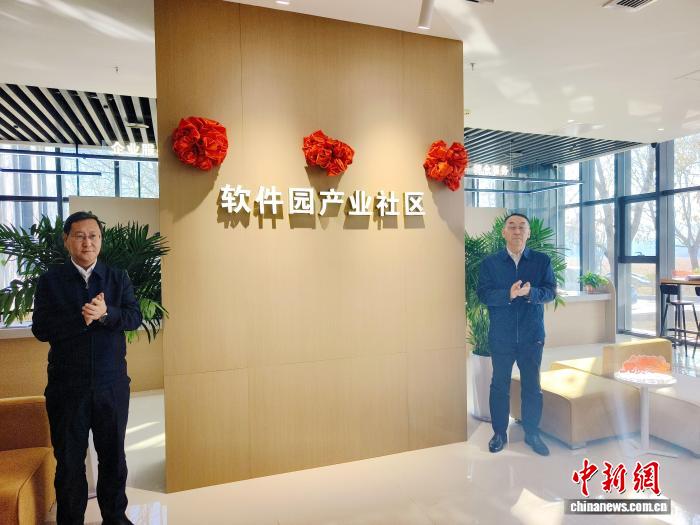
企业办事不出园区 东北首家产业社区在沈阳成立
Zhong Guo Xin Wen Wang· 2025-11-14 05:52
Core Points - The first industrial community in Northeast China was established in Shenyang International Software Park, aiming to enhance service efficiency for enterprises and optimize the business environment [1][3][4] Group 1: Industrial Community Overview - The industrial community integrates both "industry" and "community" attributes, serving as a new model to address the separation of people, production, and urban development in traditional parks [3][4] - The community aims to facilitate a "one-stop" service experience, allowing enterprises to handle various administrative tasks without leaving the park [5] Group 2: Service Model and Features - The community's service model emphasizes "departmental integration and resource aggregation," addressing the challenges enterprises face in finding the right departments for their needs [3][5] - Key service areas include enterprise registration, tax services, talent and social security services, and party-building services, all designed to meet high-frequency business needs and talent development challenges [4][5] Group 3: Infrastructure and Experience - The community features well-planned functional areas such as consultation zones, service areas, and leisure spaces, equipped with smart terminals to enhance user experience [4] - The presence of over 1,700 enterprises and more than 40,000 technology professionals in the software park highlights the community's potential impact on local economic development [4]
萧山3个小镇“全优”列阵
Hang Zhou Ri Bao· 2025-10-17 02:22
Core Insights - The Zhejiang Provincial Development and Reform Commission announced the assessment results for provincial characteristic towns in 2025, with Xiaoshan's three towns—Information Port Town, Robot Town, and Turing Town—achieving "excellent" ratings, leading the city in this category [1] Group 1: Performance of Characteristic Towns - Xiaoshan's three characteristic towns have consistently performed well, with Information Port Town receiving "excellent" ratings for six consecutive years since 2020, Robot Town also achieving "excellent" for three consecutive years, and Turing Town improving from "good" to "excellent" since 2021 [1][2] - The Information Port Town has a total output of 11.189 billion yuan in the first half of 2025, with 92.32% of this output coming from its characteristic industries [2] Group 2: Industry Focus and Development Strategies - Information Port Town focuses on four key industries: artificial intelligence, healthcare, integrated circuits, and new consumption, creating a diversified and highly interconnected industrial cluster [2] - Robot Town specializes in the intelligent robot industry, establishing a comprehensive ecosystem that includes research, manufacturing, and application [2] - Turing Town is centered on AIGC (Generative Artificial Intelligence) technology, with its AIGC computing center accounting for over 50% of Xiaoshan's total computing power supply, supporting the explosive growth of the regional AI industry [2] Group 3: Future Development Plans - Turing Town is developing a "Chip and Model Community" aimed at creating a complete closed-loop AI industry ecosystem, supported by a 1 billion yuan AI policy package from Xiaoshan District [3] - Information Port Town is also exploring community-based development with a focus on "AI + Healthcare," leveraging its digital industry foundation and medical data resources [3] - The transition from characteristic towns to industrial communities signifies a profound change in development philosophy, moving from spatial aggregation to ecological integration, enhancing innovation, industry, and talent chains for high-quality regional economic development [3]