
数字经济产业

Search documents
“十四五”期间昆明高新区规上工业总产值突破4400亿元
Xin Hua Wang· 2026-02-12 09:13
Core Insights - During the 14th Five-Year Plan period, Kunming High-tech Zone achieved an industrial output value of 440.34 billion yuan, marking a 54.1% increase compared to the 13th Five-Year Plan period [1] - The zone's ranking in the Torch Comprehensive Evaluation improved from 64th to 59th, making it the only park in the province to be listed among the top 100 high-quality development parks in the country for five consecutive years [1] Group 1: Industrial Development - Kunming High-tech Zone focused on industrial development, achieving significant results in specialized and clustered industrial growth, with the Yunnan Central Rare and Precious Metals Cluster recognized as a national advanced manufacturing cluster [1] - The East District of Kunming High-tech Zone was selected as a key digital economy park in Yunnan Province [1] Group 2: Technological Innovation - The zone maintained a total of 374 high-tech enterprises and 336 national and provincial-level technology-based SMEs, representing increases of 64.75% and 68% respectively compared to the 13th Five-Year Plan [1] - Kunming High-tech Zone ranked 29th among national high-tech zones in terms of innovation capability of listed companies, reinforcing the position of enterprises as innovation leaders [1] Group 3: Green Development - The zone made strides in green development, creating 20.79 kilometers of public greenways and 110 small parks, while consistently ranking among the top development zones for civilized city construction for three consecutive years [1] - It was recognized as a national-level green park and a provincial-level zero-carbon park, contributing to the increasing sense of well-being among the populace [1] Group 4: Talent Development and Future Goals - The zone emphasized talent acquisition and high-level talent training, retaining 163 provincial-level talents and 176 municipal-level talents, along with 50 high-level talents under the "Spring City Plan" [2] - Looking ahead to the 15th Five-Year Plan, Kunming High-tech Zone aims to focus on the development positioning of "three areas and one platform," striving for the "sixfold increase" goals while optimizing the industrial, working, and political ecosystems [2]
“准两万亿”城市出分,还差一步之遥
Mei Ri Jing Ji Xin Wen· 2026-01-26 23:23
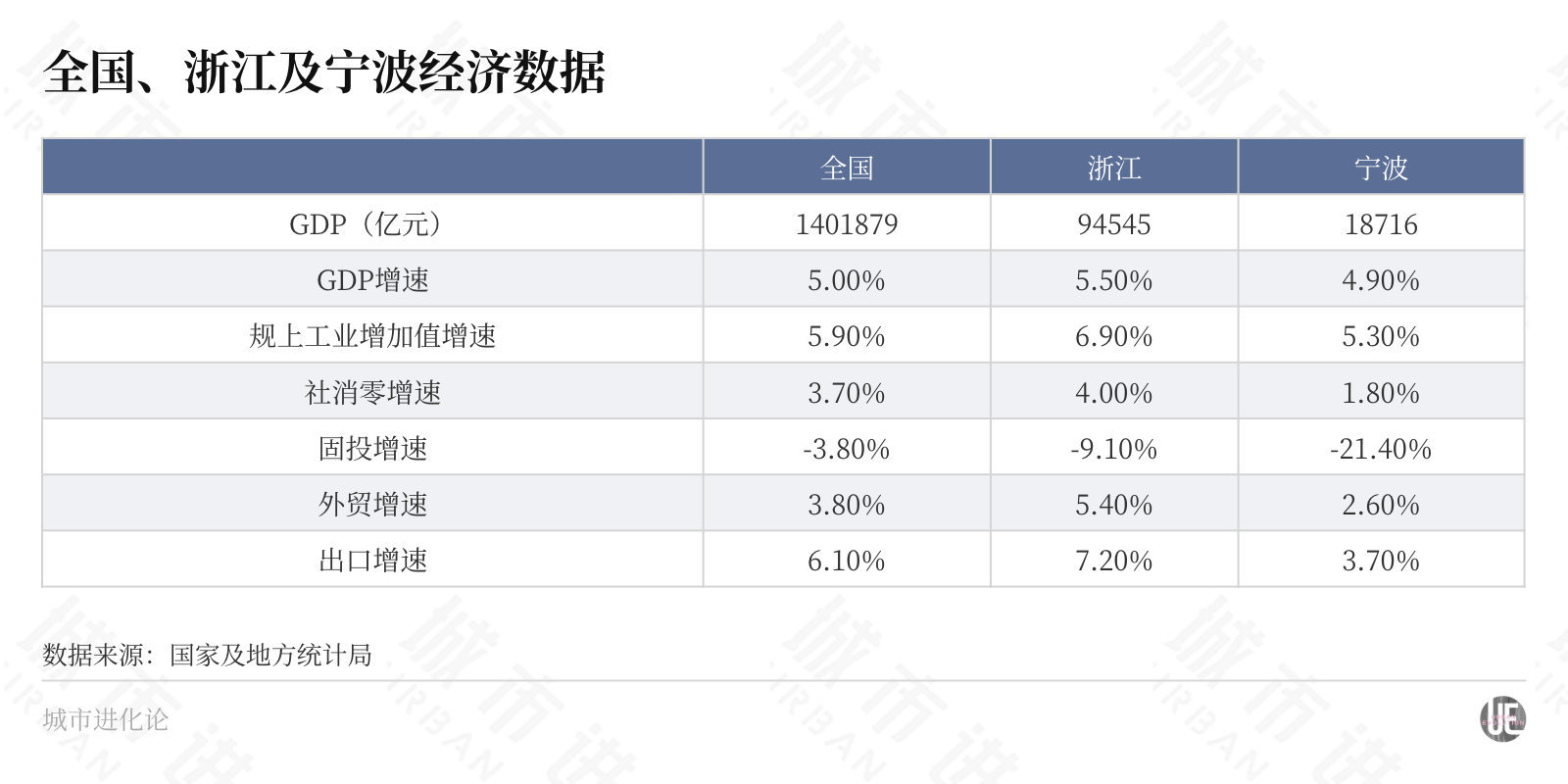
Core Viewpoint - In 2025, Ningbo's GDP reached 1.8716 trillion yuan, with a year-on-year growth of 4.9%, indicating overall stable economic performance and progress in high-quality development [1] Economic Performance - Ningbo's GDP composition by industry shows the primary industry added value at 47.2 billion yuan (3.9% growth), secondary industry at 786.6 billion yuan (4% growth), and tertiary industry at 1,037.8 billion yuan (5.6% growth) [1] - The contribution rates to GDP growth from the three industries were 1.9%, 36.2%, and 61.9% respectively [1] Comparison with Targets - Ningbo's 2025 GDP of 1.8716 trillion yuan falls short of the target of 2 trillion yuan set for entering the top 10 cities in China [2] - The year-on-year growth of 4.9% is lower than the national and provincial averages by 0.1 and 0.6 percentage points respectively [2] Industrial Performance - The industrial output value above designated size in Ningbo grew by 5.3%, which is below the national and provincial growth rates by 0.6 and 1.6 percentage points respectively [2] - High-tech, digital economy, and equipment manufacturing sectors saw increases of 11.9%, 6.9%, and 5.9% respectively, outperforming the overall industrial growth [2] Demand Side Analysis - The total retail sales of social consumer goods in Ningbo reached 570.3 billion yuan, with a year-on-year growth of 1.8% [4] - Fixed asset investment decreased by 21.4%, while export value was 980.8 billion yuan, growing by 3.7% [4] - Ningbo's foreign trade dependence is at 78.3%, significantly higher than the national average of 32.5% and provincial average of 58.4% [4] Competitive Positioning - As of 2025, Ningbo's GDP ranks 11th nationally, trailing behind Nanjing by nearly 80 billion yuan and ahead of Tianjin by approximately 16 billion yuan [4] - The city aims for a GDP of 2.6 trillion yuan by 2030, indicating a target growth of nearly 40% over the next five years [4]

每个开发区确定不超过3个主导产业
Xin Lang Cai Jing· 2026-01-15 22:31
Core Viewpoint - The Yunnan Provincial Government has issued the revised "Yunnan Province Development Zone Management Measures," aiming to promote high-quality development of development zones through clear guidelines on establishment, adjustment, planning, management, and industrial development [1] Group 1: Establishment and Adjustment of Development Zones - Development zones must adhere to principles of complementary advantages, industrial linkage, regional collaboration, and differentiated development, with a maximum of one development zone per county (city, district) and a total not exceeding national control indicators [2] - Adjustments to development zones include expansion, reorganization, integration, changes, and exits, with underperforming zones given a two-year rectification period before potential consolidation or closure [2] Group 2: Management and Operation of Development Zones - Development zones will generally establish a Party Working Committee and Management Committee, operating as a unified entity, with a focus on developing the real economy and gradually transferring social affairs management to local governments [3] - The province supports various management models, including "Management Committee + Enterprise" and "Platform + Marketization," and will implement a comprehensive performance evaluation system based on efficiency, aggregation, and environmental impact [3] Group 3: Industrial Development Focus - Development zones are encouraged to prioritize manufacturing while integrating related service industries, promoting intelligent, green, and integrated development, and enhancing traditional industries while fostering emerging sectors [4] - Local governments are tasked with guiding each development zone to identify up to three leading industries, ensuring differentiation to avoid homogeneous competition [4] Group 4: Digital Economy and Innovation - The province encourages digital economy enterprises to cluster in development zones, promoting smart upgrades and digital transformation of industries, and enhancing the integration of the real and digital economies [5] - Development zones are to explore diverse cooperation models and enhance investment attraction, foreign trade, and international cooperation, aiming to create a high ground for openness [5]
物价温和回升背后,有哪些积极变量?
2 1 Shi Ji Jing Ji Bao Dao· 2026-01-10 02:10
Group 1 - The consumer price index (CPI) in China increased by 0.8% year-on-year in December 2025, marking the highest growth since March 2023, driven by effective domestic demand policies and increased consumption during the New Year holiday [1] - The core CPI, excluding food and energy prices, rose by 1.2% year-on-year, indicating sustained consumer recovery momentum [1] - The industrial producer price index (PPI) showed a month-on-month increase, with the year-on-year decline narrowing, reflecting improvements in industrial production and pricing [1] Group 2 - The service sector and quality consumer goods prices have been steadily rising, with service prices increasing for eight consecutive months, indicating a shift in consumer spending from basic to quality-oriented products [2] - Prices in the digital economy sector, such as external storage devices, rose by 15.3% year-on-year, while biomass liquid fuel prices increased by 9%, showcasing the structural support for industrial prices from new productive forces [2] - The overall price recovery is supported by the optimization of demand structure and industrial upgrades, reflecting new growth momentum in the market [2] Group 3 - Policies aimed at reducing "involution" competition and building a unified national market are positively impacting PPI recovery, with prices in previously over-competitive sectors like coal and lithium batteries showing a continuous narrowing of year-on-year declines [3] - The significant year-on-year drop in pork prices by 14.6% in December is a major factor pulling down food prices and overall CPI, while international oil prices are expected to influence domestic fuel prices [3] - The recovery pace of the real estate market will also affect overall domestic demand and is a key variable in determining the price level [3] Group 4 - The internal recovery momentum is expected to dominate, promoting a continued moderate increase in prices, supported by macro policies and ongoing industrial upgrades [4] - Policies such as trade-in programs are anticipated to effectively boost consumer demand, with CPI and core CPI likely to continue their moderate upward trend [4] - The supply-demand relationship in the industrial sector is expected to improve, driven by the growth of the digital economy and green industries, leading to a potential year-on-year positive PPI by the second half of 2026 [4]
CPI同比创2023年3月以来最高
2 1 Shi Ji Jing Ji Bao Dao· 2026-01-09 23:30
Group 1: Consumer Price Index (CPI) Insights - In December 2025, the Consumer Price Index (CPI) increased by 0.2% month-on-month and 0.8% year-on-year, with the year-on-year growth rate reaching its highest since March 2023 [1][3] - The rise in CPI was primarily driven by an increase in food prices, which rose by 1.1%, contributing approximately 0.17 percentage points to the year-on-year CPI increase [4] - The overall CPI for 2025 remained flat compared to the previous year, indicating a relative lack of effective consumer demand and a mismatch between supply and demand [2][6] Group 2: Producer Price Index (PPI) Insights - The Producer Price Index (PPI) saw a month-on-month increase of 0.2% in December 2025, marking the third consecutive month of growth, while the year-on-year decline narrowed to 1.9% [7] - Key industries such as coal mining and lithium-ion battery manufacturing experienced price increases, reflecting improvements in supply-demand structures and ongoing capacity management policies [7][8] - The PPI's year-on-year decline is expected to continue narrowing due to the implementation of macroeconomic policies and improvements in market competition [7][9] Group 3: Future Outlook - The gradual release of "stabilizing growth and promoting consumption" policies is anticipated to lead to a moderate increase in CPI in 2026, surpassing the flat growth of 2025 [2][6] - Positive factors for 2026 include the expected improvement in upstream mining and extraction sectors due to "anti-involution" policies and the construction of a unified national market [9] - The complex domestic and international economic environment may drive up prices for upstream raw materials, contributing to an increase in PPI in 2026 [9]
滨州经济技术开发区数字经济产业社区入选全市“优秀”等次
Qi Lu Wan Bao· 2026-01-05 06:32
Core Viewpoint - The article highlights the successful evaluation of the Digital Economy Industrial Community in Binzhou Economic and Technological Development Zone, which was recognized as "Excellent" in the assessment of grassroots governance innovation and new field party building initiatives for 2025. Group 1: Strengthening Party Building - The Digital Economy Industrial Community established its Party Committee in March 2025, integrating leadership from state-owned enterprises with non-public enterprises to enhance party building [2] - A "1+2+3+X+N" work system was created, focusing on comprehensive governance and community development, involving 12 grassroots party organizations and 464 party members [2] - The community achieved full coverage of party work by forming joint organizations and appointing 13 party instructors, with the first batch of "Party Member Demonstration Posts" being selected [2] Group 2: Improving Services - The community emphasizes the importance of mechanism optimization, strong organization, and team building to ensure sustainable development [3] - A "Service Team" was formed, consisting of 11 units, to address enterprise needs through regular visits and surveys, resolving over 51 issues related to green space, utilities, and parking [3] - Investments of 300,000 yuan were made to enhance community infrastructure, including monitoring systems and dining facilities, to improve the business environment [3] Group 3: Integrated Governance - The community implemented a grid management system, dividing it into 10 grids, with staff assigned to monitor and address local issues effectively [4] - Volunteer service teams were established to provide support in maintenance, mental health counseling, and environmental protection, ensuring a supportive community atmosphere [4] Group 4: Enriching Daily Activities - The community organized various cultural and recreational activities, including health lectures and sports events, to promote well-being and engagement among employees [5]
杭州 推动共同富裕迈出坚实步伐
Ren Min Ri Bao· 2025-12-29 22:10
Core Viewpoint - The article emphasizes that common prosperity is an essential requirement of socialism and a significant feature of Chinese-style modernization, with Hangzhou aiming to establish a model for common prosperity through high-quality development and innovative reforms [1][8]. Group 1: High-Quality Development - Hangzhou's GDP surpassed 2 trillion yuan during the 14th Five-Year Plan period, with strong performance in high-end manufacturing and digital economy, indicating a robust economic foundation for common prosperity [2]. - The city completed investments of 135 billion yuan in 235 major projects, achieving an investment completion rate of 125.6%, which injects strong momentum into economic growth [2]. Group 2: Income Distribution and Social Structure - The income disparity between urban and rural residents decreased from 1.75 in 2021 to 1.64 in 2024, reflecting improved living standards and increased happiness among the populace [3]. - Hangzhou is implementing reforms to promote income distribution equity, focusing on creating an "olive-shaped" social structure dominated by the middle-income group [3]. Group 3: Urban-Rural Integration - Hangzhou is advancing urban-rural integration by addressing the "three major gaps" and promoting a comprehensive approach to rural revitalization [4]. - The city has implemented 1,786 urban renewal projects with an investment completion rate of 101%, enhancing urban infrastructure and governance [4]. Group 4: Public Service Improvement - The city is enhancing public services across seven key areas, including education, healthcare, and housing, to ensure equitable access and improve overall quality of life for residents [6][7]. - Initiatives such as the "Qinghe Station" provide free short-term accommodation for job-seeking youth, demonstrating a commitment to supporting new residents [7]. Group 5: Future Outlook - Hangzhou aims to continue its efforts towards common prosperity by narrowing urban-rural development gaps and enhancing public welfare, providing replicable experiences for other regions [8].
经济大省冲刺年度收官 全力以赴挑大梁
Zheng Quan Ri Bao Wang· 2025-12-25 02:59
Group 1 - Economic provinces are playing a crucial role in stabilizing and advancing economic growth, focusing on high-quality development through measures such as promoting consumption, expanding investment, and fostering emerging industries [1][3] - The "Guangdong Enjoys Warm Winter" consumption season will run from November 1, 2025, to March 31, 2026, with a budget of 3.5 billion yuan allocated for consumer vouchers to stimulate spending [1] - Major infrastructure projects are being accelerated, including the Chengdu-Dazhou-Wanzhou high-speed railway and significant water resource projects in Guangdong [1] Group 2 - The "Guangdong Provincial National Digital Economy Innovation Development Pilot Zone Construction Plan (2025-2027)" aims for the digital economy's core industry value-added to exceed 16% of GDP by 2027, with a target annual growth rate of over 15% for the data industry [2] - The plan also sets a goal for the artificial intelligence core industry to surpass 440 billion yuan and for over 60,000 industrial enterprises to undergo digital transformation [2] Group 3 - Economic provinces are expected to balance immediate actions with long-term development strategies, focusing on expanding domestic demand and optimizing economic structure to foster new growth drivers [3][4] - The central economic work conference emphasized the importance of supporting economic provinces in their role as a pillar of the national economy, highlighting their capacity to drive innovation and reduce regional disparities [3]
我省发布最新工资指导价位 数字经济产业职业位列前三
Xin Hua Ri Bao· 2025-12-24 23:33
Group 1 - The core viewpoint of the article highlights the significant rise in salary levels within the rapidly growing digital economy sector, with the highest salary positions being occupied by professionals in this field [1][2] Group 2 - The released salary data for enterprise employees includes various occupational salary levels, industry-specific skilled talent salary levels, and certain digital profession salary levels, based on 2024 enterprise employee salary data processed using a weighted method [2] - Financial service personnel rank first in salary levels at the 90th percentile with an annual salary of 313,227 yuan [2] - In the industry-specific skilled talent salary levels, senior skilled personnel in the electricity, heat, gas, and water production and supply sector rank first at the 90th percentile with an annual salary of 287,918 yuan [2] - Within the digital economy sector, four occupational groups have annual incomes exceeding 300,000 yuan, with artificial intelligence engineering technicians leading at the 90th percentile with an annual salary of 530,260 yuan [2] - Embedded system design engineering technicians and integrated circuit engineering technicians follow, with annual salaries of 333,146 yuan and 328,559 yuan respectively at the 90th percentile [2]
中信建投:海南有望成为产业迁移的热土
Zheng Quan Shi Bao Wang· 2025-12-19 00:49
Core Viewpoint - The Hainan closure policy is a significant initiative in China's new round of reform and opening-up, characterized by unprecedented depth in institutional design and broad policy coverage [1] Group 1: Policy Framework - Hainan's free trade port policy system is built on "zero tariffs, low tax rates, and simplified tax systems," which significantly reduces operational costs for enterprises [1] - The financial sector in Hainan adopts a regulatory model of "freeing up the first line and controlling the second line," facilitating the liberalization and convenience of cross-border capital flows [1] - The establishment of the EF account system provides an upgraded infrastructure for financial openness [1] Group 2: Economic Opportunities - The policy dividends are expected to make Hainan a hotspot for industrial migration, with high-end manufacturing, air logistics, and digital economy industries likely to cluster in the region, creating new economic growth points [1] - Hainan's measures to relax visa policies and optimize the tourism environment effectively stimulate overseas consumption and enhance its status as an international tourism consumption center [1] Group 3: Demographic Changes - The relaxation of household registration policies and talent introduction plans in Hainan significantly promote population structure optimization and urbanization processes [1] - The influx of high-quality talent provides strong support for the construction of Hainan's free trade port [1] Group 4: Challenges and Future Outlook - The Hainan closure policy faces risks and challenges from deteriorating international economic and trade relations and rising global trade protectionism, which may restrict population migration [1] - Overall, the Hainan closure policy is expected to significantly enhance Hainan's position in the global value chain and inject new momentum into China's high-quality economic development [1] - Hainan needs to continue deepening policy implementation, strengthening risk prevention, and promoting the continuous achievement of new results in free trade port construction [1]
