产品稳定性

Search documents
安克创新20260320
2026-03-22 14:35
Summary of Anker Innovations Conference Call Industry Overview - The UV printer industry is on the verge of explosive growth, with expected annual shipments reaching 200,000 units within 1-2 years, and potentially increasing to 400,000 units by 2029 [2][6] - Anker Innovations has a first-mover advantage, leading production timelines by approximately one year compared to competitors like Toubu and six months ahead of xTool [2][12] Core Insights and Arguments - **Product Stability**: The core competitive advantage lies in product stability, with key technical challenges in motion control, positioning calibration, color management, and ink path system algorithms [2][8] - **Cost Structure**: Print heads account for about 40% of total costs, currently reliant on imports from Japan and South Korea. The domestic production of piezoelectric print heads by 2027 is a critical observation point for cost reduction [2][9] - **Market Positioning**: The short-term target customer base includes mid-to-high-end users with budgets over $1,000, while long-term penetration depends on reducing average prices to the range of 3,000-4,000 RMB [2][5] Comparative Analysis - **Market Size**: The 3D printer market is relatively mature, with an expected shipment of about 5 million units by 2025, primarily FDM technology at an average price of $500. The laser engraving machine market is smaller, with expected shipments of 1 million units at an average price of $900 to $1,000 [3] - **Advantages of UV Printers**: - Lower user entry barriers, requiring only simple software input for custom printing [3] - Superior color performance, capable of full-color printing in one hour, unlike 3D printers which are limited to fewer colors [3] - Broad application scenarios due to open design, allowing for various print sizes [3] - Complementary to 3D printing and laser engraving, enabling color application on models created by these technologies [3][4] Market Space Evaluation - **Market Penetration Assumptions**: The assessment of UV printer market space is based on two main assumptions: 1. UV printer penetration trends will mirror those of laser engraving machines [5] 2. The existing high-end customer base in laser engraving and 3D printing markets is a target for conversion to UV printers [5] - **Projected Growth**: The UV printer industry is likely to achieve 200,000 annual shipments in the next 1-2 years, with long-term growth dependent on price reduction and product maturity [6][12] Key Success Factors - **Product Stability**: Stability is crucial for market penetration and competitive landscape, as evidenced by the success of Toubu despite not having the best price or parameters [7] - **Ecosystem Development**: A mature ecosystem, including a vibrant model community and diverse consumables, is essential for attracting and retaining users [7] - **Technical Challenges**: Key technical difficulties include motion control, positioning calibration, color management, and ink path system algorithms, which directly affect product reliability [8] Future Directions - **3D Printing Evolution**: A significant future direction for UV printers is the development of full-color 3D printing to address current limitations [10][11] - **Cost Reduction Opportunities**: The main cost reduction opportunities lie in domestic production of print heads and achieving economies of scale in other components [9] Comparison with Previous Ventures - Anker's previous failure in the 3D printing business was primarily due to product stability issues, with early models having low success rates [11] - In contrast, the UV printer business shows more promise, with Anker leading in production timelines and initial product stability feedback being relatively positive [11][12]

我们不需要100万台“跳舞机器人”
3 6 Ke· 2026-01-28 02:56
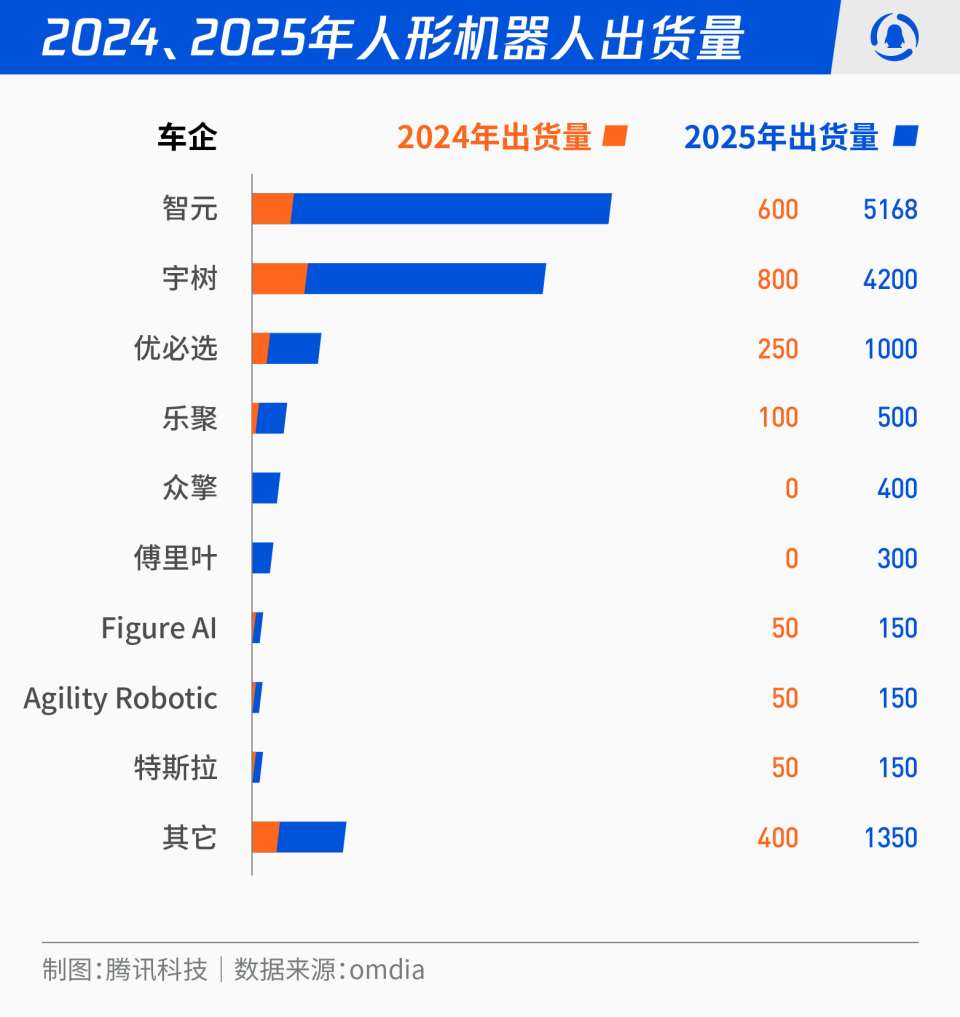
Core Viewpoint - The article discusses the competitive landscape of humanoid robots, highlighting the discrepancies in projected shipment volumes and market share among leading companies, particularly focusing on Yuzhu Technology's response to Omdia's data on humanoid robot shipments for 2025 [1][3][6]. Group 1: Market Data and Company Responses - Yuzhu Technology claims that its actual shipment volume for humanoid robots in 2025 will exceed 5,500 units, countering Omdia's report which listed it at 4,200 units [6][26]. - Omdia's report ranks the top three humanoid robot manufacturers by shipment volume as Zhiyuan Robotics (5,168 units), Yuzhu Technology (4,200 units), and Ubtech (1,000 units) [1][3]. - Counterpoint's data corroborates the market share of the top three companies, with Zhiyuan at 30.4%, Yuzhu at 26.4%, and Ubtech at 5.2% [3]. Group 2: Industry Growth and Challenges - The humanoid robot industry is expected to see a significant increase in shipments, with a total of over 10,000 units projected for 2025, compared to less than 2,000 units in 2024, indicating a substantial year-on-year growth [6][26]. - Despite the optimistic projections, the industry faces challenges, including the fact that over 140 companies are entering the humanoid robot market, with more than 330 products launched, suggesting that many companies have yet to realize substantial production capabilities [6][26]. - The article emphasizes that the humanoid robot sector is still in its early exploratory phase, with many products lacking practical applications beyond entertainment [12][20]. Group 3: Application and Market Perception - The perception of humanoid robots is largely limited to entertainment, such as dancing, which raises concerns about their practical applications in real-world scenarios [8][9]. - Industry experts suggest that while entertainment applications are currently popular, the future of humanoid robots will depend on their ability to perform more complex tasks and integrate into various sectors [12][20]. - The article notes that the current market for humanoid robots is primarily focused on developers and research institutions, with consumer adoption hindered by the lack of "out-of-the-box" usability [18][20]. Group 4: Future Outlook and Production Challenges - The article discusses the ambitious production goals set by companies like Tesla, which aims for 1 million units of its Optimus robot, contrasting this with the current low shipment figures [23][24]. - The industry is characterized by a significant gap between ambitious production targets and actual output, with many companies still struggling with hardware stability and practical applications [26][28]. - The potential for scaling production exists, but it is contingent on market demand and the ability of humanoid robots to solve specific problems effectively [28][29].