
二次开发

Search documents
涛涛车业20230331
2026-04-01 09:59
Company and Industry Summary Company Overview - **Company**: TaoTao Automotive - **Industry**: Electric Low-Speed Vehicles (LSVs), including golf carts and all-terrain vehicles (ATVs) Key Financial Performance - **Revenue Growth**: 32% increase in 2025 - **Profit Growth**: 89% increase in 2025 - **Gross Margin**: Reached 41.48%, the highest in company history - **Net Profit Margin**: 20.73% - **Self-Brand Sales**: Increased from over 60% to approximately 74% [3][3][3] - **Dividend**: Planned dividend of 1.5 CNY per share for 2025, reflecting strong profitability and healthy cash flow [3][3] Market Outlook - **Electric Low-Speed Vehicle Demand**: Strong demand with a target of 200,000 units sold annually in the U.S. [2][4] - **Sales Performance**: Strong sales in Q1 2026, with healthy dealer inventory [2][4] - **Price Adjustments**: Price increase of $100-$300 for main models in March 2026, with no negative impact on sales [2][4][6] Production and Capacity - **Production Focus**: U.S. production to avoid anti-dumping risks, with a planned sales target of 65,000-70,000 units in 2026 [2][5] - **Cost Comparison**: U.S. production costs only about $200 higher than in China [2][5] - **New Product Launches**: Plans to introduce new products, including a dump truck in 2026 and entry into the golf course vehicle market in 2027 [2][5] Competitive Landscape - **Management Experience**: Core management team has nearly 20 years of localized management experience in the U.S. [2][8] - **Production Facilities**: Over 100,000 square meters of production base in the U.S. [8][9] - **Market Competition**: Welcomes competition as it promotes industry growth; plans to introduce higher-end brands to compete effectively [8][9] New Business Ventures - **Robotics and Software Development**: Focus on software and secondary development for robotic products, particularly in the machine dog segment [6][7] - **Commercialization Testing**: Ongoing testing for machine dog rental business, with a focus on finding a viable profit model [11][12] Future Growth Strategies - **Sales Channels**: Strong channel presence through partnerships with major retailers, aiming to diversify product offerings [10][19] - **R&D Investments**: Increased R&D spending planned for 2026 to support product upgrades and new developments [3][19] - **Market Expansion**: Plans to leverage existing brands and channels for new product categories, including AI toys and home tools [10][19] Challenges and Risks - **Currency Fluctuations**: Experienced foreign exchange losses in 2025, impacting profits [3][3] - **Cost Pressures**: Rising raw material costs, but expected to be manageable through price adjustments [14][14] - **Second Growth Curve**: Uncertainty regarding the development of a second growth curve, with a focus on maintaining core business growth [19][19] Conclusion - **Overall Outlook**: The company is positioned for continued growth in the electric low-speed vehicle market, with strong financial performance and strategic plans for product expansion and market penetration. However, it faces challenges related to competition, cost management, and the development of new business lines.

我们不需要100万台“跳舞机器人”
虎嗅APP· 2026-01-31 03:54
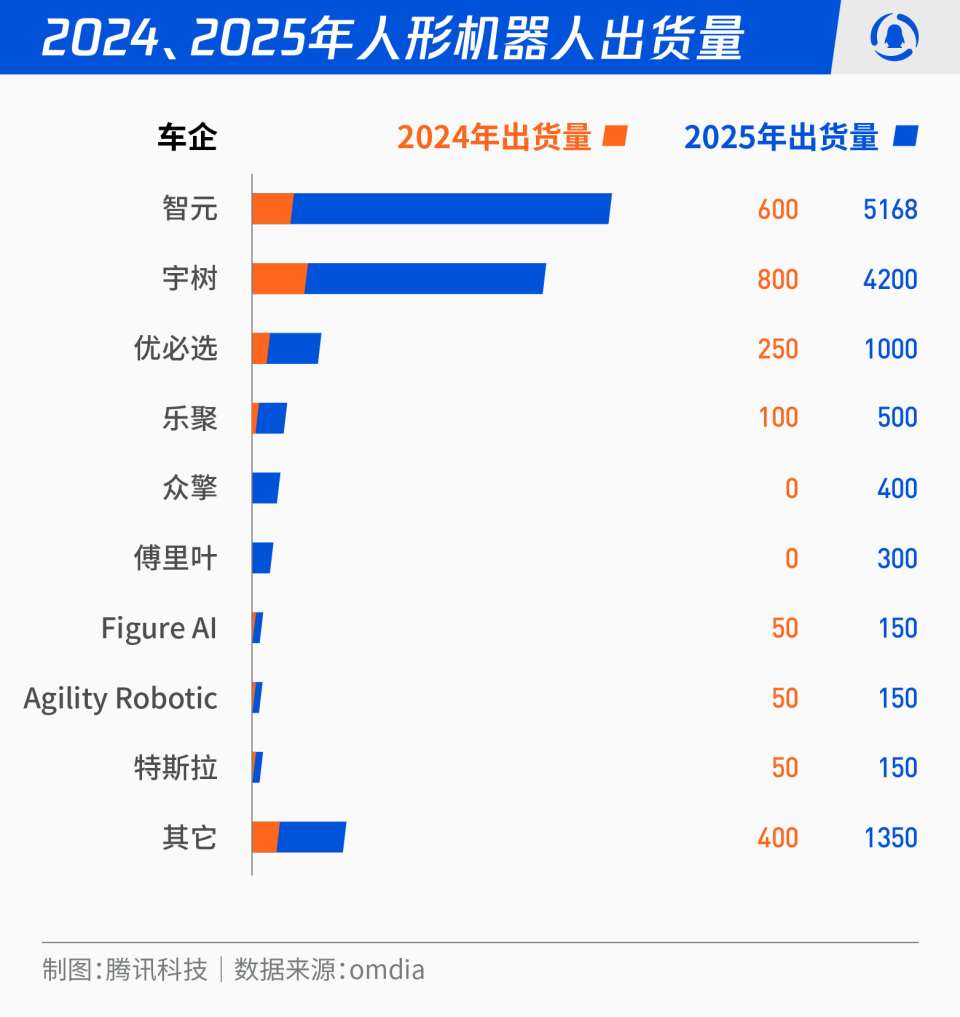
Core Viewpoint - The article discusses the current state and future prospects of humanoid robots, highlighting the discrepancies in projected shipment volumes and the challenges faced by the industry in achieving practical applications beyond entertainment [5][6][12]. Group 1: Market Data and Projections - Omdia's report lists the top three humanoid robot manufacturers for 2025 as Zhiyuan Robotics, Yushu Technology, and Ubtech, with projected shipments of 5168 units, 4200 units, and 1000 units respectively [6]. - Counterpoint's data shows that these three companies hold market shares of 30.4%, 26.4%, and 5.2% in the humanoid robot sector [9]. - Yushu Technology claims its actual shipment volume will exceed 5500 units in 2025, countering external claims of lower figures [12]. Group 2: Industry Challenges - Despite the optimistic projections, the humanoid robot industry is still in its early exploratory phase, with over 140 companies and more than 330 products expected by 2025, indicating a lack of substantial production capacity [12][13]. - The industry faces significant hurdles in application and market acceptance, with many robots currently limited to entertainment functions like dancing, which raises concerns about their practical utility [14][18]. - The need for further development and the high barrier for consumer adoption are evident, as many users report their robots becoming unused after initial excitement [19][20]. Group 3: Development and Innovation - The article emphasizes the importance of product stability and the need for a simplified "proof of concept" (POC) process to enhance deployment efficiency [20][21]. - Current humanoid robots struggle with hardware reliability, often requiring additional support to function properly, which hampers their market readiness [22]. - The potential for humanoid robots to evolve into more functional roles exists, but significant advancements in intelligence and application are necessary for widespread adoption [27][28]. Group 4: Future Outlook - The article suggests that achieving mass production targets, such as the ambitious goal of 1 million units set by Elon Musk for Tesla's Optimus, may be unrealistic in the near term due to existing technological and market challenges [25][28]. - Industry experts believe that the path to scaling production will depend on continuous iteration and improvement of the robots' capabilities, drawing parallels with the electric vehicle industry's growth trajectory [23][27].



我们不需要100万台“跳舞机器人”
3 6 Ke· 2026-01-28 02:56
Core Viewpoint - The article discusses the competitive landscape of humanoid robots, highlighting the discrepancies in projected shipment volumes and market share among leading companies, particularly focusing on Yuzhu Technology's response to Omdia's data on humanoid robot shipments for 2025 [1][3][6]. Group 1: Market Data and Company Responses - Yuzhu Technology claims that its actual shipment volume for humanoid robots in 2025 will exceed 5,500 units, countering Omdia's report which listed it at 4,200 units [6][26]. - Omdia's report ranks the top three humanoid robot manufacturers by shipment volume as Zhiyuan Robotics (5,168 units), Yuzhu Technology (4,200 units), and Ubtech (1,000 units) [1][3]. - Counterpoint's data corroborates the market share of the top three companies, with Zhiyuan at 30.4%, Yuzhu at 26.4%, and Ubtech at 5.2% [3]. Group 2: Industry Growth and Challenges - The humanoid robot industry is expected to see a significant increase in shipments, with a total of over 10,000 units projected for 2025, compared to less than 2,000 units in 2024, indicating a substantial year-on-year growth [6][26]. - Despite the optimistic projections, the industry faces challenges, including the fact that over 140 companies are entering the humanoid robot market, with more than 330 products launched, suggesting that many companies have yet to realize substantial production capabilities [6][26]. - The article emphasizes that the humanoid robot sector is still in its early exploratory phase, with many products lacking practical applications beyond entertainment [12][20]. Group 3: Application and Market Perception - The perception of humanoid robots is largely limited to entertainment, such as dancing, which raises concerns about their practical applications in real-world scenarios [8][9]. - Industry experts suggest that while entertainment applications are currently popular, the future of humanoid robots will depend on their ability to perform more complex tasks and integrate into various sectors [12][20]. - The article notes that the current market for humanoid robots is primarily focused on developers and research institutions, with consumer adoption hindered by the lack of "out-of-the-box" usability [18][20]. Group 4: Future Outlook and Production Challenges - The article discusses the ambitious production goals set by companies like Tesla, which aims for 1 million units of its Optimus robot, contrasting this with the current low shipment figures [23][24]. - The industry is characterized by a significant gap between ambitious production targets and actual output, with many companies still struggling with hardware stability and practical applications [26][28]. - The potential for scaling production exists, but it is contingent on market demand and the ability of humanoid robots to solve specific problems effectively [28][29].

宏润建设:公司持股星际动力60%
Zheng Quan Ri Bao Wang· 2026-01-26 14:13
Group 1 - The company Hongrun Construction (002062) holds a 60% stake in Xingji Power [1] - The CEO and CTO of Xingji Power have been appointed, and the team is currently being assembled [1] - Xingji Power will focus on algorithm optimization and reliability enhancement based on the underlying framework of Matrix Super Intelligence for product market positioning [1]

人形机器人走向大众?宇树科技首发应用商店,行业生态“暗战”浮出水面
Hua Xia Shi Bao· 2025-12-17 04:59
Core Insights - The article discusses the challenges and advancements in the humanoid robot market, particularly focusing on the efforts of companies like Yushu Technology and Zhiyuan Robotics to lower the technical barriers for users [3][9][10] Group 1: Market Demand and User Experience - Many sellers on second-hand platforms are offloading humanoid robots due to high technical barriers, indicating that widespread adoption of humanoid robots in daily life is still a distant goal [3][6] - Yushu Technology has launched its first humanoid robot application store, allowing users without professional knowledge to operate robots, while Zhiyuan Robotics has introduced the "Lingchuang" platform to encourage user participation in robot development [3][6][9] - The current application store from Yushu Technology is in public testing, offering only three actions for its G1 humanoid robot, which reflects the limited initial offerings available to users [5][7] Group 2: Development Platforms and Ecosystem - The development of platforms like Yushu Technology's application store and Zhiyuan Robotics' "Lingchuang" is driven by the market demand for secondary development of humanoid robots [9][10] - The platforms aim to bridge the gap between developers and ordinary users, allowing for easier access to robot programming and customization [9][10] - Experts suggest that the success of these platforms hinges on building a robust ecosystem that combines hardware and software, similar to successful models seen in companies like Apple and NVIDIA [10][11] Group 3: Challenges and Future Outlook - Despite the advancements, the hardware sales of humanoid robots have not reached a critical mass, making the software offerings seem less essential in the current market [11] - The article emphasizes that the primary challenge remains in expanding the user base for humanoid robots, as a larger user base is necessary for a thriving software ecosystem [11]

人形机器人后续行情如何布局?
2025-03-05 05:45
Summary of Human-Robot Industry Conference Call Industry Overview - The conference call focused on the human-robot industry, particularly the outlook for humanoid robots in 2024 and beyond [2][4]. Key Points and Arguments - **Market Expectations for Production**: The market currently anticipates production levels of humanoid robots to be between 5,000 and 10,000 units in 2025, with a target of 100,000 units by 2027. The ability to meet the 100,000-unit target in 2026 is a critical focus [2][4]. - **Impact of Production Rhythm**: The rhythm and scale of humanoid robot production are pivotal for market trends. A downward adjustment in production expectations could lead to a significant market correction [2][3]. - **Investment Focus on Motion Control**: Motion control is identified as a key investment area for 2025, crucial for scaling production from thousands to tens of thousands of units. The market shows high interest in motion control, but there are significant expectation gaps [5][17]. - **Differences in B2B and B2C Applications**: B2B applications prioritize cost and efficiency over universal compatibility, contrasting with B2C applications that require diverse functionalities [6][7]. - **Development Phases**: The humanoid robot industry will evolve through primary development (by original equipment manufacturers) and secondary development (by application developers), similar to mobile app development [8][11]. - **Importance of Local Partnerships**: Companies closely partnered with local manufacturers have a competitive edge in motion control algorithm development, as local firms are more likely to provide necessary API access for software development [9][10]. - **Role of Motion Capture Technology**: Motion capture technology is essential for data collection and training in the early stages of humanoid robot development, with a projected surge in demand for related equipment [13][16]. - **Market Dynamics and Supply Chain**: The supply chain's ability to meet hardware demands is critical for the humanoid robot market's growth. Regular updates on supply chain dynamics will be essential for understanding industry developments [19]. Additional Important Insights - **Anticipated Order Volume**: The demand for motion capture equipment is expected to explode, with projections indicating hundreds to thousands of data points generated daily, reflecting a robust market for training and development [14][15]. - **Investment Opportunities**: The best investment opportunities are anticipated in the secondary development sector, where tailored software applications for specific industry needs can be developed [10][12]. - **Future Trends**: The trajectory of the humanoid robot market will heavily depend on local manufacturers' capabilities and the overall supply chain's readiness to support mass production [17][18].