
人工智能预报模型

Search documents
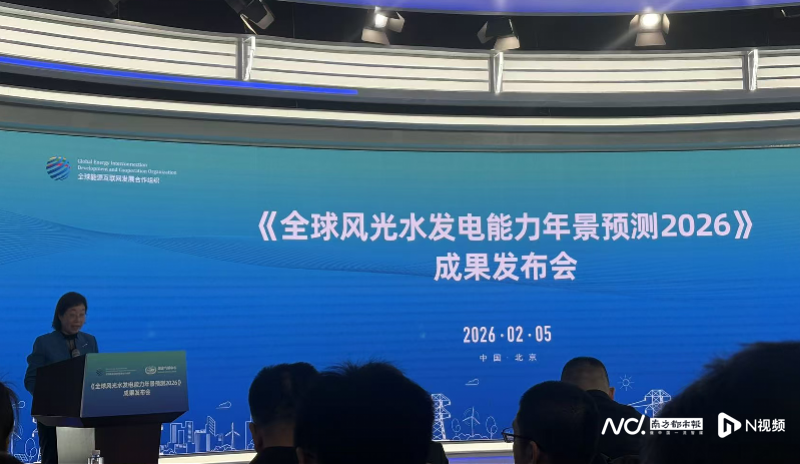
最新报告预测:中国今年光伏发电能力将增25%,风电增2%
Nan Fang Du Shi Bao· 2026-02-05 15:39
Core Viewpoint - The report "Global Wind, Solar, and Hydropower Capacity Forecast 2026" indicates a significant shift towards renewable energy in China's power system, with renewable energy capacity expected to exceed 60% by the end of 2025 [3][5]. Group 1: Renewable Energy Development in China - By 2025, China's newly added renewable energy capacity is projected to reach 440 million kilowatts, accounting for 90% of the country's new power installations and over 60% of the global increase [5]. - The average annual operating hours for wind power in China is expected to decrease by nearly 10% in 2026 compared to 2025, while total generation capacity is anticipated to grow by approximately 2% [7]. - The average annual operating hours for solar power in China is expected to remain stable, with a projected increase in total generation capacity of about 25% [7]. Group 2: Global Renewable Energy Trends - Globally, the report forecasts a slight decrease in average operating hours for wind power to around 2310 hours in 2026, while total generation capacity is expected to increase by over 6% [8]. - For solar power, the global average operating hours are projected to increase slightly to 1340 hours, with total generation capacity expected to rise by approximately 25% [8]. - Hydropower capacity globally is expected to show a steady increase of about 7% in 2026, although regional disparities are significant [9]. Group 3: Strategic Initiatives and Collaborations - The China Meteorological Administration and the National Energy Administration have jointly issued guidelines to enhance the energy meteorological service system, focusing on three key areas: improving monitoring and forecasting, applying meteorological results across the renewable energy chain, and building innovative platforms for technology collaboration [5]. - The integration of meteorological data with energy systems is deemed crucial for ensuring energy security and addressing climate change challenges [3][5].

加快推进气象科技能力现代化 天气预报预测准确率进一步提升
Ren Min Ri Bao· 2026-01-27 02:00
Core Viewpoint - The accuracy of weather forecasting in China has significantly improved, with the lead time for severe convective weather warnings reaching a historical high of 48 minutes, an increase of 10 minutes compared to the "13th Five-Year Plan" period [1] Group 1: Forecasting Accuracy - The 24-hour typhoon path forecast error has been reduced to 58 kilometers, maintaining international leadership [1] - The meteorological department is accelerating the modernization of meteorological technology capabilities to steadily enhance forecasting accuracy [1] Group 2: Observation Network Enhancements - The observation network has been continuously improved, with the launch of 2 Fengyun meteorological satellites and the establishment of 296 new weather radars, 150 ship meteorological stations, and over 50 drifting buoys [1] - The average distance between automatic meteorological stations has been reduced to 9.8 kilometers, contributing to improved observation quality [1] Group 3: Technological Advancements - The accuracy of the Beidou sounding wind measurement has improved to 0.3 meters per second [1] - The Earth system forecasting development strategy has been released, with deep applications of artificial intelligence forecasting models further enhancing forecasting capabilities [1]
“多圈层”的地球系统预报要来了!将怎样改变你的生活?
2 1 Shi Ji Jing Ji Bao Dao· 2025-12-18 11:57
Core Viewpoint - The "Earth System Forecast Development Strategy (2025-2035)" aims to establish an advanced, self-controlled Earth system forecasting system in China by 2035, focusing on eight key tasks to enhance forecasting capabilities across multiple spheres [1][3]. Group 1: Earth System Forecasting vs Traditional Forecasting - Earth system forecasting integrates various spheres (atmosphere, ocean, land, cryosphere, and biosphere) into a cohesive model, contrasting with traditional forecasting that primarily focuses on atmospheric conditions [1][2]. - The new approach utilizes advanced technologies such as numerical models, artificial intelligence, and digital twins to better represent interactions and feedback mechanisms among different spheres, enhancing risk assessment and disaster response capabilities [2][3]. Group 2: Key Technological Breakthroughs Required - Development of a fully coupled Earth system model that integrates atmosphere, ocean, land, cryosphere, biosphere, and socio-economic factors is essential, with a focus on achieving global kilometer-level and regional hundred-meter-level atmospheric modeling [2][3]. - Innovations in artificial intelligence forecasting models are necessary, particularly in the integration of weather and climate models and multi-sphere coupling [2]. - A deep integration of numerical forecasting and artificial intelligence is required to improve forecasting accuracy and computational efficiency [2][3]. Group 3: Digital Infrastructure for Earth System Forecasting - The Earth system digital infrastructure is crucial for high-quality forecasting development, comprising a multi-sphere data foundation, coupled models, and an open data-sharing platform [4][5]. - The data foundation will utilize various observational tools to collect comprehensive data across multiple spheres, supporting research and operational applications [4]. - The coupled models will leverage advanced computational capabilities to accurately simulate past, present, and future states of the Earth system [4][5]. Group 4: Strategic Value and Applications - The strategy aims to enhance forecasting capabilities significantly, improving the precision, richness, and reliability of weather forecasts, which will directly support disaster prevention and mitigation efforts [6][7]. - The expanded forecasting capabilities will empower economic and social development by extending meteorological services to various industries, including low-altitude aviation and transportation [6][7]. - Reliable Earth system forecasting will provide essential scientific support for climate change adaptation and ecological civilization initiatives, aiding in carbon emission assessments and reduction strategies [7].