人才外流

Search documents
科研精英“去美潮”:美国不欢迎,他们去了哪里?
虎嗅APP· 2026-03-13 10:18
Core Viewpoint - The article discusses the impact of the U.S. government's restrictive immigration policies on foreign researchers and international students, highlighting a potential talent exodus from the U.S. and questioning the sustainability of America's technological superiority in the long term [4][24]. Group 1: U.S. Immigration Policies and Their Effects - The U.S. National Institute of Standards and Technology (NIST) has implemented a risk classification policy for foreign researchers, categorizing individuals from countries like China, Russia, and Iran as "high-risk," leading to restricted access to sensitive research areas [4][8]. - The U.S. Department of Education issued a memorandum requiring universities to limit international undergraduate students to no more than 15% and those from any single country to 5%, which signals a shift in the U.S. stance towards international talent [5][6]. - The number of international students in the U.S. dropped by 17% in the fall of 2025 compared to the previous year, resulting in an economic loss of at least $1.1 billion and the loss of 23,000 jobs [6][10]. Group 2: Impact on Young Researchers - Young researchers, particularly those in STEM fields, are facing significant challenges due to funding cuts and hiring freezes at major research institutions like the NIH, with over 10,000 Ph.D. holders leaving the federal research system [13][14]. - The article highlights individual stories of young scientists who have chosen to leave the U.S. for better opportunities abroad, reflecting a broader trend of talent migration away from the U.S. [15][16]. Group 3: International Response and Talent Migration - European countries are actively seeking to attract talent from the U.S., with initiatives like Austria's APART-USA program and the EU's €500 million "Choose Europe" plan aimed at luring international researchers [18][19]. - The article notes that the tightening of immigration policies has led to a reverse migration trend, with more individuals, including U.S. citizens, considering relocation abroad due to factors like violence and political instability [20][22].


美国申请者涌向欧洲著名研究机构
Xin Lang Cai Jing· 2026-02-10 01:53
Core Insights - The surge in applications from American researchers to relocate to Europe indicates a significant brain drain from the U.S. research sector, driven by recent U.S. government policies that have cut funding for scientific research [1][6]. Group 1: Application Trends - The number of applications from U.S. researchers for funding from the European Research Council (ERC) has increased by over 120% in the past year, with funding amounts reaching up to €2.5 million over five years [1][6]. - Applications for senior researcher grants have seen the most significant increase, rising from 23 to 114, nearly a fivefold increase [2][6]. - The overall application numbers for senior grants increased by 31%, but the success rate dropped from 11% to 8% [2][6]. Group 2: Funding and Resource Challenges - The ERC has introduced a long-term "super grant" program with a total budget of €500 million, offering up to €7 million per grant over seven years to attract researchers [4][7]. - There are concerns that Europe may not have sufficient resources to accommodate the influx of new researchers without increasing competition among existing researchers [2][4]. - The ERC has planned a budget of €175 billion for the upcoming "Framework Program 10," but calls for an increase to €220 billion have been made to better support the growing demand for research funding [4][5][7]. Group 3: Implications of U.S. Policies - The increase in applications is seen as a direct consequence of the Trump administration's science policies, which have been perceived as detrimental to academic freedom and funding [6]. - The "Choose Europe for Science" initiative aims to attract U.S. researchers, but its effectiveness has been questioned, indicating a need for more substantial investment in new programs to ensure sustainable talent mobility [5][7].
81岁的任正非,为何仍劝我们别恨美国?还要多用美国的技术和芯片
Sou Hu Cai Jing· 2025-12-07 09:42
Core Viewpoint - Huawei's founder Ren Zhengfei emphasizes the importance of utilizing American technology and talent, advocating for a balanced approach rather than a confrontational stance against the U.S. tech industry [4][6][9]. Group 1: Huawei's Position on U.S. Technology - Ren Zhengfei acknowledges the significant impact of U.S. sanctions on Huawei, leading to a push for "self-reliance" in technology [3][4]. - He argues that the desire for complete domestic substitution of U.S. technology may not be practical, suggesting that leveraging American technology is beneficial for Chinese companies [6][9]. - Ren's perspective reflects a broader sentiment among Chinese citizens who are skeptical of U.S. technology, yet he advocates for a more open and collaborative approach [4][9]. Group 2: Talent Mobility and Globalization - Ren views the migration of top talent to the U.S. as a positive development, as it allows for knowledge and innovation to flow back to China, benefiting the global tech landscape [15][16]. - He highlights that the domestic market in China is large enough to retain talent, reducing the necessity for strict measures to keep talent from leaving [15][16]. - The emphasis is on the importance of continuous learning and growth, regardless of geographical location, which aligns with the global nature of talent mobility [18][20]. Group 3: Strategic Insights for the Future - Ren stresses that true strength comes from openness and learning rather than isolation and resentment towards competitors [18][20]. - He encourages young people to seek opportunities where they can maximize their potential, whether domestically or internationally [18]. - The call for a balanced approach to competition and collaboration suggests a strategic mindset that prioritizes long-term growth over immediate emotional responses [20].

韩民调:大批理工科人才欲“逃离韩国”,薪酬待遇成为主因
Huan Qiu Shi Bao· 2025-11-04 23:00
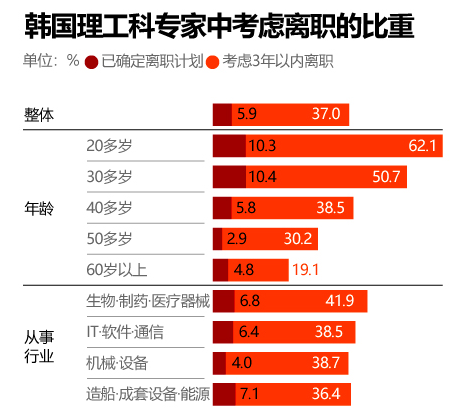
Core Insights - The trend of high-end talent exodus in South Korea's STEM fields is intensifying, driven by dissatisfaction with domestic salary structures and research environments [1][4] - A significant portion of young researchers is considering overseas employment, reflecting a structural imbalance in education and industry that favors medical fields over engineering and technology [1][5] Group 1: Talent Exodus Statistics - 42.9% of surveyed STEM professionals expressed intentions to leave South Korea, with the highest percentage (72.4%) among those in their 20s [1] - Approximately 34,000 STEM professionals have moved abroad from 2013 to 2022, including around 96,000 with master's or doctoral degrees [4] Group 2: Reasons for Outflow - 66.7% of respondents identified salary as the primary reason for considering leaving South Korea, highlighting a disparity in income compared to overseas counterparts [4] - The average time to reach peak salary for overseas professionals is 13 years, while it takes 19 years for South Korean workers [4] Group 3: Research Environment and Job Satisfaction - Satisfaction levels regarding research ecosystems, working conditions, and career advancement opportunities are significantly higher for overseas STEM professionals, with research ecosystem satisfaction being 1.64 times greater than that of South Korean counterparts [4] - The South Korean research environment is criticized for low efficiency and a closed nature, leading many researchers to feel compelled to leave due to inadequate support [4][6] Group 4: Structural Issues and Recommendations - The outflow of STEM talent reflects deeper structural issues in education and industry, with top students often gravitating towards the medical field, resulting in a shortage of innovation talent in engineering [5] - The Bank of Korea suggests reforms including a results-oriented salary system, improved career advancement pathways for master's level researchers, and enhanced collaboration with international research institutions to encourage talent return [6]
美媒:“逆向移民”,非裔美国人去肯尼亚创业
Huan Qiu Shi Bao· 2025-07-29 22:57
Core Viewpoint - The article discusses the phenomenon of reverse migration, where African Americans are relocating to Kenya and other African countries, seeking a sense of belonging and connection to their ancestral roots, driven by the current political climate in the United States [1][2]. Group 1: Migration Trends - Many African Americans, like Kenneth Harris, are moving to Kenya, viewing it as a way to reconnect with their heritage and culture [1]. - The trend includes individuals starting businesses such as travel agencies, restaurants, and farms in Nairobi, indicating a growing community of African Americans in Kenya [1]. - The migration is partly influenced by the perception of a fractured social structure in the U.S., prompting individuals like Austin Hollman to seek a more inclusive environment in Kenya [2]. Group 2: Economic Implications - The influx of African Americans could benefit African economies, particularly in regions that are committed to combating corruption and improving the investment climate [2]. - The United Nations Human Settlements Programme expert, Rafael Obonyo, notes that the U.S. is losing talent and resources, which undermines the narrative of America as a land of dreams and opportunities [2].

75%美研究人员称“正在考虑离开美国”
日经中文网· 2025-04-04 07:34
Group 1 - A survey conducted by "Nature" magazine indicates that 75% of American researchers are considering leaving the U.S. due to increased restrictions on research activities by the Trump administration [1] - Among postdoctoral researchers, approximately 79% are contemplating moving abroad, with Canada and European countries being the most preferred destinations [1] - The Trump administration's policies have led to a significant budget cut of about $3 billion for the National Institutes of Health (NIH), representing a 60% year-over-year decrease [1][2] Group 2 - The U.S. Department of Commerce reported that R&D accounted for 2.3% of the U.S. GDP in 2021, highlighting the importance of public-private collaboration in research [2] - Research funding for universities has been significantly impacted, with institutions like Harvard halting new faculty hires and the University of Pennsylvania reducing graduate student admissions [2] - Strict immigration policies are likely to exacerbate talent outflow, as evidenced by the arrest of a Turkish student and a Russian researcher due to visa issues related to their activities [3]