
代际泡沫

Search documents
白银暴跌之后又暴涨,贵金属上涨潮卷土重来
Zhong Guo Ji Jin Bao· 2025-12-30 23:26
Core Viewpoint - Recent fluctuations in silver prices have been extreme, characterized by significant drops followed by rapid recoveries, with silver prices rising above $74 per ounce after a notable decline [1] Group 1: Market Dynamics - Silver prices experienced a dramatic drop of 9% in the previous trading session, attributed to increased margin requirements and technical indicators signaling an overheated market [1] - Analysts suggest that the recent sell-off was primarily driven by technical factors, including profit-taking after a rapid increase in precious metals prices and forced deleveraging among leveraged long positions [1] - The structural conditions supporting the recent price increase, such as a weaker dollar and ongoing geopolitical uncertainties, remain intact, indicating potential for renewed buying interest [1] Group 2: Analyst Insights - Tony Sycamore from Sydney IG noted that the initial surge in silver prices was likely triggered by stop-loss orders, price volatility, panic buying, and increased margin requirements from the CME, but lacked sustained buying momentum at high levels [2] - Despite the recent cooling in precious metals, the overall trend may not be over, as supply gaps, stockpiling by countries, and export restrictions persist [2] Group 3: Geopolitical and Economic Factors - Geopolitical tensions, particularly between Russia and Ukraine, have intensified, impacting the outlook for peace agreements and contributing to market volatility [3] - Some exchanges have raised margin requirements for COMEX silver futures, forcing some speculators to reduce positions or liquidate holdings due to the inability to meet additional margin calls [3] - Despite recent pullbacks, gold and silver are on track for their strongest annual performance since 1979, supported by strong central bank purchases, continued inflows into exchange-traded funds (ETFs), and a series of interest rate cuts by the Federal Reserve [3] - Reports indicate that the current rise in silver prices is being shaped by real physical shortages, with factors such as supply restrictions driven by policy and increased inventory concentration playing a significant role in price determination [3]
马斯克:白银暴涨可不是什么好事
3 6 Ke· 2025-12-30 01:21
Core Viewpoint - Silver prices have reached historic highs, with significant increases attributed to geopolitical risks, supply shortages, and expectations of future interest rate cuts by the Federal Reserve [1][3][7]. Price Movement - In December, silver prices surged, exceeding $83 per ounce, marking a rise of over 180% from $29 per ounce at the beginning of 2025 [1][3]. - As of the latest report, silver is priced at $81 per ounce, continuing a six-day upward trend [1]. Supply and Demand Dynamics - The global silver market has been in a structural deficit for five consecutive years, with physical inventories rapidly depleting [3]. - In 2025, global silver demand is projected to reach 1.24 billion ounces, while supply is only expected to be 1.01 billion ounces, resulting in a supply gap of 100 to 250 million ounces [3]. Industrial Concerns - Elon Musk has expressed concerns regarding the rising silver prices, indicating that it could negatively impact industrial development, as silver is essential in various manufacturing processes [4][5]. - Silver is increasingly used in sectors such as electrification, solar panels, electric vehicles, and data centers, all of which are experiencing growing demand [5]. Market Sentiment - Analysts are divided on the future of silver prices, with some optimistic about prices potentially exceeding $100 per ounce next year, while others warn of a possible correction due to overvaluation [8]. - Concerns about market liquidity and the potential for a rapid decline in precious metal prices have been raised by various analysts [8]. Regulatory Environment - A significant portion of accessible silver is stored in New York, pending investigations by the U.S. Department of Commerce regarding national security risks associated with key mineral imports, which could lead to tariffs or trade restrictions [7].

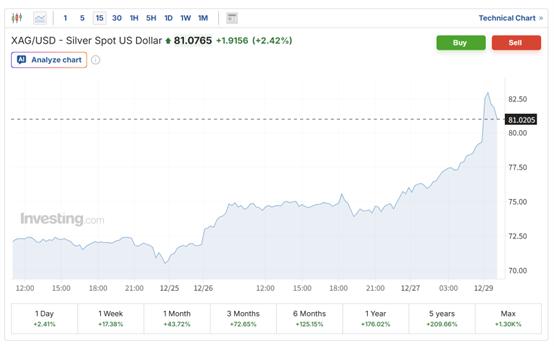
白银价格又双叒叕创新高,马斯克疾呼:这可不是什么好事
Feng Huang Wang· 2025-12-29 01:15
Core Viewpoint - Silver prices have reached historic highs, with significant implications for downstream manufacturers due to supply shortages and rising demand for industrial applications [1][4]. Price Movement - In December, silver prices surged, exceeding $83 per ounce, marking a continuous increase for six consecutive trading days, with a current price of $81 per ounce [1]. - The price of silver was only $56 per ounce at the beginning of December and $29 per ounce at the start of 2025, indicating a year-to-date increase of approximately 180% [3]. Supply and Demand Dynamics - The global silver market has been in a structural deficit for five consecutive years, with physical inventories rapidly depleting and major exchange stock levels significantly declining [3]. - In 2025, global silver demand is projected to reach 1.24 billion ounces, while supply is expected to be only 1.01 billion ounces, resulting in a supply gap of 100 to 250 million ounces [3]. Industrial Applications - Silver is essential in various industrial processes, including electrification, solar panels, electric vehicles, and data centers, all of which are experiencing growing demand [5]. Market Sentiment - Analysts are divided on the future of silver prices, with some optimistic about prices potentially exceeding $100 per ounce next year, while others warn of a potential correction due to overvaluation [8]. - Concerns have been raised about the rapid increase in precious metal prices being driven by insufficient market liquidity, which could lead to a swift decline [8]. Geopolitical Factors - Geopolitical risks and expectations of further interest rate cuts by the Federal Reserve in 2026 have bolstered demand for safe-haven assets like silver [3][7]. - The availability of silver is also influenced by ongoing investigations into the national security risks of key mineral imports, which may lead to tariffs or trade restrictions [7].
