
伊核协议谈判

Search documents
伊朗:已同意“永远不再拥有可制造核武器的核材料”
Xin Lang Cai Jing· 2026-02-28 01:40
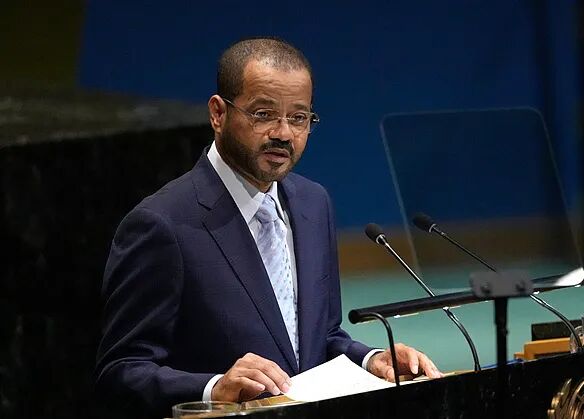
Group 1 - The core point of the article is that Iran has agreed not to possess nuclear materials that can be used to manufacture nuclear weapons, marking a significant breakthrough in negotiations [1][3] - The new key provision in the negotiations is that Iran will achieve "zero accumulation, zero stock," and will accept comprehensive verification by the International Atomic Energy Agency (IAEA) [1] - Existing nuclear stockpiles will be diluted to minimal natural levels and converted into irreversible nuclear fuel, shifting the focus from uranium enrichment debates to stockpiling issues [1] Group 2 - The negotiations are described as having made substantial progress, with the potential for a peace agreement being within reach [3] - The timeline for implementing key issues such as stockpile management, verification mechanisms, access arrangements, and oversight measures is estimated to be around three months if negotiations proceed smoothly [3] - The third round of indirect negotiations between the U.S. and Iran took place in Geneva, facilitated by Oman, with significant advancements reported [3]

【原油点评】美国或打击伊朗,假期油价上行
Xin Lang Cai Jing· 2026-02-23 09:23
Core Viewpoint - Oil prices have continued to rise during the Spring Festival, driven by a significant drop in U.S. crude and refined oil inventories and geopolitical tensions, particularly between the U.S. and Iran [3][14]. Group 1: Oil Price Movements - Brent crude futures increased by 4.1%, surpassing the $70 mark, while WTI crude rose over 4%, exceeding $65 [3][14]. - The EIA reported a week-on-week decrease in crude oil inventories by 9.014 million barrels, gasoline inventories by 3.213 million barrels, and distillate inventories by 4.566 million barrels [3][14]. Group 2: U.S.-Iran Negotiations - The second round of negotiations between the U.S. and Iran on February 17-18 ended in a deadlock, with no consensus on key issues [3][14]. - Following the failed negotiations, the U.S. issued an ultimatum on February 19, indicating potential military action if an agreement was not reached [3][14]. - Reports suggest that the U.S. may conduct military strikes against Iran on February 23 or 24, with intentions for a larger military campaign in the following months to compel Iran to comply with U.S. demands [3][14]. Group 3: Historical Context of U.S.-Iran Relations - The U.S. withdrew from the Iran nuclear deal in May 2018, leading to renewed sanctions against Iran and a significant deterioration in diplomatic relations [15][16]. - Diplomatic relations have gone through three phases, with the Biden administration attempting to restart indirect negotiations, which have faced fundamental disagreements [16][15]. Group 4: Supply Dynamics - OPEC's monthly report indicated a decrease in production by 135,000 barrels per day in January, primarily due to declines in Iran and Venezuela's output [19]. - Venezuela's production fell by 87,000 barrels per day, attributed to U.S. sanctions affecting its exports and oil field operations [19]. - The EIA projects that Venezuela's production could recover to around 1 million barrels per day in the second quarter, contingent on the easing of sanctions [19].

集运指数(欧线):高位震荡,10-12反套、10-02反套轻仓持有
Guo Tai Jun An Qi Huo· 2025-07-21 01:47
Report Investment Rating - No specific investment rating for the industry is provided in the report. Core Viewpoints - The container shipping index (European Line) is expected to experience high-level fluctuations. It is recommended to hold the 10 - 12 and 10 - 02 reverse spreads lightly. [1][9] - The 2508 contract's performance is influenced by Maersk's freight rates. Depending on different scenarios, its delivery settlement price may fall within different ranges. [8] - The 2510 contract is in the traditional off - season for the European Line. The market's fundamental trading logic is to short on rallies, but in the short term, it may show high - level fluctuations due to factors such as concentrated short positions and market sentiment. [9] Summary by Relevant Catalogs 1. Futures Market Data - **Contract Prices and Changes**: The EC2508 contract closed at 2,265.9 points, up 5.80%; EC2510 closed at 1,613.0 points, up 1.55%; EC2512 closed at 1,791.0 points, up 2.22%. Over the past week, the main 2510 contract rose 16.7% and added 22,398 lots; the secondary main 2512 contract rose 16.2% and added 2,131 lots; the near - month 2508 contract rose 235.3 points and reduced 13,984 lots. [1][6] - **Volume and Open Interest**: The trading volume and open interest of different contracts showed different trends. For example, the trading volume of EC2510 was 68,673, and its open interest was 51,371, with an increase of 1,346 in open interest. [1] 2. Freight Rate Index - **SCFIS and SCFI**: The SCFIS for the European route was 2,421.94 points, up 7.3% week - on - week; the SCFIS for the US West route was 1,266.59 points, down 18.7% week - on - week. The SCFI for the European route was $2,079/TEU, down 1.0% bi - weekly; the SCFI for the US West route was $2,142/FEU, down 2.4% bi - weekly. [1] - **Spot Freight Rates**: In late July, MSC and Yang Ming slightly decreased their rates, while other shipping companies' FAK remained stable. In August, ONE's offline rates remained the same, and the OA Alliance and MSC may announce rate increases. [7] 3. Shipping Capacity - **Weekly and Monthly Average Shipping Capacity**: Data on weekly and monthly average shipping capacities from China to European basic ports are presented, but specific analysis is not provided in the report. Future sailings may be dynamically adjusted, and the pending voyages in September are not included in the shipping capacity statistics. [4] 4. Market Fundamentals - **Cargo Volume**: Benefiting from the strong FOB cargo volume, shipping companies' loading conditions at the end of July were optimistic, and the cargo volume at the beginning of August still had support. However, on a monthly basis, August is likely to see an increase in supply and a decrease in demand, but the inflection point of cargo volume is unclear. [8] - **Contract Analysis**: Different scenarios for the 2508 contract's delivery settlement price are analyzed based on Maersk's freight rates. For the 2510 contract, due to it being in the off - season, the fundamental trading logic is to short on rallies, but short - term high - level fluctuations are expected. [8][9] 5. Macro News - **Geopolitical Events**: A new round of cease - fire negotiations in Gaza is expected to reach an agreement within two weeks. The Israeli military issued an evacuation warning and will launch a ground offensive in Deir al - Balah in central Gaza. Iran agreed to hold a new round of negotiations with three European countries on the nuclear issue. [5][6]
美国和伊朗第六轮会谈将于13日或15日举行
news flash· 2025-06-09 21:24
Core Viewpoint - The sixth round of talks between the United States and Iran is scheduled to take place on June 13 in Oslo, Norway, or on June 15 in Muscat, Oman, marking a significant step in diplomatic efforts following the U.S. withdrawal from the Iran nuclear deal in May 2018 [1]. Group 1 - The first round of indirect talks occurred on April 12 in Muscat, Oman, representing the first formal negotiations since the U.S. exited the nuclear agreement [1]. - A total of four rounds of indirect negotiations have taken place since the initial meeting [1].
伊朗总统:伊朗对谈判态度认真 但不会接受销毁全部核设施
Xin Hua She· 2025-05-12 10:34
Core Points - Iran's President Pezeshkian stated that Iran is serious about negotiations with the U.S. but will not accept the complete destruction of its nuclear facilities [1] - Iran assures it will not develop nuclear weapons but emphasizes the need for nuclear energy for peaceful purposes in various sectors [1] - The Iranian Foreign Minister Araghchi described the fourth round of indirect talks with the U.S. as more serious and candid compared to previous rounds, focusing on detailed issues [1] - The discussions have led to a better understanding of each other's positions, with both sides moving closer together despite challenges [1] - The Omani Foreign Minister Badr mentioned that the fourth round of talks in Muscat resulted in some beneficial and original ideas [1] Summary of Related Events - The first round of indirect talks between Iran and the U.S. took place on April 12 in Muscat, marking the first formal negotiations since the U.S. unilaterally withdrew from the Iran nuclear deal in May 2018 [2] - Two additional rounds of indirect talks were held on April 19 and April 26 [2]