低成本精确制导弹药

Search documents
军工与新材料行业每周研究汇总
2025-11-16 15:36
Summary of Military Industry and New Materials Weekly Research Report Industry Overview - The military industry in China is experiencing a fluctuating upward trend in 2025, with a year-to-date increase of 14.63% from January to October, although it underperformed compared to the Shanghai Composite Index by 4.64 percentage points [1][3] - Public fund holdings in the military sector have significantly increased, indicating growing institutional interest [1][3] Financial Performance - From Q2 2025 onwards, revenue and net profit have shown a clear year-on-year recovery, with overall revenue growth of 16.99% and net profit up by 14.01% [1][4] - Various sub-sectors are showing signs of bottom recovery, with notable growth in defense information technology (73.6%), aviation (26%), aerospace (21%), shipbuilding (26.14%), and commercial aerospace (14.84%) [1][4] - Profit growth is evident in several sub-sectors, including ground weaponry (110%), aerospace (106%), and defense information technology (3.98%) [1][4] Industry Dynamics - The midstream sector saw a slight increase of 6%, with subsystem revenue growing by 73.77% and downstream machinery increasing by 25.7% [5] - Downstream machinery and midstream subsystems experienced significant net profit growth of 48.92% and 89.71%, respectively [5] - The upstream electronic components and chips saw a reduction in profit decline from -40% to -1.75% [5] Geopolitical Context - The long-term strategic situation between China and the U.S. remains unchanged, with the U.S. defense budget reaching a record high of $1.01 trillion for FY 2026, a 13% increase [6] - The European Union's defense spending is also on the rise, reaching €800 billion [6] - Geopolitical uncertainties are increasing, and China is expected to maintain a high defense budget during the 15th Five-Year Plan, outpacing overall GDP growth [6] Strategic Directions - The core direction of domestic military construction is "building a system," transitioning from platform-to-platform to system-to-system, emphasizing cross-domain collaboration to create asymmetric advantages [1][7] - The 93rd National Day parade showcased advanced weapon systems, including hypersonic weapons, nuclear strike capabilities, air defense systems, and AI-enabled unmanned systems [1][7] Military Trade and Global Market - The military trade market in China is poised for growth, particularly after the 2025 India-Pakistan conflict, which validated China's weaponry capabilities [2][11] - China has developed comprehensive military product research and development capabilities, with an increasing share in the global military trade market, expected to rise post-2025 [2][12] Civilian Applications of Military Technology - The "military-civilian integration" strategy is crucial for expanding enterprise scale, with emerging industries such as commercial aerospace, low-altitude economy, and deep-sea technology expected to create trillion-level market opportunities [2][13] - Military new materials are rapidly gaining traction in the consumer electronics sector, with significant demand growth noted [2][15] Emerging Material Trends - Superhard materials, particularly diamond, are gaining attention for their thermal conductivity and potential applications in military observation windows and nuclear fusion [16] - Ceramic matrix composites are becoming essential in aerospace engines, gradually replacing some high-temperature alloys due to their superior heat resistance [18] Future Development Landscape - The military industry is transitioning from a single domestic demand model to a three-pronged growth strategy: domestic demand foundation, expanding military trade, and civilian technology spillover [19][20] - This new structure is reshaping the military industry landscape and significantly enhancing growth potential [19][20]
高层会议首次提出“航天强国”,军工ETF龙头(512680)盘中冲高涨超2%,成分股航天智装20cm涨停,中国卫星、航天科技10cm涨停
Xin Lang Cai Jing· 2025-10-24 05:15
Group 1 - The 20th Central Committee's Fourth Plenary Session emphasizes the concepts of "a strong aerospace nation" and "a strong transportation nation," highlighting the importance of advanced manufacturing as the backbone of a modern industrial system [1] - The session is expected to build on the achievements of the 14th Five-Year Plan, focusing on the goal of military modernization by 2035, with a specific target set for the centenary of the People's Liberation Army in 2027 [1] - The successful launch of 12 low-orbit satellites using the Long March 8 rocket marks a significant step in China's satellite internet construction, indicating a shift towards regular deployment and accelerated progress in low-orbit constellation networking [1] Group 2 - The military industry is experiencing three major growth trends: domestic demand driven by low-cost precision-guided munitions and unmanned systems, accelerated construction of an informationized and intelligent combat foundation, and a potential surge in military trade demand due to regional conflicts [2] - The military ETF sector has shown strong performance, with the China Securities Military Industry Index rising by 2.16%, and key stocks such as Aerospace Intelligence and China Satellite reaching their daily limit [2] - The leading military ETF has seen significant growth in scale, with an increase of 49.45 million yuan over the past two weeks, and a total inflow of 412 million yuan over the last ten trading days [2]

军工ETF(512660)近20日净流入超21亿元,规模居同类第一,回调或可布局
Mei Ri Jing Ji Xin Wen· 2025-10-23 07:31
Group 1 - The seventh Tianjin General Aviation Expo focuses on low-altitude economy and breakthroughs in domestic helicopter technology, showcasing the Z-20T assault helicopter for the first time, demonstrating the multi-mission capabilities of domestic helicopters [1] - The exhibition established a low-altitude economy display area, promoting the signing of 21 key projects covering the entire chain of research, manufacturing, and operation, highlighting the investment potential in the low-altitude economy and the all-domain combat capabilities of domestic helicopters [1] - The military industry is exhibiting three growth curves: domestic demand driven by low-cost precision-guided munitions and unmanned systems; accelerated construction of an informationized and intelligent combat foundation; and military trade demand potentially exploding due to the India-Pakistan conflict [1] Group 2 - The military industry is transitioning from a phase of "increased volume and price" to "increased volume and stable price," shifting focus from "platform volume" to "building systems, addressing shortcomings, and going global," with a focus on AI-enabled intelligent combat foundations, low-cost precision-guided munitions, and unmanned systems [1] - The military ETF (512660) tracks the CSI Military Industry Index (399967), which selects listed companies in aviation, aerospace, shipbuilding, weaponry, and military electronics from the Shanghai and Shenzhen markets to reflect the overall performance of China's military industry listed companies [1] - The index constituents exhibit a small and medium-cap style, primarily focusing on the aviation equipment and military electronics sectors [1]
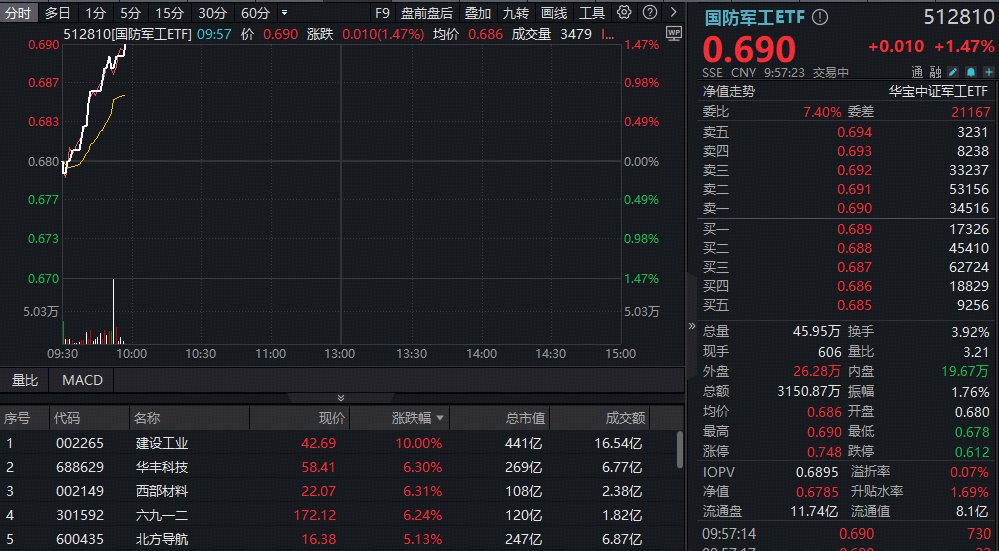
ETF盘中资讯|八一临近,国防军工ETF冲高1.47%,建设工业涨停!机构:关注三条投资主线
Sou Hu Cai Jing· 2025-07-28 02:17
Group 1 - The defense and military industry sector is experiencing active performance, with the China Securities Military Industry Index constituents showing significant gains, including a limit-up for Construction Industry and over 6% increases for several other stocks [1] - The "August 1" defense military ETF (512810) saw a rapid price increase of over 1%, with real-time transactions exceeding 31 million yuan [2] - The upcoming August 1 Army Day and the approaching September 3 military parade are expected to increase attention on the defense and military sector [1][4] Group 2 - As of July 25, 2025, several listed companies have reported their semi-annual results, showing structural characteristics with strong performance in segments like shipbuilding and low-cost precision-guided munitions [4] - The military electronics sector is performing well from an upstream perspective, and the defense industry is anticipated to enter a performance realization phase in the second half of 2025 due to personnel adjustments and institutional reforms [4] - Investment recommendations focus on three main lines: building systems with AI-enabled intelligent combat bases, addressing shortcomings in low-cost and intelligent sectors, and promoting companies with high military trade ratios [4] Group 3 - The "August 1" defense military ETF (512810) is highlighted as an efficient investment tool that covers various popular themes, including commercial aerospace, deep-sea technology, military AI, low-altitude economy, and large aircraft [4]