低波动资产

Search documents
高风险、高收益的背后:看得见的高收益,吃不到的财富自由
雪球· 2025-12-23 13:01
Core Viewpoint - The article emphasizes that high volatility assets, often perceived as high return opportunities, can lead to significant losses for most investors due to behavioral biases and misjudgment of risk tolerance [5][6][10]. Group 1: High Volatility and Its Illusion - High returns from high volatility assets are statistical results predicated on investors holding their positions throughout market fluctuations [8]. - Most investors struggle to maintain their positions during downturns, often selling at losses due to fear and emotional decision-making [9][10]. - The reality is that high volatility leads to high perceived returns, but for ordinary investors, it often results in low or negative actual returns [10]. Group 2: Misjudgment of Risk Tolerance - Investors frequently misjudge their risk tolerance, believing they can handle high volatility when they cannot [12]. - True risk tolerance is determined by how much loss can cause emotional distress, not just by the maximum potential loss [12]. - This misjudgment can lead to significant investment errors, where investors take on more risk than they can handle, ultimately leading to panic selling [12]. Group 3: Wisdom of Low Volatility - Low volatility assets, such as high-quality fixed income and dividend-paying stocks, may offer lower annual returns (5%-8%) but are easier for investors to hold through market fluctuations [14]. - The power of compounding is more effective with stable investments, as consistent returns over time can lead to significant growth [14]. - Low volatility investments align better with human behavior, allowing for reasonable returns even amidst anxiety and mistakes [14]. Group 4: Choosing Low Volatility and Low Returns - The choice between high volatility with low returns and low volatility with low returns reflects a conscious decision; the latter ensures a more stable investment journey [16]. - It is recommended that most investors limit their equity exposure to 50% or less, with conservative investors keeping it below 20% [16]. - The article concludes that abandoning the pursuit of short-term high returns in favor of matching investments to one's risk tolerance is crucial for long-term success [17].


红利低波迎“源头活水” ,关注红利低波动ETF(563020)、恒生红利低波ETF(159545)等长期投资价值
Mei Ri Jing Ji Xin Wen· 2025-12-12 04:50
Core Insights - The Financial Regulatory Bureau has announced adjustments to the risk factors for insurance companies, lowering the risk factor for stocks held over three years in the CSI 300 Index and the CSI Low Volatility 100 Index from 0.3 to 0.27, and for stocks listed on the Sci-Tech Innovation Board held over two years from 0.4 to 0.36 [1] Group 1 - The adjustment is expected to alleviate capital pressure on insurance companies, theoretically bringing in long-term market funds in the range of hundreds of billions [1] - The lowered risk factors are anticipated to enhance the solvency adequacy ratio of insurance companies, thereby releasing incremental funds for investment [1] - High dividend, low volatility assets are becoming a favorable solution for insurance capital allocation, especially in the context of the new accounting standards [1] Group 2 - The encouragement of "long money, long investment" is likely to lead to a continuous influx of capital into the low volatility dividend sector [1] - Investors can conveniently allocate related assets through index investment tools such as ETFs [1] - E Fund is currently the only fund company that implements low fee rates for all dividend ETFs, with management fees for its products set at 0.15% per year [1]
全球长期资本加速涌入,港股红利资产配置价值凸显
Sou Hu Cai Jing· 2025-07-14 05:39
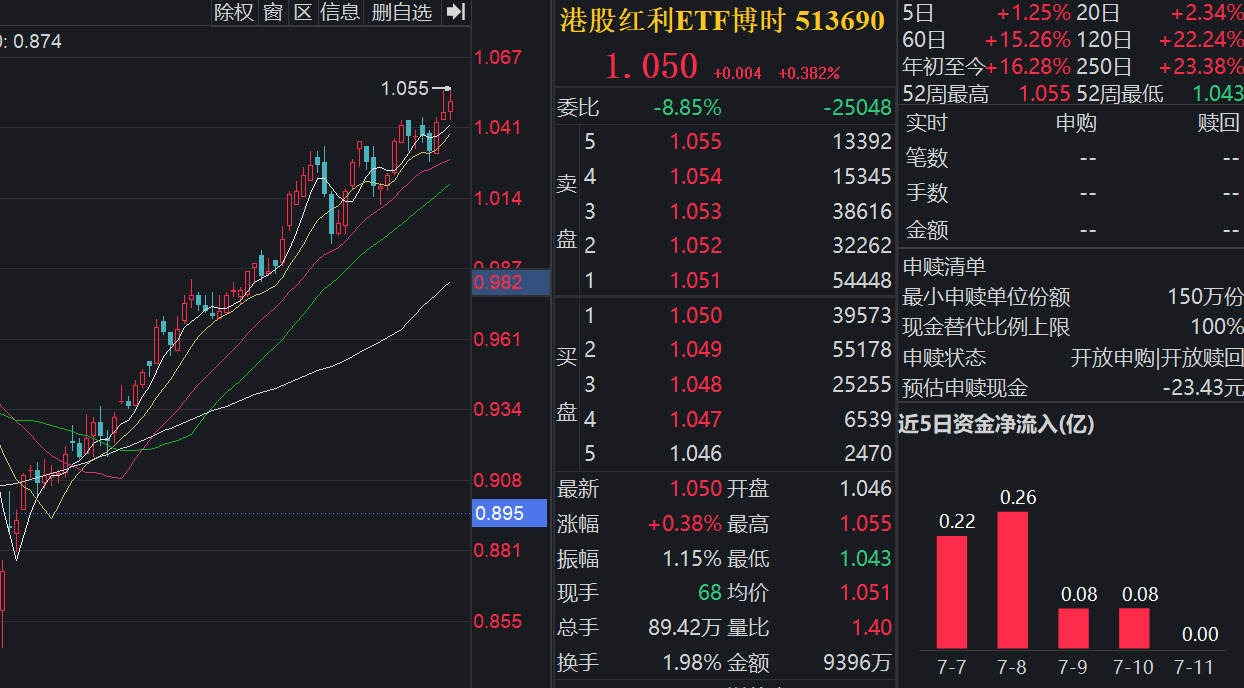
Group 1 - The banking sector has seen a significant rise, with stocks like Guiyang Bank and Minsheng Bank increasing by over 4% and 3% respectively, contributing to the overall positive performance of related ETFs [3] - The Hong Kong Dividend ETF Bosera (513690) experienced a 0.38% increase, with a trading volume of 93.96 million and a net inflow of 64 million over the past four days [1][2] - Foreign long-term funds are actively investing in Chinese equity assets, with notable investments such as a $50 million allocation by a German pension fund through a Hong Kong asset management firm [1][3] Group 2 - Southbound funds have net bought over 3 billion HKD, indicating strong foreign interest in Hong Kong stocks, particularly in the banking sector [4] - Analysts predict that the high dividend yield of bank stocks, which is expected to increase by 0.3-0.62 percentage points by early August 2024, will support continued upward trends in the banking sector [4][5] - The banking sector is viewed as a potential "new darling" for investors due to favorable policies and the increasing allocation of insurance funds to A-shares [5][6] Group 3 - The valuation of bank stocks remains low, with a price-to-book ratio of approximately 0.6, and dividend yields ranging from 4% to 7%, significantly higher than the 10-year government bond yield of 1.8% [6] - The recent surge in A-share bank stocks is attributed to improved macroeconomic expectations and a reduction in asset quality concerns [5][6] - The Hong Kong Dividend ETF Bosera saw a growth of 750,000 shares on July 14, with a net inflow of approximately 9.3 million HKD [6]