低淘汰)

Search documents
大摩交易员:“AI恐惧”可能已到达顶峰,如果没有,那么买HALO吧
Hua Er Jie Jian Wen· 2026-02-25 06:52
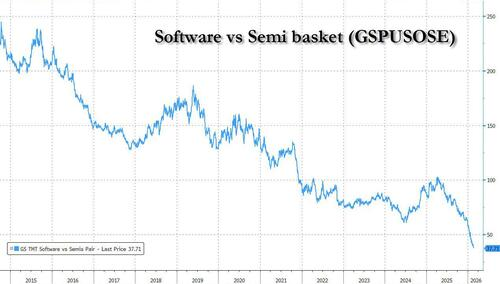
Core Insights - The market's fear regarding AI disrupting traditional industries may have peaked, with "HALO" trades (heavy assets, low obsolescence) being the best hedge for investors still concerned about AI impacts [1][8] Group 1: Market Sentiment and AI Impact - The recent briefing by AI company Anthropic indicated a preference for "cooperation" between AI and existing software providers, contrasting previous fears of complete replacement, leading to a rebound in previously shorted software stocks [1][7] - Despite the S&P 500 index remaining stable since late October last year, extreme fund flows have caused unprecedented internal market divergence, with significant capital inflows into AI beneficiaries and semiconductor sectors while indiscriminately selling software assets [1][4] Group 2: Stock Market Dynamics - The divergence in stock performance has been extreme, with growth and value stocks experiencing a 24% return difference, and the S&P 500's technology and consumer discretionary sectors facing an 11% decline [4] - Defensive and cyclical sectors have seen significant gains, with industrials up 13%, consumer staples up 16%, materials up 22%, and energy up 25% during the same period [4] Group 3: Fund Flows and Positioning - Hedge funds have significantly increased their exposure to semiconductor and AI-related stocks, reaching the highest levels since 2020, while infrastructure software has been the most sold theme, dropping to the 0th percentile since 2020 [7] - Following the Anthropic briefing, there was a reassessment of extreme positions, with software stocks previously labeled as "at risk from AI" rebounding approximately 5% [7] Group 4: HALO Strategy - For investors who believe the "AI fear" has not peaked, Morgan Stanley recommends investing in HALO assets, which are characterized by high production capacity and low obsolescence [8][10] - The HALO basket has risen 28% over the past year, while stocks affected by AI disruption have fallen 43%, indicating a significant attractiveness of this strategy [10]