HALO(重资产

Search documents
研究所日报-20260311
Yintai Securities· 2026-03-11 02:56
Report Industry Investment Rating - Goldman Sachs reaffirmed its "Overweight" stance on the Chinese stock market [11] Core Viewpoints - A-shares will continue to outperform H-shares until global geopolitical and AI disruption concerns subside due to their higher Sharpe ratio and lower global market beta [11] - China is less sensitive to oil price shocks than other emerging Asian market peers, but high oil prices may lead to a 20% decline in the fair value of the Chinese stock market [11] - The "Two Sessions" policy signals are in line with market expectations, and the fiscal policy will remain expansionary this year [12] - AI is the most concerned investment theme, and China's AI has potential economic benefits [13] - Driven by AI, "going global", and "anti-involution", corporate profit growth may accelerate to about 14% in 2026 [14] Summary by Related Catalogs Macroeconomic Data - In the first two months of 2026, China's total value of goods trade imports and exports was 7.73 trillion yuan, with a year-on-year growth rate of 18.3%. Exports were 4.62 trillion yuan, a year-on-year increase of 19.2%; imports were 3.11 trillion yuan, a year-on-year increase of 17.1%; the trade surplus was 1.50349 trillion yuan [2] - The 10-year Treasury bond yield dropped 0.38BP to 1.803%, and DR007 dropped 0.73BP to 1.440% [4] - The US dollar index closed at 98.94, up 0.23% slightly, and the offshore US dollar to offshore RMB exchange rate was 6.8813, down 0.09% [5] A-share Market - On March 10, the A-share market showed a general upward trend. The ChiNext Index led the gains with a rise of 3.04%, and small and medium-cap indexes such as CSI 2000 and STAR 50 were active. The Shanghai and Shenzhen 300 Index rose 1.28%. The market turnover was 2.42 trillion yuan [3] - The communication and electronics sectors were strong, with increases of 4.32% and 3.41% respectively. The machinery and equipment, building materials, and pharmaceutical and biological sectors also had high increases. The energy and raw material sectors had large declines, with the petroleum and petrochemical sector dropping 5.14% and the coal sector dropping 3.11% [3] - The A-share total market value was 115.48 trillion yuan, an increase of 6.73 trillion yuan compared with the beginning of the year. The cumulative turnover this year was 111.56 trillion yuan, with an average daily turnover of 272.0893 billion yuan [20] Global Market - Asia-Pacific and European markets generally rose. The South Korean Composite Index rose 5.35%, the Nikkei 225 Index rose 2.88%, and the German DAX and French CAC40 Indexes both rose more than 1.7%. The Hang Seng Index rose 2.17%, and the Nasdaq Golden Dragon China Index rose 1.96%. The US stock market was weak, with the Nasdaq Index rising slightly by 0.01%, and the Dow Jones Industrial Index and S&P 500 Index falling 0.07% and 0.21% respectively [3]
大摩交易员:“AI恐惧”可能已到达顶峰,如果没有,那么买HALO吧
Hua Er Jie Jian Wen· 2026-02-25 06:52
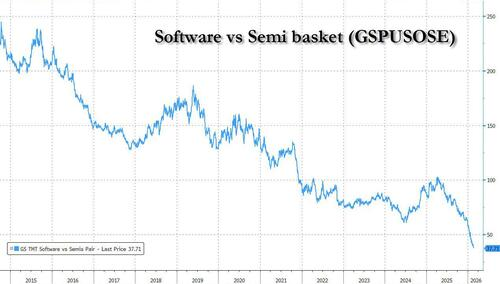
Core Insights - The market's fear regarding AI disrupting traditional industries may have peaked, with "HALO" trades (heavy assets, low obsolescence) being the best hedge for investors still concerned about AI impacts [1][8] Group 1: Market Sentiment and AI Impact - The recent briefing by AI company Anthropic indicated a preference for "cooperation" between AI and existing software providers, contrasting previous fears of complete replacement, leading to a rebound in previously shorted software stocks [1][7] - Despite the S&P 500 index remaining stable since late October last year, extreme fund flows have caused unprecedented internal market divergence, with significant capital inflows into AI beneficiaries and semiconductor sectors while indiscriminately selling software assets [1][4] Group 2: Stock Market Dynamics - The divergence in stock performance has been extreme, with growth and value stocks experiencing a 24% return difference, and the S&P 500's technology and consumer discretionary sectors facing an 11% decline [4] - Defensive and cyclical sectors have seen significant gains, with industrials up 13%, consumer staples up 16%, materials up 22%, and energy up 25% during the same period [4] Group 3: Fund Flows and Positioning - Hedge funds have significantly increased their exposure to semiconductor and AI-related stocks, reaching the highest levels since 2020, while infrastructure software has been the most sold theme, dropping to the 0th percentile since 2020 [7] - Following the Anthropic briefing, there was a reassessment of extreme positions, with software stocks previously labeled as "at risk from AI" rebounding approximately 5% [7] Group 4: HALO Strategy - For investors who believe the "AI fear" has not peaked, Morgan Stanley recommends investing in HALO assets, which are characterized by high production capacity and low obsolescence [8][10] - The HALO basket has risen 28% over the past year, while stocks affected by AI disruption have fallen 43%, indicating a significant attractiveness of this strategy [10]