供应链策略

Search documents
AutoZone(AZO) - 2025 FY - Earnings Call Transcript
2025-12-17 15:02
Financial Data and Key Metrics Changes - The LIFO effect for Q1 was just under $100 million, and for Q2, it is expected to be around $60 million due to higher incoming costs and tariffs [12][13][14] Business Line Data and Key Metrics Changes - The company has been diversifying its sourcing strategies across multiple countries and categories to mitigate tariff impacts and control costs [14] Market Data and Key Metrics Changes - The company opened 89 stores in Mexico and 7 or 8 in Brazil last year, indicating a strong international expansion strategy [15][16] Company Strategy and Development Direction - The long-term strategy includes opening around 300 stores domestically and 200 stores internationally by 2028, aiming for a total of approximately 500 stores globally [16] Management's Comments on Operating Environment and Future Outlook - Management emphasized the importance of providing exceptional customer service and expressed confidence in the company's mission moving forward [17] Other Important Information - The company successfully re-elected all 11 directors and ratified the appointment of Ernst & Young LLP as the independent auditor for fiscal year 2026 [10] Q&A Session Summary Question: What is the LIFO effect due to the tariffs, and are there any changes in the supply chain? - The LIFO effect is primarily caused by higher incoming costs, with charges expected to continue due to tariffs [12][13] - The company has been working on diversifying its sourcing strategies since 2016 to mitigate risks and control costs [14] Question: What is the strategy for international expansion, especially in Mexico? - The company plans to continue its expansion in Mexico and Brazil, with a goal of opening around 500 stores globally by 2028 [15][16]

AutoZone(AZO) - 2025 FY - Earnings Call Transcript
2025-12-17 15:00
Financial Data and Key Metrics Changes - The LIFO effect for Q1 was just under $100 million, and for Q2, it is expected to be around $60 million due to higher incoming costs and tariffs [12][13] Business Line Data and Key Metrics Changes - The company opened 89 stores in Mexico and 7 or 8 in Brazil last year, indicating a strong focus on international expansion [13] Market Data and Key Metrics Changes - The company is diversifying its sourcing strategies across multiple countries and categories to mitigate tariff impacts and ensure a sustainable supply chain [13] Company Strategy and Development Direction - The long-term strategy includes opening around 300 stores domestically and 200 stores internationally by 2028, aiming for a total of approximately 500 stores globally [13] Management's Comments on Operating Environment and Future Outlook - Management emphasized the importance of providing excellent customer service and maintaining a strong commitment to their mission [15] Other Important Information - The appointment of Ernst & Young LLP as the company's Independent Registered Public Accounting Firm for fiscal year 2026 was ratified [10] Q&A Session All Questions and Answers Question: What is the LIFO effect due to the tariffs, and are there any changes in the supply chain? - The LIFO effect is caused by incoming costs being higher than current inventory, with charges for Q1 just under $100 million and expected to be around $60 million for Q2 due to higher tariffs [12] - The company has been working on changing supply chain strategies since the first tariffs in 2016 and 2017, focusing on diversifying sourcing and having multiple suppliers to control costs [13] Question: What is the strategy for international expansion in Mexico? - The company plans to continue its strategy in Mexico and Brazil, having opened 89 stores in Mexico last year and aiming for a total of 500 stores globally by 2028 [13]
特斯拉“供应链去中国化”?陶琳辟谣:供应商原产国或地理来源不构成排除性标准
Mei Ri Jing Ji Xin Wen· 2025-11-26 07:24
Core Insights - Tesla's global supply chain strategy is based on strict and objective standards, focusing on quality, total cost, technological maturity, and long-term supply continuity, regardless of the supplier's country of origin [1][2] - The localization rate of parts for the Model 3 and Model Y produced at Tesla's Shanghai Gigafactory has exceeded 95%, contributing to competitive pricing in the Chinese market [2] - Tesla's Q3 revenue reached $28.1 billion, a 12% year-over-year increase, while net profit fell by 29% to $1.77 billion [2] - Global production in Q3 was 447,400 vehicles, a 4.8% year-over-year decline, while global deliveries increased by 7.4% to 497,000 vehicles, surpassing market expectations [3] Financial Performance - Tesla's core automotive business revenue grew by 6% in Q3, reaching $21.2 billion compared to $20 billion in the same period last year [2] - Despite strong Q3 performance, total global deliveries for the first three quarters of 2025 are projected to decline by approximately 5.9% compared to the same period in 2024 [3] Market Dynamics - In the Chinese market, Tesla's sales for the first half of 2025 totaled 263,400 vehicles, a decrease of about 5.4% from the previous year [3] - Q3 sales in China showed improvement, with 169,200 vehicles sold, representing a 31% quarter-over-quarter increase, and over 90,000 vehicles delivered in September alone [3]


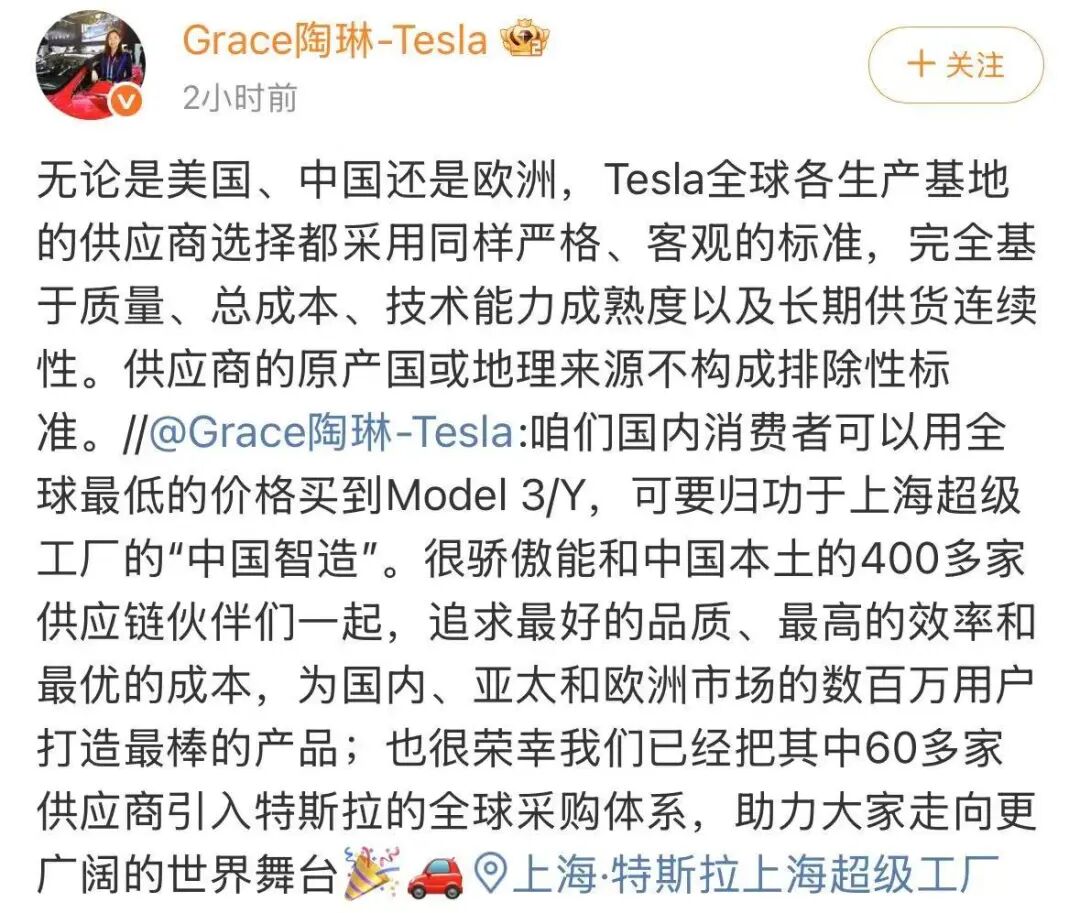
辟谣“供应链去中国化”,特斯拉高管:供应商原产国或地理来源不构成排除性标准
Sou Hu Cai Jing· 2025-11-26 04:10
Core Viewpoint - Tesla's global supply chain strategy is based on strict and objective standards, focusing on quality, total cost, technological maturity, and long-term supply continuity, regardless of the geographical origin of suppliers [1][2]. Group 1: Supply Chain Strategy - Tesla's Vice President, Tao Lin, emphasized that the supplier selection process is consistent across the U.S., China, and Europe, with no exclusion based on the country of origin [1][2]. - The localization rate of parts produced at Tesla's Shanghai Gigafactory for Model 3 and Model Y has exceeded 95%, contributing to competitive pricing in the Chinese market [2]. Group 2: Financial Performance - In Q3, Tesla reported revenues of $28.1 billion, a 12% year-over-year increase, while net profit fell by 29% to $1.77 billion (non-GAAP) [2]. - The core automotive business revenue grew by 6% in Q3, reaching $21.2 billion compared to $20 billion in the same period last year [2]. Group 3: Production and Delivery Data - Tesla's global production in Q3 was 447,400 vehicles, a 4.8% year-over-year decline, while global deliveries reached 497,000 vehicles, a 7.4% increase, surpassing market expectations [4]. - In the Chinese market, Tesla's sales for the first half of 2025 totaled 263,400 vehicles, a decrease of approximately 5.4% compared to the same period last year, but Q3 sales showed a turnaround with 169,200 vehicles sold, a 31% increase from the previous quarter [4].

今飞凯达一季度营收同比增长28.25% 美国关税对公司业务影响有限
Zheng Quan Shi Bao Wang· 2025-04-29 11:26
Core Viewpoint - The company reported strong financial performance in Q1 2025, with a revenue of 1.215 billion yuan, representing a year-on-year growth of 28.25%, and a net profit of 16.7767 million yuan, up 10.33% year-on-year [1] Financial Performance - The company achieved a revenue of 1.215 billion yuan in Q1 2025, marking a 28.25% increase compared to the same period last year [1] - The net profit after deducting non-recurring items was 16.7767 million yuan, reflecting a year-on-year growth of 10.33% [1] Impact of US Tariff Policy - The recent US tariff adjustments have had a limited impact on the company, as only a small portion of its aluminum alloy automotive wheels are exported to the US, while other products are minimally affected [1] - The company operates under a FOB sales model, meaning that tariffs are borne by the customers, which mitigates the impact of tariff changes [1] - The company’s production facility in Thailand maintains a low tax rate advantage, allowing it to continue exporting to the US effectively [1] Expansion in Thailand - To meet the growing market demand from Chinese automotive companies expanding into Thailand, the company is increasing its investment in the region, with a new project expected to produce 3 million aluminum alloy wheels annually, set to be completed by Q4 2025 [2] - The subsidiary in Thailand has secured multiple projects with a leading new energy vehicle manufacturer, preparing for the benefits of increased production capacity [2] - The company has also obtained export licenses for motorcycle wheels to India, with its high-strength, high-pressure molded motorcycle wheels passing certification from Honda [2] Future Outlook - The company views overseas markets as a key growth driver and plans to continue refining its products and technologies in the global market [2] - The company will actively adjust its supply chain strategies in response to changes in international trade policies to ensure the healthy development of its overseas business [2]