
供应链透明度

Search documents
飞鹤、蒙牛、君乐宝、达能、Arla、喜宝等多家乳企回应:所有产品中ARA目前无任何问题
Di Yi Cai Jing· 2026-01-09 10:24
Core Viewpoint - Nestlé has initiated a global recall of infant formula products due to potential quality issues with ARA (Arachidonic Acid) sourced from suppliers, affecting over 50 countries and raising public concern about the safety of infant formula ingredients [1] Group 1: Company Responses - Mengniu stated that its ARA raw material suppliers are unrelated to the European recall incident, and all products undergo strict quality control [3] - Feihe confirmed that its ARA raw materials are not affected by any issues related to Bacillus cereus toxins, and the company adheres to stringent quality standards [3] - Junlebao mentioned that its ARA suppliers are Roget and Runke Bio, and the company follows internal control standards that exceed national regulations [3] - Danone emphasized that all its infant formula products are produced under high standards and do not use ARA from the suppliers involved in the recall [4] - Arla conducted a comprehensive review of its infant nutrition products and confirmed that its ARA suppliers are not linked to the recall issues [4] - HiPP stated that the ARA used in its products is sourced from suppliers not involved in the recall, ensuring safety and reliability [4] Group 2: Regulatory Oversight - The State Council's Food Safety Office and the Market Supervision Administration have urged Nestlé (China) to effectively manage the recall of affected products in China, ensuring consumer rights are protected [2] - The recall in the Chinese market includes four brands: Litojing, Platinum Enfamil, Shuyi Enfamil, and Wyeth's children's growth milk powder, totaling 30 batches [2]


电子产品数字产品护照(DPP)产业调研:全球市场规模增长趋势
Sou Hu Cai Jing· 2025-12-25 13:18
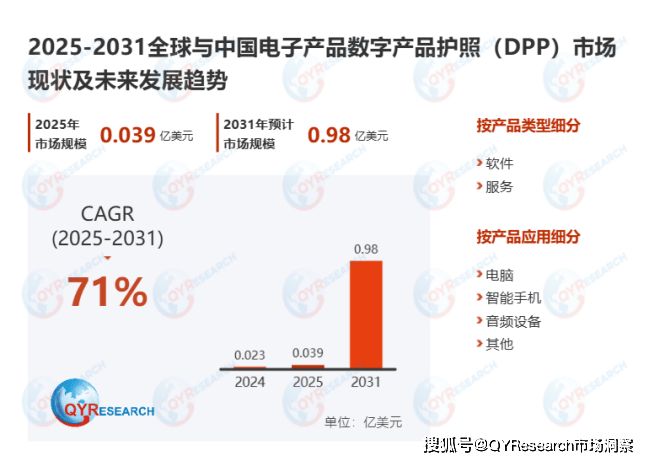
Group 1: Market Overview - The global market for Digital Product Passports (DPP) is projected to reach $160 million by 2031, with a compound annual growth rate (CAGR) of 71% over the next few years [2] - DPP is a digital identity system that records the entire lifecycle of electronic products, enhancing supply chain transparency and promoting circular economy and sustainability [2] Group 2: Key Players - Major manufacturers in the DPP space include Piconext, Protokol, and Circularise, with the top five companies holding approximately 38% of the market share in 2024 [4] - Piconext focuses on creating unique digital identities for physical products using NFC and QR codes, enhancing brand protection and supply chain transparency [5] - Protokol specializes in Web3 and blockchain technologies, providing solutions for digital assets and identity systems [6] - Circularise offers a proprietary blockchain and smart questioning technology to ensure material traceability and environmental impact data sharing [6][7] Group 3: Industry Chain Analysis - The upstream segment involves data standards, technical protocols, and core data sources, which are essential for establishing a common language for DPP [8] - The midstream consists of DPP solution integration, deployment, and operation, primarily by digital passport platform service providers [8] - The downstream includes compliance applications and value realization, with electronic product brands and manufacturers as the main users of DPP [9][10] Group 4: Industry Trends and Opportunities - DPP is evolving from a compliance tool to a core digital platform that drives value creation throughout the product lifecycle [11] - Regulatory frameworks, such as the EU Battery Regulation, are creating a robust market demand for DPP solutions [13] - DPP enables manufacturers to optimize supply chains and enhance brand value through increased transparency and sustainability [13] - The technology integration and standard interoperability are becoming critical for the successful implementation of DPP [11] Group 5: Challenges and Barriers - High collaboration costs and data acquisition challenges hinder the establishment of DPP across the supply chain [14] - The risk of technology and standard fragmentation poses a significant obstacle to achieving scale and value realization in DPP [14] - Concerns regarding data security, privacy, and the protection of commercial secrets are major barriers to participation in DPP initiatives [15] - The complexity of building an ecosystem that includes various stakeholders creates high entry barriers for new players [16]

航空供应链问题掣肘 国际航协测算2025年航司成本增加超110亿美元
Zheng Quan Shi Bao Wang· 2025-10-14 10:25
Core Insights - The aviation industry is expected to face an increase in costs exceeding $11 billion by 2025 due to slow production speeds and supply chain bottlenecks [1][2] - The International Air Transport Association (IATA) highlights that the current supply chain issues are limiting airlines' ability to meet rising passenger demand, with a projected 10.4% increase in demand for 2024 [2][3] Cost Breakdown - Additional fuel costs are projected to account for approximately $4.2 billion, as airlines continue to operate older, less fuel-efficient aircraft due to delays in new aircraft deliveries [1][2] - Extra maintenance costs are estimated at $3.1 billion, driven by the aging fleet requiring more frequent and costly maintenance [2] - Engine leasing costs are expected to rise by $2.6 billion, as longer maintenance periods for aircraft lead to increased engine rentals, with leasing rates having increased by 20% to 30% since 2019 [2] - Inventory holding costs are projected to increase by $1.4 billion due to airlines stocking more spare parts to mitigate supply chain uncertainties [2] Supply Chain Challenges - The backlog of global commercial aircraft orders has reached a historic high of over 17,000 units, significantly above the average backlog of approximately 13,000 units from 2010 to 2019 [1] - The IATA identifies several root causes for the supply chain challenges, including the current economic model of the aviation manufacturing industry, geopolitical instability, raw material shortages, and a tight labor market [2][3] Proposed Solutions - The IATA suggests that opening the aftermarket could provide airlines with more options for parts and services, thereby alleviating some supply chain pressures [3] - Enhancing supply chain transparency is recommended to help airlines plan for bottlenecks and assist original equipment manufacturers (OEMs) in mitigating potential issues [3] - The report advocates for collaborative strategies among all stakeholders in the aviation manufacturing industry to address complex challenges and improve production and maintenance capabilities [4]