
保证利率

Search documents
收益率最高超4%,专属商业养老保险值得入手吗?
2 1 Shi Ji Jing Ji Bao Dao· 2026-02-05 10:34
Core Viewpoint - The exclusive commercial pension insurance with a settlement interest rate exceeding 4% has attracted significant investor attention, especially in a declining interest rate environment where products yielding over 3% are rare [1] Group 1: Product Characteristics - The settlement interest rate of 4% does not equate to the actual yield received by investors, as this product is primarily a pension annuity insurance rather than a straightforward investment vehicle [3] - The insurance operates on an account management model, where premiums accumulate in an account for growth until the payout phase, typically starting at retirement or age 60 [3] - The product features an accumulation phase and a payout phase, with the settlement interest rate reflecting the overall return on the investment portfolio during the accumulation phase [3] Group 2: Investment Options - Insurance companies offer both conservative and aggressive investment portfolios, allowing policyholders to choose or mix between them [4] - The conservative portfolio primarily invests in fixed-income assets, while the aggressive portfolio has a higher allocation to equity assets, often resulting in lower guaranteed rates for aggressive options [4] - Despite the potential for higher returns in aggressive portfolios, some conservative options have demonstrated higher settlement rates, indicating variability in performance across different products [4] Group 3: Historical Performance - Notable products with high settlement interest rates include the Agricultural Bank of China Life's pension insurance, with settlement rates of 4.35% for conservative and 4.55% for aggressive portfolios, although guaranteed rates are relatively low [5] - Many current products have guaranteed rates around 1.5% to 1.75%, with a few reaching 2%, but the settlement rates have been declining in recent years due to lower interest rates [5] Group 4: Payout Mechanism - The design of these insurance products encourages long-term holding, with penalties for early withdrawal within the first five years and limited returns for withdrawals made between six to ten years [6] - Upon reaching the payout phase, the insurance company calculates the monthly or annual payout based on the accumulated account value at the time of withdrawal, with options for lifetime or fixed-term payouts [6][10] - The payout amounts can vary significantly based on the chosen payout method and the conversion tables used, which may change over time based on market conditions [10][11] Group 5: Conclusion - Exclusive commercial pension insurance is primarily intended as a supplementary retirement solution rather than a straightforward investment product, with a focus on providing retirement security [12] - While a 4% settlement interest rate appears attractive, the guaranteed returns are limited to the guaranteed interest rate, and future settlement rates remain uncertain [12]

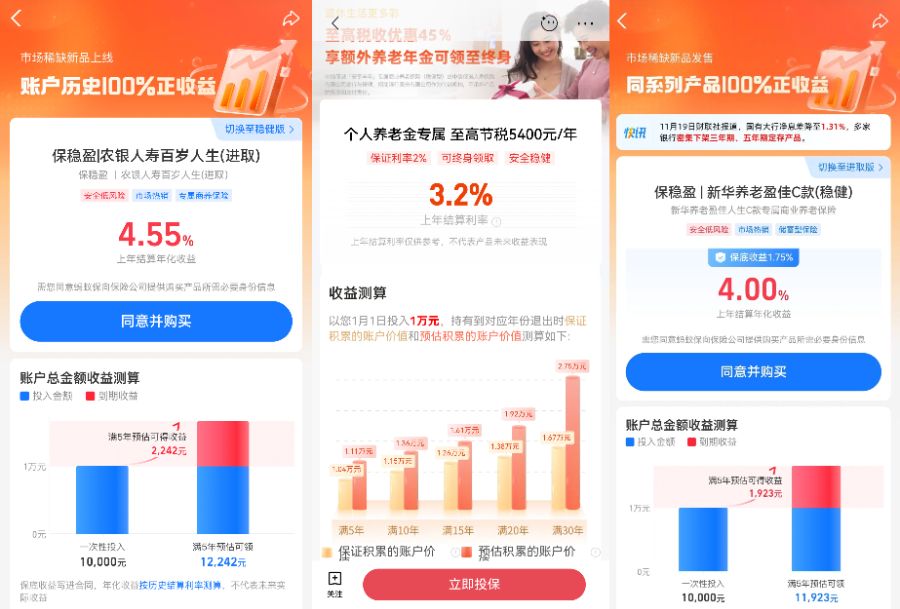
2026年保险“开门红”大战再起
Mei Ri Shang Bao· 2025-11-13 22:42
Core Viewpoint - The insurance industry is gearing up for the 2026 "opening red" battle, with dividend insurance taking center stage as companies employ "hunger marketing" strategies to stimulate consumer purchases and lay a solid foundation for future performance [1][2][3] Group 1: Product Launches and Trends - Major insurance companies have accelerated the launch of new products, with significant offerings such as Xinhua Insurance's "Shengshi Glory Celebration Edition" whole life insurance and Ping An Life's "Ping An Yuxiang Jinyue (2026)" whole life insurance [2][3] - The structure of 2026 insurance products shows a marked shift, with dividend insurance becoming the dominant product, especially among large insurers who are focusing on it as a core business expansion strategy [2][3] - Notable innovations include China Life's "Xinhongfu Pension Annuity Insurance," which removes traditional age limits for policyholders, and Ping An's customizable features in its new products [2][3] Group 2: Sales Channels and Performance - The "reporting and banking integration" policy has led to tighter regulation of individual insurance channels, resulting in a significant decline in new individual policy premiums since September [4][5] - In contrast, the bancassurance channel has shown robust growth, with Ping An Life's new business value (NBV) increasing by 170.9% year-on-year, and other companies like Taikang Life and Xinhua Insurance also reporting substantial growth in this channel [4][5] - The bancassurance channel is expected to play a crucial role in the 2026 "opening red" campaign, driven by strong demand for stable wealth management products that align with the characteristics of dividend insurance [5] Group 3: Consumer Guidance and Market Dynamics - Industry experts emphasize the need for consumers to make rational decisions when purchasing dividend insurance, considering the inherent uncertainties in actual returns [6] - Consumers are advised to assess their risk gaps and understand key concepts such as guaranteed rates and historical dividend performance before making purchases [6] - The industry is encouraged to shift focus from short-term sales strategies to long-term sustainable development, emphasizing the importance of aligning asset-liability management and providing clear product structures to clients [6]


港险演示利率“限高” 业内称实际回报不缩水
2 1 Shi Ji Jing Ji Bao Dao· 2025-07-07 12:46
Core Viewpoint - The recent adjustment of the demonstration interest rate cap for participating insurance in Hong Kong has raised concerns, but industry experts clarify that actual returns will not be affected by this change [1][2]. Regulatory Changes - The Hong Kong Insurance Authority has set the demonstration interest rate cap for HKD participating policies at 6% and for non-HKD policies at 6.5%, effective from July 1, 2025 [1][2]. - This adjustment is seen as a prudent regulatory measure to ensure fair marketing practices and prevent overly optimistic return predictions by insurance companies [4]. Actual Returns - The average dividend realization rate in the Hong Kong insurance industry is over 90%, indicating that the actual returns are generally stable despite the cap on demonstration rates [2]. - The demonstration interest rate cap only applies to new policies sold after July 1, 2025, and does not affect existing policies [2]. Market Dynamics - The competitive landscape in Hong Kong's insurance market has led to some companies making unrealistic return promises, which could mislead consumers [4][5]. - The demand for insurance products from mainland Chinese customers remains strong, with new premiums reaching HKD 219.8 billion in 2024, a 22% increase year-on-year [6]. Investment Appeal - Hong Kong insurance products are attractive to mainland consumers due to their flexible asset allocation and higher potential returns compared to domestic products [7][8]. - The current yield on USD-denominated assets significantly exceeds that of RMB-denominated assets, enhancing the appeal of Hong Kong insurance policies [7]. Challenges and Considerations - There are concerns regarding the high proportion of non-guaranteed dividends in participating insurance, which may lead to uncertainty in future policy returns [9]. - Issues such as the difficulty of repatriating dividends or claims back to mainland China need to be addressed to improve the overall attractiveness of Hong Kong insurance products [9].