保险产品转型

Search documents
东吴证券:负债端、资产端均持续改善 保险板块估值仍有较大向上空间
智通财经网· 2025-11-04 02:06
Core Viewpoint - The current market shows strong savings demand, with declining bank deposit rates and relatively attractive insurance product rates, benefiting insurance sales. The stock market's recent strength has led to increased equity investment ratios among listed insurance companies, enhancing their benefits from market gains. As the domestic economy recovers, any potential rise in long-term interest rates may alleviate pressure on new fixed-income investment returns for insurance companies. The insurance sector remains undervalued, with a projected 2025 valuation of 0.56-0.92 times PEV and 1.07-2.07 times PB, indicating a "buy" rating for the industry [1]. Group 1: Operational Review - Listed insurance companies reported a significant increase in net profit, with a 33.5% year-on-year growth in the first three quarters of 2025, and a 68.3% increase in Q3 alone, driven by stock market gains and improved investment returns [1]. - The net asset value of listed insurance companies increased by 10.3% year-to-date and 9.1% since mid-year, indicating strong profit growth and expectations for stable dividend increases in 2025 [1]. - New business value (NBV) growth accelerated, with a year-on-year increase of over 30% for listed insurance companies, supported by a surge in new single premium sales and improved NBV margins [1]. Group 2: Industry Transformation - The trend towards floating income products is gaining momentum, with a significant shift in the insurance product landscape from single protection to diversified protection and long-term savings, making products like dividend and universal insurance more attractive in a low-interest environment [2]. - The individual insurance and bancassurance channels are undergoing reforms, focusing on enhancing workforce quality and productivity, while bancassurance is evolving towards a more integrated value-driven model [2]. Group 3: Market Review - Historical performance of insurance stocks has been influenced by factors such as stock market trends, interest rates, new single premium sales, and NBV growth, with stock market performance being the most immediate catalyst for short-term gains [3]. - The correlation between insurance stock prices and performance has increased in 2023, particularly during periods of high profit growth disclosures [3].

保险行业2026年度投资策略:资负两端全面开花,估值低位攻守兼备
Soochow Securities· 2025-11-03 07:05
Group 1 - The insurance industry has shown strong growth in both the liability and asset sides, with a notable increase in net profit and net asset value for listed insurance companies in 2025 [3][13][15] - The net profit of listed insurance companies for the first three quarters of 2025 reached CNY 426 billion, a year-on-year increase of 33.5%, with Q3 alone showing a remarkable growth of 68.3% [13][14] - The new business value (NBV) for listed insurance companies grew over 30% year-on-year, driven by a significant increase in new policy premiums, particularly from the bancassurance channel [3][29] Group 2 - The insurance industry is undergoing a transformation with a shift towards floating income products and channel reforms, enhancing growth prospects [3][5] - The bancassurance channel has experienced explosive growth, contributing significantly to new business and NBV, with major companies like Xinhua and China Life seeing substantial increases in new premiums [48][49] - The historical performance of insurance stocks has been influenced by factors such as stock market trends, interest rates, and new policy premium growth, with stock market performance being a key short-term catalyst [3][5] Group 3 - The investment strategy for the insurance sector indicates continued improvement in both liability and asset sides, with significant upside potential in valuations [3][5] - The current market conditions, including high savings demand and declining bank deposit rates, favor insurance product sales, while the stock market's upward trend benefits listed insurance companies' equity investments [3][5] - As of October 31, 2025, the valuation of the insurance sector is at historical lows, with expected price-to-earnings ratios ranging from 0.56 to 0.92 times [3][5]



上半年净亏8.39亿,横琴人寿转型之路或布满荆棘
Guan Cha Zhe Wang· 2025-09-04 07:59
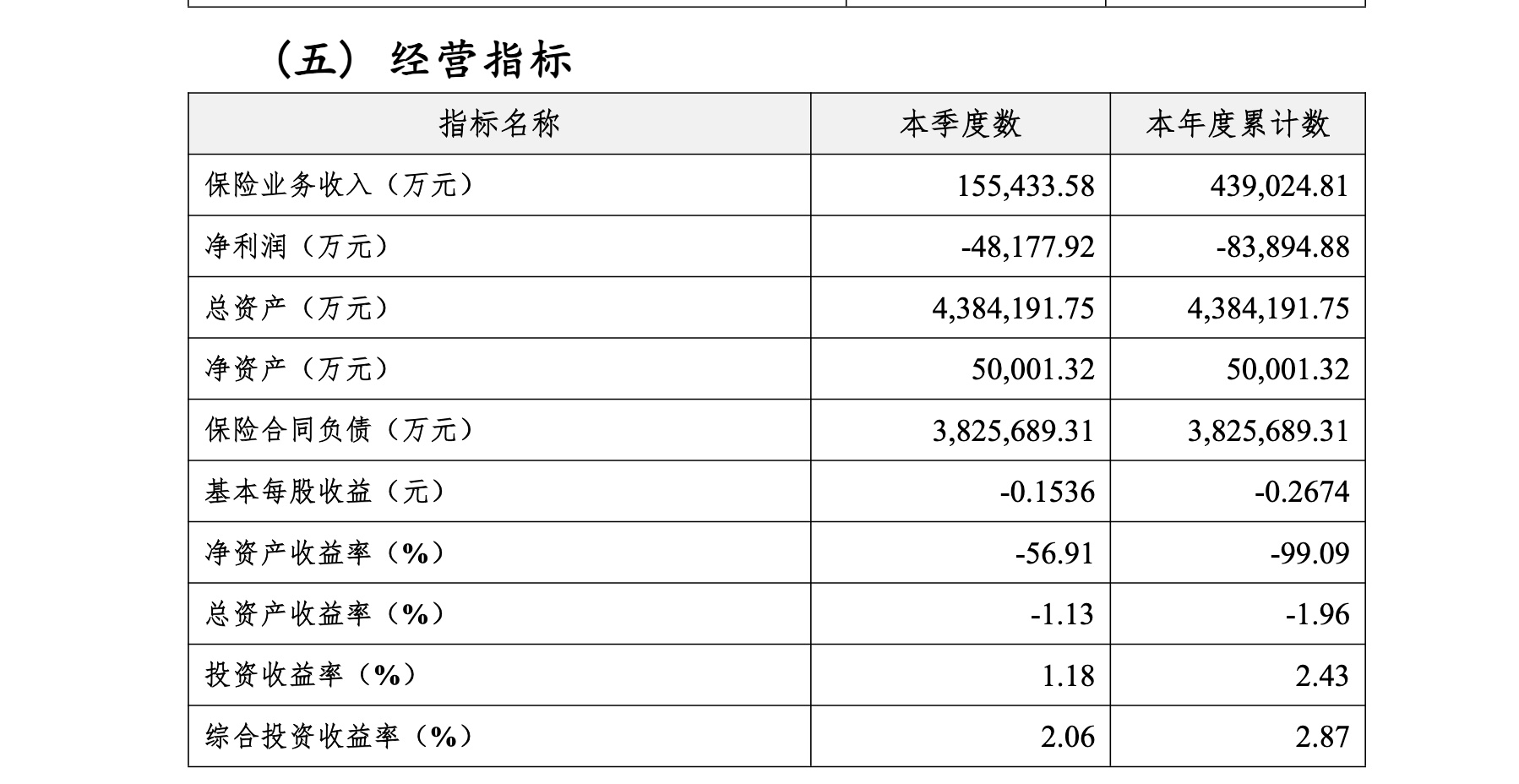
Core Insights - Hengqin Life Insurance Co., Ltd. reported a net loss of 839 million yuan in the first half of 2025, with insurance business revenue at 4.39 billion yuan, indicating significant operational pressure and challenges ahead for the company's transformation [1][2] Financial Performance - The company has experienced a cumulative net loss of 1.79 billion yuan in 2022, 772 million yuan in 2023, and 564 million yuan in 2024, totaling 1.515 billion yuan over three years [2] - In the first half of 2025, the net loss of 839 million yuan surpassed the total loss for the entire year of 2024, highlighting increasing operational challenges [2] - Insurance business revenue decreased by 22.85% compared to the same period last year, amounting to 4.39 billion yuan [2] Operational Metrics - In Q2 2025, the company recorded a single-quarter net loss of 482 million yuan, contrasting sharply with a profit of 31 million yuan in the same quarter of the previous year [4] - The comprehensive surrender rate increased to 0.79% by the end of Q2 2025, up from 0.46% at the end of the previous quarter, indicating rising customer withdrawals [4] - The top three products with the highest surrender amounts were Hengqin Beautiful and Happy Annuity Insurance (53.70 million yuan), Hengqin Excellent Winner Annuity Insurance (20.40 million yuan), and Hengqin Excellent Winning Whole Life Insurance (14.51 million yuan) [4] Cash Flow and Capital Position - The net cash flow from operating activities for the first half of 2025 was -970 million yuan, with significant outflows from dividend accounts totaling 3.3 billion yuan [5] - The company's net assets decreased from 1.17 billion yuan at the end of 2024 to 500 million yuan by the end of Q2 2025, a decline of over 57% [5] Management Changes - The executive team has undergone significant changes, with the number of executives decreasing from 9 to 7 over the past year, including the departure of several long-standing members [6][7] - Recent appointments include Yang Jingbo as assistant general manager and Yan Zhiyang as a member of the party committee and deputy secretary of the discipline inspection commission [1][6] - Frequent changes in the management team may introduce uncertainty into the company's operational stability and strategic direction [7]