信用重估

Search documents
香港第一金:黄金上演500美元“过山车”!历史高位巨震后何去何从?
Sou Hu Cai Jing· 2026-01-30 07:33
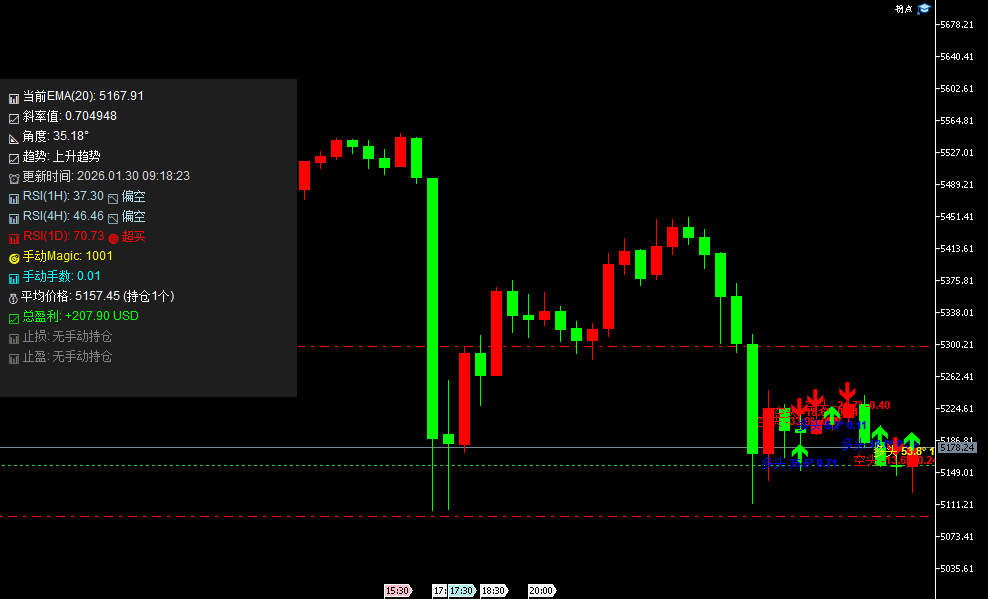
Core Viewpoint - The gold market is at a critical juncture, experiencing extreme volatility after a significant price fluctuation, with current trading between $5100 and $5400 per ounce, down from nearly $5600, indicating a crossroads between long-term narratives and short-term volatility [2] Long-term Support Factors - Iran's announcement of live-fire military exercises in the Strait of Hormuz continues to escalate tensions in the Middle East, which is a core source of risk-averse sentiment [2] - President Trump is expected to announce a new Federal Reserve chair next week and has called for significant interest rate cuts, raising concerns about the Fed's independence and expectations for future easing, which has weakened the dollar and supported gold prices [2] - The World Gold Council reported that global central banks purchased a net 230 tons of gold in Q4 last year, with demand expected to continue into 2026; UBS has raised its gold price target significantly to $6200 per ounce [2] Short-term Risk Factors - The recent price fluctuation of nearly $500 and significant year-to-date gains indicate that the market is severely overbought, with any minor disturbance potentially triggering profit-taking [2] - To manage risk, the CME has raised margin requirements for gold futures, and similar measures have been adopted by domestic institutions like the Shanghai Futures Exchange, increasing trading costs and suppressing short-term speculation [2] - The current price surge has exceeded fundamental support, leading to a market dominated by uncertainty, which could result in a "long squeeze" scenario [2] Market Analysis - Following the recent volatility, the market requires consolidation to find a new balance [2] - Current trading range is between $5100 and $5400, with short-term resistance at $5500-$5550 and historical resistance at $5600; key support is at $5316 [3] - The core trend support levels are at $5183 and $5000, with a significant bearish signal indicating a loss of upward momentum, suggesting a high-level consolidation phase [4] Personal Strategy - A potential buying opportunity may arise if gold prices pull back to the $5130-$5150 range, targeting $5230-$5300-$5400; conversely, if prices rise to around $5400, a selling opportunity may be considered, targeting $5300-$5200 [4] - The long-term bullish foundation for gold remains intact, driven by de-dollarization and credit reassessment, but the short-term market is currently characterized by extreme volatility driven by emotions and leverage [4]

今日1.27金价:大家不必等待了,接下来,金价有可能会重演历史
Sou Hu Cai Jing· 2026-01-27 16:44
Core Viewpoint - Central banks globally have significantly increased their gold reserves, surpassing the euro to become the world's second-largest reserve asset, indicating a strategic shift towards gold as a reliable asset amidst concerns over fiat currency stability [1][3]. Group 1: Central Bank Behavior - Since 2022, central banks have been purchasing over 1,000 tons of gold annually, nearly double the average of the previous decade, with countries like China, Poland, and Turkey leading the charge [1]. - The proportion of gold purchases by central banks has risen from 14.8% in 2018 to 23% of total gold demand, indicating their role as a stabilizing force in the gold market [5][6]. - China's central bank has consistently increased its gold holdings for 14 months, demonstrating a long-term commitment to gold as a strategic asset [6]. Group 2: Changing Perception of Gold - The traditional pricing formula for gold, which relied on the strength of the dollar and real interest rates, has become less effective since 2022, as gold prices have risen even when U.S. Treasury yields increased [3][11]. - The new valuation logic for gold centers around the concept of "credit," particularly a reassessment of the trust in sovereign currencies, especially the U.S. dollar [3][5]. Group 3: Market Dynamics - The global gold ETF holdings reached a historical peak of 4,025 tons by the end of November 2025, with a significant inflow of $89 billion in 2025 alone, reflecting strong investor interest [6]. - Geopolitical tensions and economic uncertainties have led to a sustained demand for gold as a long-term hedge, reinforcing its status as a "safe-haven" asset [8][11]. Group 4: Silver Market Insights - Silver has experienced a remarkable price increase of nearly 150% in 2025, driven by both its financial attributes as "shadow gold" and its industrial demand in sectors like solar energy and electric vehicles [9]. - The U.S. has elevated silver's strategic importance by designating it as a "critical mineral," further enhancing its market appeal [9]. Group 5: Price Trends - Gold prices have reached unprecedented levels, breaking through $4,000 for the first time on October 8, 2025, and climbing to $4,531 by December 24, 2025, with further increases into 2026 [11]. - The evolving role of gold is now seen as a core asset for pricing uncertainties in sovereign credit, moving beyond its traditional functions as an inflation hedge or crisis refuge [11].

红狮集团发布2026全球投资机会研究报告
Sou Hu Cai Jing· 2026-01-21 07:32
Core Viewpoint - The "2026 Global Investment Opportunities Research Report" highlights a significant shift in global economic and geopolitical dynamics, marking 2026 as a pivotal year for investment opportunities amid structural changes and risks [2]. Group 1: 2025 Investment Market Review - In 2025, global markets exhibited structural differentiation due to macro policies, geopolitical tensions, and changes in industrial chains, with the U.S. tariff war failing to boost domestic manufacturing but increasing trade costs and inflation [2]. - The European economy remained weak, while Japan faced challenges in normalizing its monetary policy. In contrast, China's economy showed resilience with a historic expansion of trade surplus driven by the "new quality productivity" strategy [2]. Group 2: Commodity Trends - Futures for copper, gold, and silver saw significant price increases, with gold prices reaching a historical high of $4550 per ounce by the end of 2025, marking an annual increase of over 70% [4][5]. - Silver prices surged to a record high of $83.97 per ounce, with an annual increase exceeding 200%, driven by both financial and industrial demand [5]. Group 3: Stock Market Performance - The U.S. stock market demonstrated resilience amid tariff pressures and interest rate cuts, with the Nasdaq index rising by 18.5% and sectors like AI and defense leading the market [7]. - The A-share market in China experienced a significant bull market, with the CSI 300 index increasing by 22.6% and the Sci-Tech 50 index soaring by 35.4% [7]. Group 4: 2026 Investment Outlook - The investment opportunities in 2026 are centered around three main themes: the continued strength of precious metals, technology and high-end manufacturing, and the potential for currency and emerging market opportunities [9][11]. - Precious metals, particularly gold, are expected to maintain an upward trend, with a potential challenge to reach $5000 per ounce due to deepening global credit reassessment and geopolitical uncertainties [8]. - Silver is anticipated to experience significant price increases, potentially exceeding $100 per ounce, driven by structural supply shortages and surging industrial demand [11]. Group 5: Technology and High-End Manufacturing - The focus on "self-reliance" in technology and manufacturing has become crucial, with sectors like AI and semiconductors expected to continue their growth trajectory in 2026 [11][13]. - Investment should target companies with real-world applications and core algorithm capabilities in AI, particularly in smart driving, industrial internet, and biomedicine [13]. - The domestic replacement of critical semiconductor components and high-end manufacturing is expected to accelerate, benefiting from policy and capital support [14]. Group 6: Currency and Emerging Markets - The anticipated resumption of the Fed's interest rate cuts in 2025 may lead to a weakening of the dollar's dominance, creating opportunities for non-dollar currencies and emerging markets [11]. - Major currencies like the euro and Australian dollar are expected to experience recovery, with the Australian dollar benefiting from increased demand for minerals from China [11]. - The stability and resilience of the Chinese yuan may improve, supported by bilateral currency swaps and growing global demand for yuan reserves [11]. Group 7: Asset Allocation Recommendations - Investors are advised to adopt a "core-satellite" asset allocation strategy, focusing on precious metals like gold as a hedge against macro uncertainties while selecting quality assets in technology and new productivity sectors as satellite investments [15].