债市宽幅震荡

Search documents
中长期纯债基“开门黑”:半数未获正收益,去年收益还不如货基
Di Yi Cai Jing· 2026-01-11 09:24
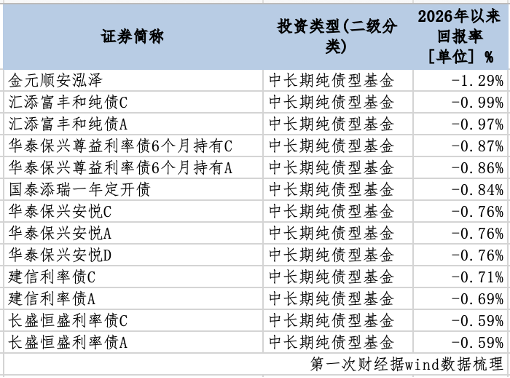
Core Viewpoint - The bond market has started 2026 on a weak note, with over 40% of pure bond funds failing to achieve positive returns, particularly in the medium to long-term category, which has become a major area of adjustment [1][2][4] Group 1: Market Performance - Approximately 1,780 out of over 4,500 pure bond funds have reported zero or negative returns this year, accounting for 40% of the total [2] - Nearly 1,600 medium to long-term pure bond funds have not achieved positive returns, representing close to 50% of all such funds [2] - The average return for bond funds over the past year is only 1.83%, nearly halved from the previous year's 3.60% [4][5] Group 2: Fund Performance - Several funds have seen their net values decline by more than 0.7% this year, with specific funds like Jinyuan Shun'an Hongze and Huatai Baoxing Zun Cheng experiencing significant drops [2] - The average return for medium to long-term pure bond funds in 2025 was only 0.78%, a drastic decline of nearly 80% compared to 3.44% in 2024 [6] Group 3: Fund Outflows - The weak performance of the bond market has led to significant capital outflows, with over 50 billion yuan withdrawn from bond ETFs [3] - Some off-market bond funds have experienced large redemptions, prompting certain funds to increase the precision of their net asset value calculations [3] Group 4: Factors Influencing Returns - The primary reason for the decline in returns is attributed to rising long-term interest rates, with the 10-year government bond yield increasing by approximately 5 basis points to 1.89% and the 30-year yield rising by about 8 basis points to 2.33% [8] - Many underperforming pure bond funds had heavily invested in long-term government bonds, which have faced significant valuation pressure due to rising interest rates [8][9] Group 5: Future Outlook - The bond market is expected to enter a phase of wide fluctuations, with limited downward space for yields but manageable risks of significant upward movement [1][12] - Analysts suggest that a conservative interest rate strategy may offer better allocation value than a trading-oriented strategy in the current market environment [1][12]

债市投资难度加大 多家银行调整策略构建对冲组合
Zheng Quan Shi Bao· 2025-09-28 22:14
Core Viewpoint - The bond market is experiencing intensified volatility and challenges, with banks facing difficulties in bond investments and adjusting their strategies accordingly [1][3][4]. Group 1: Market Conditions - The bond market is currently in a state of wide fluctuations, with the ten-year government bond yield oscillating between 1.85% and 1.9%, reflecting increased volatility [3]. - After the implementation of new tax regulations on bond interest, the attractiveness of bonds has decreased, leading to a potential reallocation of assets towards equities and other investments [2]. - In August, the trading volume of bonds declined significantly, with state-owned banks trading approximately 3.568 trillion yuan and joint-stock banks trading about 11.232 trillion yuan, marking a drop from previous months [2]. Group 2: Bank Performance - In the first half of the year, over 80% of A-share listed banks reported positive growth in investment income, with an average increase exceeding 45%, primarily driven by the realization of bond floating profits [5][6]. - Notably, the China Construction Bank achieved an investment income of 27.912 billion yuan, with a year-on-year growth exceeding 200%, significantly contributing to its revenue [6]. - However, many banks are experiencing a decline in non-interest income due to the challenging market conditions, with some reporting negative growth [4]. Group 3: Investment Strategies - Banks are adjusting their investment strategies in response to the volatile bond market, focusing on wave trading and increasing the use of derivative instruments for hedging [9][10]. - The Postal Savings Bank has adopted a more flexible asset-liability strategy, actively expanding its balance sheet to capture income opportunities amid market fluctuations [9]. - The overall sentiment among bank executives is cautious regarding the sustainability of investment income growth in the second half of the year [3][4].