股债跷跷板效应

Search documents
利率债周报:通胀担忧缓和叠加股市低迷,债市有所回暖-20260330
Dong Fang Jin Cheng· 2026-03-30 07:55
1. Report Industry Investment Rating No relevant content provided. 2. Core Viewpoints - Last week, the bond market generally showed a warm trend, with the yield curve becoming flatter. On March 23, the bond market continued to be under pressure due to the unclear Middle - East geopolitical situation and the continuous fermentation of inflation expectations. However, starting from March 24, as overseas released signals of the easing of the US - Iran conflict, inflation concerns subsided, and the domestic stock market was sluggish. The bond market recovered, and the long - term bond yields declined significantly. For short - term bonds, although the capital market remained loose last week, the capital price rose slightly during the tax period, limiting the downward space of short - term bond yields, and the spread between long - and short - term bonds narrowed [2]. - This week (the week of March 30), the bond market is expected to maintain a relatively strong and volatile trend. The domestic monetary policy will focus on maintaining sufficient liquidity and stabilizing market expectations. The capital market is expected to remain loose, which will support short - term bonds. However, the concerns about imported inflation brought by the Middle - East situation and the cooling of the expectations of reserve requirement ratio cuts and interest rate cuts will continue to suppress the bond market sentiment, making the long - end trend more entangled. Considering the expected continued sluggish performance of the stock market and the market's dull reaction to geopolitical conflicts, the bond market is expected to continue its relatively strong and volatile trend this week, but attention should be paid to whether the manufacturing PMI and price sub - indices announced on Tuesday this week will have unexpected performance [2]. 3. Summary by Directory 3.1 Last Week's Bond Market Review 3.1.1 Secondary Market - The bond market generally showed a warm trend last week, and the long - term bond yields declined significantly. The 10 - year Treasury bond futures' main contract rose 0.00% cumulatively throughout the week. On the last Friday, the 10 - year Treasury bond yield was 1.27bp lower than that of the previous Friday, and the 1 - year Treasury bond yield was 0.50bp lower than that of the previous Friday, with the term spread narrowing [3]. - On March 23, the bond market was generally weak and volatile. The yields of major inter - bank interest - rate bonds generally rose, and the 10 - year Treasury bond yield rose 0.17bp. Most of the main contracts of Treasury bond futures at all terms closed down, with the 10 - year main contract down 0.09%. - On March 24, the bond market recovered. The yields of major inter - bank interest - rate bonds mostly declined, and the 10 - year Treasury bond yield declined 0.44bp. Most of the main contracts of Treasury bond futures at all terms closed up, with the 10 - year main contract up 0.02%. - On March 25, the bond market was warm. The yields of major inter - bank interest - rate bonds mostly declined, and the 10 - year Treasury bond yield declined 0.39bp. The closing performance of the main contracts of Treasury bond futures at all terms was divergent, and the 10 - year main contract remained flat. - On March 26, the bond market continued to be warm. The yields of major inter - bank interest - rate bonds generally declined, and the 10 - year Treasury bond yield declined 0.39bp. All the main contracts of Treasury bond futures at all terms closed up, with the 10 - year main contract up 0.08%. - On March 27, the bond market was slightly warm. The long - end yields of major inter - bank interest - rate bonds generally declined, and the 10 - year Treasury bond yield declined 0.22bp. The closing of the main contracts of Treasury bond futures at all terms was mixed, with the 10 - year main contract down 0.01% [4]. 3.1.2 Primary Market - Last week, 102 interest - rate bonds were issued, the same as the previous week. The issuance volume was 664.6 billion yuan, a decrease of 406.6 billion yuan compared with the previous week, and the net financing amount was 205.9 billion yuan, a decrease of 570.5 billion yuan compared with the previous week. In terms of bond types, the issuance volume and net financing amount of Treasury bonds, policy - financial bonds, and local government bonds all decreased compared with the previous week [13]. - The subscription demand for interest - rate bonds last week was generally acceptable. Two Treasury bonds were issued with an average subscription multiple of 3.24 times; 25 policy - financial bonds were issued with an average subscription multiple of 4.72 times; 75 local government bonds were issued with an average subscription multiple of 17.40 times [14]. 3.2 Last Week's Important Events On March 25, the central bank carried out a 500 - billion - yuan MLF operation with a 1 - year term. Since 450 billion yuan of MLF matured in March, the MLF continuation in that month increased by 50 billion yuan, which was the 13th consecutive month of increase. The main reason is that the issuance scale of government bonds in March and the following period will continue to be at a high level. At the same time, the issuance of 800 billion yuan of new policy - financial instruments announced in March this year will continue to drive large - scale bank supporting loans in March and later, and the issuance of policy - financial bonds will also increase significantly, which will bring a tightening effect on the capital market to a certain extent. Therefore, the central bank needs to continuously inject medium - and long - term liquidity into the market through the combination of various policy tools to guide the capital market to be in a relatively stable and sufficient state [16]. 3.3 Real - Economy Observation - On the production side, most of the high - frequency data last week showed an upward trend. The blast furnace operating rate, semi - steel tire operating rate, and daily average molten iron output continued to rise, while the operating rate of petroleum asphalt plants continued to decline. - On the demand side, the BDI index fluctuated slightly downward last week, while the China Containerized Freight Index (CCFI) continued to rise slightly. The sales area of commercial housing in 30 large and medium - sized cities continued to increase. - In terms of prices, the pork price continued to decline last week, while most commodity prices rose. Among them, the prices of copper and crude oil both increased, and the price of rebar slightly declined [17]. 3.4 Last Week's Liquidity Observation - The central bank's net investment in the open market last week was 281.9 billion yuan. - The R007 and DR007 both increased last week, the inter - bank certificate of deposit issuance rate of joint - stock banks increased slightly, the national - share direct discount rates at all terms continued to decline, the trading volume of pledged repurchase continued to decrease, and the leverage ratio in the inter - bank market first decreased and then increased, with an overall slight decline [29][32][34][37].
【银行理财】监管柔性松绑?中小银行理财“清零”或转向平稳过渡——银行理财周度跟踪(2026.3.16-2026.3.22)
华宝财富魔方· 2026-03-25 11:28
Regulatory and Industry Dynamics - The regulatory environment for regional small and medium-sized banks is showing signs of flexibility, with a transition period for the requirement to clear existing wealth management products by the end of 2026 [8] - As of March 25, 2026, banks have issued a total of 1,685 wealth management products this year, with 99 products maturing beyond 2027, indicating a softer regulatory approach [8] - The transition arrangement allows for a smoother adjustment for small banks facing liquidity pressures due to a large number of fixed deposits maturing in 2026 [8] Peer Innovation Dynamics - On March 16, 2026, China Everbright Wealth successfully subscribed to its first short-term corporate bond issued by Shougang Group on the Beijing Stock Exchange, marking a significant step in its cross-market asset allocation strategy [9] - The Beijing Stock Exchange, established in September 2021, aims to support innovative small and medium-sized enterprises, focusing on high-quality "specialized and innovative" companies [9] - The bond market on the Beijing Stock Exchange is still in a developmental phase, with improving liquidity as product offerings expand and investor participation increases [9] Yield Performance - For the week of March 16-22, 2026, cash management products recorded an annualized yield of 1.21%, a decrease of 4 basis points, while money market funds saw an increase to 1.16%, up 1 basis point [10][11] - The yield on 10-year government bonds rose by 1 basis point to 1.83%, and the yield on 30-year government bonds also increased by 1 basis point to 2.30% during the same period [12] - Various factors, including geopolitical uncertainties and domestic economic data, have contributed to fluctuations in bond market yields, although the overall increase has been limited due to the stock-bond relationship [12] Net Value Tracking - The net value loss rate for bank wealth management products increased to 1.35%, up 0.53 percentage points week-on-week, indicating potential redemption pressures if the rate exceeds 5% [14] - The credit spread has contracted by 1.37 basis points, showing a correlation with the net value loss rate, although changes in the loss rate may lag behind credit spread movements [14]


股指期货:全天弱势运?股指期权:波动冲?,维持防御
Zhong Xin Qi Huo· 2026-03-20 01:21
1. Report Industry Investment Rating No relevant content provided. 2. Core View of the Report - The risk appetite in the financial derivatives market is under pressure. The stock index futures showed a weak performance throughout the day, the volatility of stock index options soared and a defensive strategy should be maintained, and the trading of treasury bond futures was affected by the intertwined factors of risk - aversion and inflation concerns [1][2]. 3. Summary by Related Catalogs (1) Market Outlook Stock Index Futures - The equity market on Thursday opened lower and moved lower, with only a few industries such as coal and oil and gas rising against the trend. The reasons for the decline include a weaker liquidity environment, further fermentation of geopolitical situations, and a strong US dollar index. Currently, the option indicators imply that it has entered the second half of the adjustment. The operation suggestion is to hold the bottom - position of IM and wait for the geopolitical situation to become clear before making further layouts [7]. Stock Index Options - The trading volume of the option market soared back above the 10 - billion mark. The proportion of put options in multiple varieties increased significantly, and the overall volatility and skewness rose. Short - term hedging and multi - volatility trading both exist. It is not recommended to immediately layout short - volatility strategies after the volatility rises. The short - term main strategy is to maintain defense [7]. Treasury Bond Futures - Treasury bond futures rose across the board yesterday, but the T main contract weakened in the afternoon. The risk - aversion sentiment and inflation concerns are intertwined. The intensification of the Middle East geopolitical conflict has increased risk - aversion sentiment and may have driven the bond market. At the same time, rising oil prices have strengthened inflation concerns, restricting the bullish sentiment in the bond market. The central bank emphasized maintaining the stable operation of the financial market, and liquidity may remain abundant. The bond market may still have support. Operation suggestions include a trend strategy of range - bound trading, paying attention to short - hedging at low basis levels, paying attention to the basis opportunities of ultra - long - term bonds, and paying attention to the convergence opportunity of the 30Y - 10Y spread [8]. (2) Derivatives Market Monitoring - The report mentions the monitoring of stock index futures, stock index options, and treasury bond futures data, but no specific data content is provided in the given text [9][13][25].
债券研究周报:两会前,债市情绪转为谨慎-20260302
Guohai Securities· 2026-03-02 15:09
Report Industry Investment Rating No specific industry investment rating is provided in the report. Core Viewpoints - From February 24 to March 2, the bond market experienced a significant adjustment, causing the sentiment indices of both sellers and buyers to decline, with the buyer sentiment dropping more [4]. - The future developments of real estate and inflation need further observation. There are potential opportunities arising from expectation gaps, and the bond market may rise during the Two Sessions. It is advisable to make arrangements during market adjustments [4]. Summary by Relevant Catalog 1. Seller Market Sentiment 1.1 Seller Market Interest Rate Bond Sentiment Index: Declined from February 24 to March 2 - The unweighted sentiment index from February 24 to March 2 was 0.1429, a decrease of 0.18 compared to February 10 - 24. Some institutions' views turned neutral, and the overall view is neutral - bullish. Among 30 institutions, 5 are bullish, 22 are neutral, and 1 is bearish [12]. - 18% of institutions are bullish, believing there may be trend - following opportunities in the bond market in Q2, significant allocation may occur in March, and it's advisable to allocate during adjustments. The recent significant appreciation of the RMB is favorable to the Chinese bond market, and interest rate cuts can be expected in the next two to three months [12]. - 79% of institutions are neutral, stating that the stock - bond seesaw effect will strengthen in March, market sentiment is relatively cautious, the winning probability of the bond market will increase after the Two Sessions, but further interest rate decline requires central bank rate cuts. The 10 - year Treasury bond may fluctuate between 1.6% - 1.9% [12]. - 4% of institutions are bearish, suggesting that if inflation continues to rise, the capital trend may tighten, and the emergence of broad - money expectations in the market may be a selling point for bonds [12]. 1.2 Buyer Market Interest Rate Bond Sentiment Index: Declined from February 24 to March 2 - The unweighted sentiment index from February 24 to March 2 was - 0.046, a decrease of 0.23 compared to February 10 - 24. The sentiment index dropped significantly, and the overall view is neutral - bearish. Among 22 institutions, 5 are bullish, 11 are neutral, and 6 are bearish [13]. - 23% of institutions are bullish, believing that the reduction of US Treasury bond funds in the market is beneficial to Chinese bonds. The geopolitical event between the US and Iran has reduced market risk appetite, which is favorable to the bond market. Historically, the bond market mostly declines after the Two Sessions [13]. - 50% of institutions are neutral, stating that the yields of medium - and short - term bonds will remain low and fluctuate under the expectation of loose funds, while the yields of long - term bonds will fluctuate upward and still face adjustment pressure. The profit - taking sentiment in the market has eased, and interest rates have declined, but the volatile pattern may continue [13]. - 27% of institutions are bearish, believing that the bond market sentiment weakened significantly this week, bearish sentiment intensified, the trading volume and activity of the forfaiting market in March are expected to increase significantly compared to January - February, and market interest rates also have some upward space [13].
瑞达期货国债期货日报-20260302
Rui Da Qi Huo· 2026-03-02 11:05
1. Report Industry Investment Rating - Not mentioned in the provided content 2. Core Viewpoints of the Report - In March, the bond market may be slightly affected by geopolitical conflicts, but the overall focus remains on the policy expectations of the Two Sessions. The current supply pressure of government bonds is generally controllable, and the "weak recovery" pattern of the fundamentals has not changed, providing bottom - support for the bond market. As the Two Sessions approach, market gaming on policy expectations intensifies, potentially causing periodic fluctuations. It is expected that Treasury bond futures in March will continue the range - bound pattern [2] 3. Summary by Relevant Catalog 3.1 Futures Market Data - **Futures Closing Prices and Volume Changes**: T, TF, TS, and TL main contract closing prices increased by 0.13%, 0.09%, 0.02%, and 0.55% respectively; T and TL main contract trading volumes increased by 4445 and 15112 respectively, while TF and TS main contract trading volumes decreased by 15942 and 2843 respectively [2] - **Futures Spread Changes**: Some spreads such as TL2606 - 2603 and T2606 - 2603 increased, while others like TF2606 - 2603 and TS2606 - 2603 decreased [2] - **Futures Position Changes**: The main contract positions of T and TF increased by 10738 and 2383 respectively, while those of TS and TL decreased by 1700 and 3208 respectively. The net positions of the top 20 in T, TS, and TL increased, while that of TF decreased [2] 3.2 Bond Market Data - **CTD Bond Net Price Changes**: The net prices of several CTD bonds such as 230004.IB and 250014.IB increased [2] - **Active Bond Yield Changes**: The yields of 1 - year, 3 - year, 5 - year, 7 - year, and 10 - year active bonds decreased by 1.00bp, 1.00bp, 2.50bp, 2.50bp, and 2.75bp respectively [2] 3.3 Interest Rate Data - **Short - term Interest Rate Changes**: Silver - pledged overnight, 7 - day, and 14 - day interest rates decreased by 0.70bp, 5.46bp, and 6.51bp respectively; Shibor overnight, 7 - day, and 14 - day interest rates decreased by 0.30bp, 3.40bp, and 0.60bp respectively [2] - **LPR Interest Rate**: The 1 - year LPR remained at 3.00%, and the 5 - year LPR remained at 3.5% [2] 3.4 Open Market Operations - The issuance scale of reverse repurchase operations was 19 billion yuan, with a maturity scale of 0 billion yuan and an interest rate of 1.4% for 7 days [2] 3.5 Industry News - The 4th Session of the 14th National Committee of the Chinese People's Political Consultative Conference will be held in Beijing on March 4, 2026 [2] - China's GDP in 2025 was 14,018.79 billion yuan, a 5.0% increase from the previous year; national total income was 13,937 billion yuan, a 5.1% increase. The population decreased by 339,000 at the end of 2025. There were 92 space launches, including 50 commercial launches. Domestic tourism reached 6.52 billion person - times, a 16.2% increase, and the number of foreigners entering China through visa - free policies was 30.08 million, a 49.5% increase [2] - Iranian Supreme Leader Khamenei was assassinated on February 28, and the US and Israel launched a joint military strike against Iran on the same day. US President Trump said the military action might last about four weeks, and the new Iranian leadership hopes to resume negotiations [2] 3.6 Key Events to Watch - The US February ISM manufacturing index at 17:00 on March 2; the 4th Session of the 14th National People's Congress will be held in Beijing on March 5 [3]
超长债周报:30 年国债冲高回落-20260301
Guoxin Securities· 2026-03-01 11:58
1. Report Industry Investment Rating No information provided in the content. 2. Core View of the Report - The bond market first declined and then rose last week, and ultra - long bonds fell again. The trading activity of ultra - long bonds decreased significantly, and both the term spread and the variety spread of ultra - long bonds narrowed [1][4][11]. - In March, the bond market is expected to first decline and then rise. The economic stability since Q4 2024 was mainly due to the central government's leverage - increasing support. In Q4 2025, there was no additional issuance of treasury bonds, and the short - term government support for the economy weakened. The GDP growth rate in Q4 2025 dropped to the lowest level in the post - pandemic era, and the Chinese economy is still under pressure. Meanwhile, the Party Central Committee attaches more importance to high - quality development in 2026, and the importance of "seeking progress while maintaining stability" in the total economic volume has been adjusted down. On the other hand, during the Two Sessions, policy expectations are optimistic, the A - share spring rally continues, and the current absolute level of interest rates is low, so the stock - bond seesaw effect is expected to strengthen [2][3][12][13]. 3. Summary According to the Directory 3.1 Ultra - long Bond Review - After the Spring Festival, with a record - high number of travelers during the holiday and the release of the "Shanghai Seven Measures" in the first week after the holiday, the A - share market continued to rebound. The bond market first declined and then rose, and ultra - long bonds fell again. The trading activity of ultra - long bonds decreased significantly last week, but it was still very active. The term spread and variety spread of ultra - long bonds narrowed [1][4][11]. 3.2 Ultra - long Bond Investment Outlook - **30 - year Treasury Bonds**: As of February 27, the spread between 30 - year and 10 - year treasury bonds was 44BP, at a relatively low level in history. The economic downward pressure in December eased, with the estimated GDP growth rate of about 4.5% year - on - year, a 0.4% increase from November. In January, CPI was 0.2% and PPI was - 1.4%, and the deflation risk continued to ease. It is expected that the bond market will first decline and then rise in March. The 30 - 10 spread is expected to fluctuate at a high level in the short term [2][12]. - **20 - year CDB Bonds**: As of February 27, the spread between 20 - year CDB bonds and 20 - year treasury bonds was 14BP, at an extremely low level in history. The economic situation and inflation data are similar to those of 30 - year treasury bonds. It is also expected that the bond market will first decline and then rise in March. Considering that the bond market is still in a volatile range, the variety spread of 20 - year CDB bonds is expected to continue to fluctuate in a narrow range [3][13]. 3.3 Ultra - long Bond Basic Overview - As of February 28, the balance of ultra - long bonds with a remaining term of more than 14 years was 1,655,081 billion (excluding asset - backed securities and project revenue notes), accounting for 15.3% of the total bond balance. Local government bonds and treasury bonds are the main sub - varieties. By variety, treasury bonds accounted for 27.5%, local government bonds accounted for 67.3%, etc. By remaining term, the 30 - year variety accounted for the highest proportion [14]. 3.4 Primary Market - **Weekly Issuance**: Last week (February 23 - March 1, 2026), the issuance volume of ultra - long bonds increased. A total of 1,902 billion yuan of ultra - long bonds were issued. Compared with the previous week, the total issuance volume increased significantly. By variety, only local government bonds were issued, with an amount of 1,902 billion yuan. By term, 315 billion yuan was issued with a 15 - year term, 271 billion yuan with a 20 - year term, and 1,316 billion yuan with a 30 - year term [19]. - **This Week's Planned Issuance**: The announced issuance plan for ultra - long bonds this week is 1,442 billion yuan, all of which are ultra - long local government bonds [25]. 3.5 Secondary Market - **Trading Volume**: Last week, the trading of ultra - long bonds was very active, with a trading volume of 6,189 billion yuan, accounting for 10.5% of the total bond trading volume. By variety, the trading volume of ultra - long treasury bonds was 5,083 billion yuan, accounting for 31.7% of the total treasury bond trading volume; the trading volume of ultra - long local bonds was 1,009 billion yuan, accounting for 42.1% of the total local bond trading volume, etc. Compared with the previous week, the trading activity of ultra - long bonds decreased significantly, with the trading volume decreasing by 4,736 billion yuan and the proportion decreasing by 2.5% [27][29]. - **Yield**: After the Spring Festival, the bond market first declined and then rose, and ultra - long bonds fell again. The yields of 15 - year, 20 - year, 30 - year, and 50 - year treasury bonds changed by 1BP, 4BP, 5BP, and 4BP respectively to 2.12%, 2.27%, 2.29%, and 2.48%. Similar changes occurred in CDB bonds, local bonds, and railway bonds. The yield of the 30 - year treasury bond active bond 25 ultra - long special treasury bond 02 changed by 1.3BP to 2.24%, and the yield of the 20 - year CDB bond active bond 21 CDB 20 changed by 3.02BP to 2.25% [40][41]. - **Spread Analysis**: - **Term Spread**: Last week, the term spread of ultra - long bonds narrowed, and the absolute level was low. The spread between 30 - year and 10 - year treasury bonds was 44BP, a - 1BP change from the previous week, at the 45% quantile since 2010 [46]. - **Variety Spread**: Last week, the variety spread of ultra - long bonds narrowed, and the absolute level was low. The spread between 20 - year CDB bonds and treasury bonds was 14BP, and the spread between 20 - year railway bonds and treasury bonds was 17BP, with changes of 0BP and - 3BP respectively from the previous week, at the 12% and 10% quantiles since 2010 [52]. 3.6 30 - year Treasury Bond Futures - Last week, the main contract TL2606 of 30 - year treasury bond futures closed at 1112.07 yuan, with an increase of - 0.66%. The total trading volume was 34.59 million lots (162,994 lots), and the open interest was 13.42 million lots (32,541 lots). The trading volume increased significantly compared with the previous week, and the open interest increased slightly [55].
37.77万亿!公募基金规模连续10个月创新高
Sou Hu Cai Jing· 2026-02-28 00:29
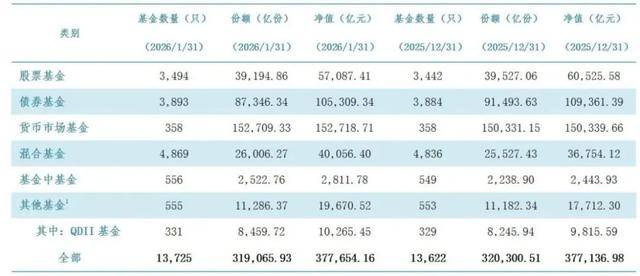
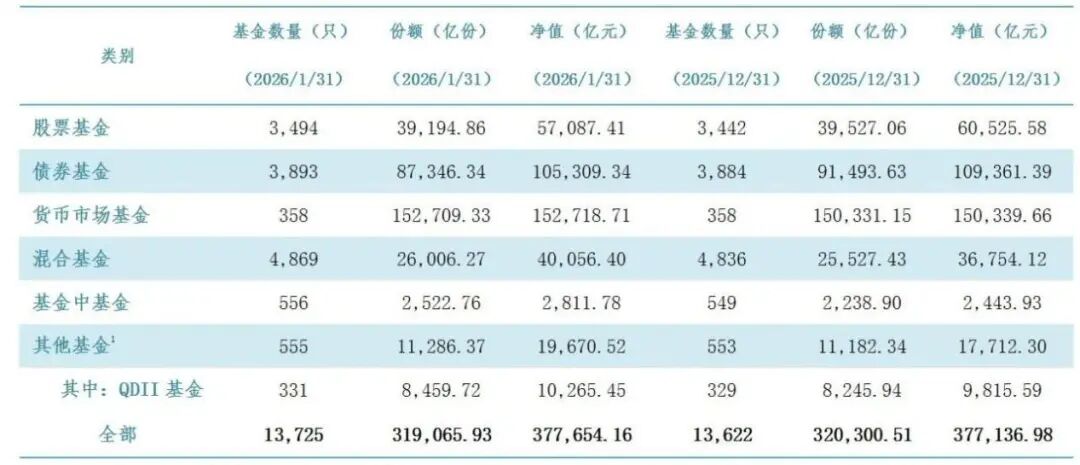
Core Insights - The public fund industry in China has reached a record high in total assets, amounting to 37.77 trillion yuan as of the end of January 2026, marking the tenth consecutive month of growth [1][2][4]. Fund Size and Growth - The total net asset value of public funds managed by 165 institutions, including 150 fund management companies, has increased significantly [2]. - Mixed, money market, and other funds have been the main contributors to this growth, with each category seeing an increase of over 100 billion yuan [1][4]. - Fund of Funds (FOF) has shown remarkable growth, with a 15.05% increase in share and a 12.68% increase in scale, reaching 2,522.76 billion shares and 2,811.78 billion yuan respectively [5][7]. Fund Performance by Type - Stock funds have experienced a decline, with a reduction of over 3,400 billion yuan, while bond funds also saw a decrease of over 4,000 billion yuan due to the "stock-bond seesaw" effect [1][8]. - The total share of public funds reached 31.91 trillion shares, a slight decrease of 0.39% compared to December 2025, but the overall scale still grew by 0.14% [3][4]. Specific Fund Categories - Mixed funds have shown strong performance, with a scale increase of 8.98%, reaching 40,056.40 billion yuan [7][8]. - Money market funds also saw a growth of 1.58%, with a scale of 152,718.71 billion yuan [7][8]. - The significant decline in stock ETFs, which dropped by 6,036.23 billion yuan, has negatively impacted the overall stock fund size [8].
37.77万亿!公募基金规模,连续10个月创新高
Zhong Guo Ji Jin Bao· 2026-02-27 16:05
Core Viewpoint - The total scale of public funds in China has reached a historical high of 37.77 trillion yuan, driven by multiple factors including seasonal market activity and an influx of new capital [1][2]. Fund Scale and Growth - As of the end of January 2026, the total scale of public funds has increased for 10 consecutive months, with a net asset value of 37.77 trillion yuan, marking a 0.14% increase from the previous month [2][4]. - The number of public fund management institutions in China stands at 165, including 150 fund management companies and 15 asset management institutions with public qualifications [4]. Fund Type Performance - Mixed, money market, and other funds have been the main contributors to the growth of public fund scale, each achieving a growth of over 100 billion yuan [2]. - Fund of Funds (FOF) has seen a significant increase, with a 15.05% rise in shares and a 12.68% increase in scale, reaching 2,522.76 billion shares and 2,811.78 billion yuan respectively [7][9]. Fund Size Changes - Stock funds have experienced a reduction of over 340 billion yuan, with a total scale of 5.71 trillion yuan, reflecting a 5.68% decrease [3][10]. - Bond funds also faced a decline, shrinking by over 400 billion yuan, with a total scale of 10.53 trillion yuan, a decrease of 3.71% [3][10]. - In contrast, money market funds and mixed funds have shown positive growth, with money market funds increasing by 1.58% and mixed funds by 8.98% [9][10]. Market Dynamics - The market has shown strong momentum, with public fund management scales consistently reaching new highs since April 2025, when it first surpassed 33 trillion yuan [6]. - The significant redemption of broad-based ETFs has impacted the overall scale of stock funds, contributing to the observed declines [3][10].
外围市场向好,A股或迎“开门红”
Xin Lang Cai Jing· 2026-02-24 00:04
Group 1 - The A-share market is expected to experience a "good start" due to consumer recovery and ample liquidity, with analysts noting a positive sentiment in the bond market as well [4][20][30] - During the Spring Festival, key retail and catering enterprises reported an average daily sales increase of 10.6% year-on-year, with significant growth in foot traffic and sales in major commercial areas [4][19][30] - The U.S. stock market showed a positive trend during the Spring Festival, with major indices rising, while the European Stoxx 600 index reached a historical high [4][19][30] Group 2 - Analysts predict a 76% probability of A-shares rising in the week following the Spring Festival, with an average increase of 1.3%, and an 80% probability of a 5.1% increase in the following ten days [20][30] - The bond market sentiment is expected to remain optimistic, supported by the central bank's actions and the recent decline in the 10-year government bond yield [21][30][31] - The performance of the bond market is influenced by the strong demand for institutional holdings during the holiday period, which is expected to continue supporting the market [30][31] Group 3 - The technology sector, particularly AI applications and semiconductors, remains a key investment theme globally, with potential for valuation recovery in consumer-related sectors following positive consumption data [5][20][30] - The U.S. effective tariff rate may decrease from 16.9% to 9.1% if certain tariffs are fully refunded, which could positively impact market sentiment, although uncertainties remain regarding international trade conflicts [21][30] - The domestic economic data and policy expectations will be crucial in determining the strength of the post-holiday market performance, with a focus on the upcoming economic indicators [30][31]

国泰海通|固收:春节期间需关注的几件事 ——海外篇
国泰海通证券研究· 2026-02-23 14:31
Economic Overview - The divergence in monetary policy between the US and Europe is accelerating, with the US showing signs of potential interest rate cuts being delayed until July, while the European Central Bank remains inactive with a growth forecast of only 1.1% for the Eurozone [1] - US January CPI increased by 2.4% year-on-year, which is below expectations, while GDP growth forecast has been revised up to 2.2%, indicating resilience in consumer spending [1] - The Munich Security Conference has prompted an acceleration in European defense spending, with NATO confirming a target for defense spending to rise to 5% of GDP by 2035 [1] Geopolitical Developments - The Geneva talks between Russia and Ukraine broke down after only two hours, with significant disagreements on territorial and ceasefire issues, leading to a pessimistic outlook for reaching an agreement within the year [1] - The EU has launched a €150 billion SAFE joint defense procurement plan, indicating a structural shift in European defense spending [1] Currency and Market Analysis - The Chinese Yuan has strengthened, surpassing the 6.90 mark, reaching a 33-month high, driven by a weaker dollar and improved expectations for trade negotiations [2] - The US Treasury yields are declining, primarily influenced by institutional risk reallocation and the stock-bond relationship, with a recommendation to adopt a coupon strategy for 30-year bonds [2] - European bonds are facing structural supply pressures due to the SAFE plan and defense expansion, suggesting a cautious approach to long-term bonds [2]