储能行业反内卷

Search documents
全国人大代表高纪凡:加强储能行业反内卷
中国能源报· 2026-03-09 12:23
Group 1 - Energy storage is a key pillar industry and core support for the new power system, crucial for energy structure transformation, energy security, and renewable energy consumption, significantly contributing to achieving the "dual carbon" goals [2] - Recommendations include strengthening capacity regulation to address supply-demand imbalances, implementing window guidance for new capacity approvals, and establishing a national energy storage capacity database for risk warnings [2] - The article suggests upgrading industry standards for lithium-ion batteries and energy storage systems, and creating a comprehensive evaluation system for integrated management of wind, solar, and storage [2] Group 2 - The article emphasizes the need to improve quality and safety standards in the energy storage industry, proposing mandatory national standards for core indicators such as thermal management and grid connection safety [2] - It advocates for a robust supervision mechanism and a quality traceability system across the entire supply chain, along with increased penalties for violations to enhance quality control [2] - The article highlights the issue of vicious low-price competition in the energy storage sector, recommending the establishment of a price monitoring and cost investigation mechanism to combat irrational competition [3]


储能行业健康发展倡议征求意见稿出炉
Huan Qiu Wang· 2025-08-18 10:13
Core Viewpoint - The storage industry in China is responding to intense low-price competition by signing a "anti-involution" initiative to promote fair competition and healthy development [1][2] Group 1: Initiative Overview - The initiative was released by the China Chemical and Physical Power Industry Association and includes a draft titled "Proposal for Maintaining Fair Competition Order and Promoting Healthy Development of the Storage Industry" [1] - A total of 149 companies have signed or participated in the initiative, including major players like BYD, EVE Energy, Huawei Digital, and Haicheng Energy [1] - The participating companies span various sectors of the storage industry, including lithium-ion batteries, flow batteries, sodium-ion batteries, compressed air storage, flywheel storage, supercapacitors, thermal storage, and more [1] Group 2: Content Structure of the Initiative - The initiative is divided into six chapters, covering general principles, cost pricing behavior norms, product and service fulfillment, technological innovation and green development, and industry coordination mechanisms [2] - The cost pricing behavior norms chapter emphasizes reasonable pricing and fair competition, encouraging members to base market participation on technology, service, reputation, and fulfillment capabilities [2] - It advises companies to quote prices based on their operational status, cost assessments, and project risks, while avoiding irrational low-price behaviors to prevent "bad money driving out good" [2] - In terms of bidding behavior, the initiative encourages members to adhere to principles of integrity, transparency, professionalism, and prudence, while discouraging false promises and cost-underbidding [2] - The China Chemical and Physical Power Industry Association is currently seeking feedback on the initiative and invites more willing companies to join in refining and implementing its contents [2]


南都电源亏损2.32亿背后:“缩铅扩锂”陷阵痛、电池回收降六成,发力数据中心增收不增利
Sou Hu Cai Jing· 2025-08-15 12:30
Core Viewpoint - Nandu Power (300068.SZ) is experiencing a transitional pain period after its transformation, with significant revenue and profit declines in the first half of 2025 [2][3]. Financial Performance - The company reported a revenue of 3.923 billion, a year-on-year decrease of 31.67%, and a net loss of 232 million, compared to a profit of 185 million in the same period last year [2]. - In the second quarter, the company achieved a revenue of 2.78 billion, a slight increase of 0.9% year-on-year, and a profit of approximately 34 million, indicating a turnaround [3]. Business Segments - The revenue from the resource regeneration segment fell by 65.74% to 1.086 billion, with a negative gross margin of -5.52%, a decline of 2.58% year-on-year [7][5]. - The revenue from the lithium-ion battery segment was 1.994 billion, up 17.63%, while the lead-acid battery segment generated 843 million, an increase of 16.37% [7]. - The communication and data center storage segment saw revenue growth of 34.09% to 1.89 billion, making it the only segment with positive revenue growth [9][10]. Market Dynamics - The company is focusing on the data center market, establishing long-term partnerships with major internet companies and financial institutions, and winning contracts for overseas lithium battery projects [3][10]. - The domestic battery market is facing intense competition, leading to a decline in gross margins, with domestic battery product revenue at 2.057 billion and a gross margin of 12.83%, down 11.41% year-on-year [11]. - In contrast, the overseas battery product revenue was 780 million, with a gross margin of 28.92%, indicating significantly higher profitability compared to the domestic market [12]. Strategic Adjustments - Nandu Power is adjusting its operations in response to the increasing number of retired batteries from new energy vehicles, focusing on lithium battery expansion and reducing lead battery production capacity [8]. - The company is part of a broader industry initiative to combat irrational pricing behaviors in the domestic storage market, with 149 companies participating in this "anti-involution" movement [12].

152家储能企业发声反内卷,储能企业迎来盈利改善机会
Xuan Gu Bao· 2025-08-14 15:12
Group 1 - The China Chemical and Physical Power Industry Association released a draft initiative on August 13 to promote fair competition and healthy development in the energy storage industry [1] - As of August 14, 152 companies have participated in the initiative, covering various sectors such as lithium-ion batteries, flow batteries, sodium-ion batteries, compressed air storage, flywheel storage, supercapacitors, thermal storage, PCS, BMS, energy storage system integrators, smart equipment, temperature control systems, fire protection systems, design planning, and construction installation [1] - Notably, nine out of the top ten lithium-ion battery manufacturers and eight out of the top ten energy storage system integrators have actively participated, indicating strong support and response from the energy storage industry [1] Group 2 - The energy storage battery, inverter, and system industries are experiencing accelerated expansion and increased competitive pressure, leading to profitability challenges for many companies [1] - With ongoing efforts to reduce internal competition and correct pricing, market consolidation is expected to increase, and leading companies with cost and technological advantages are anticipated to have improved profitability elasticity [1] - Goodwe ranks first globally in the small power PCS segment, while Penghui Energy has solidified its position in the energy storage lithium battery business, expanding its product offerings and establishing deep collaborations with leading clients in emerging sectors [2]


近三成系统集成商低于成本价销售 储能行业亟待反内卷落地
Di Yi Cai Jing· 2025-08-14 14:40
Core Viewpoint - The energy storage industry is facing significant challenges due to irrational price competition, leading to systemic risks and a decline in product quality and safety [1][2]. Group 1: Industry Challenges - The Energy Storage Alliance (EESA) has highlighted the emergence of pricing below reasonable costs, excessive commitments not aligned with actual capabilities, and misleading advertising practices within the energy storage sector [1]. - Data from the National Energy Administration indicates that by mid-2025, the installed capacity of new energy storage in China is expected to reach 94.91 million kilowatts (222 million kilowatt-hours), representing a growth of approximately 29% compared to the end of 2024 [1]. - The price of lithium battery storage systems has plummeted nearly 80% over the past three years, resulting in a situation where revenue growth does not translate into profit for storage companies [1]. Group 2: Industry Responses - The president of Envision Energy, Tian Qingjun, noted that nearly one-third of system integrators are selling below cost, with prices dropping significantly since the second half of 2022, leading to widespread losses across the industry [2]. - Recommendations include leading by example to resist bidding below cost, establishing enforceable self-regulatory mechanisms, and reforming the bidding evaluation process to emphasize technical capabilities over price [2]. - The energy storage industry is encouraged to learn from the wind power sector, which has successfully stabilized prices and improved profit margins through collective self-regulation [2]. Group 3: Proposed Solutions - The EESA has proposed three solutions to address the issues of low-price competition and unhealthy development: 1. Improve the management mechanisms for exhibitions and industry information dissemination, exploring price rationality and technical capability review systems [3]. 2. Promote the establishment of industry self-regulatory agreements to clearly oppose false advertising, concept switching, and malicious low pricing [3]. 3. Retain the right to take necessary restrictive measures against behaviors that severely disrupt market order [3].
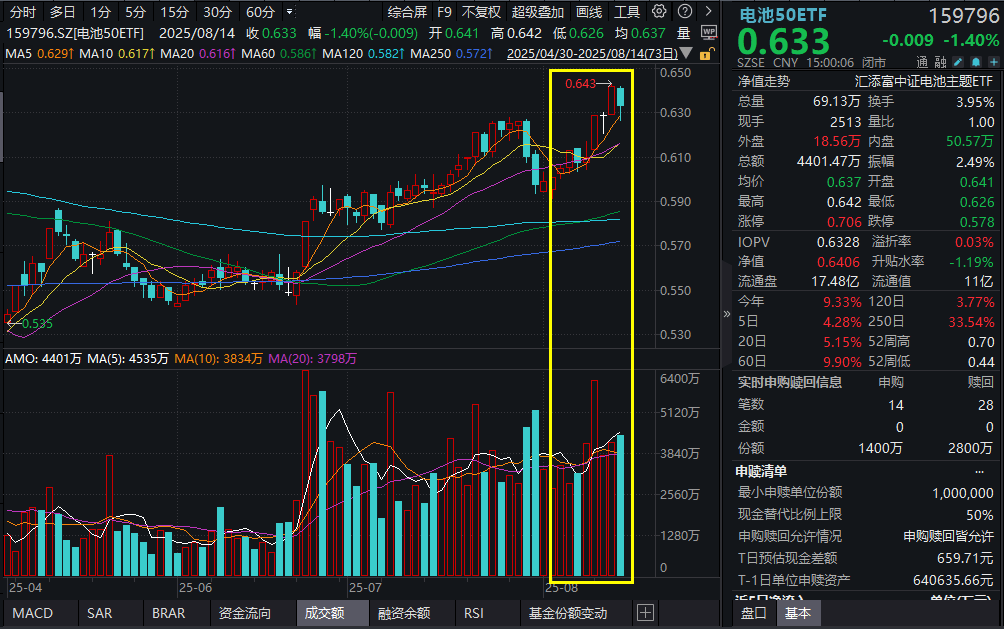
宁德时代逆势涨超2%,拟派发44亿红利!费率最低档的电池50ETF(159796)收跌1.4%,149家储能企业积极响应“反内卷”,供需格局怎么看?
Sou Hu Cai Jing· 2025-08-14 09:57
Market Overview - On August 14, the A-share market saw over 4,000 stocks decline, with a significant trading volume, and the Shanghai Composite Index closed down by 0.46% [1] - The Battery 50 ETF (159796), which is among the leading in scale and lowest in fees, narrowed its decline to 1.4% by the end of the trading session [1] Battery 50 ETF Performance - The closing price of Battery 50 ETF (159796) was 0.633, reflecting a decrease of 1.4% (-0.009) [2] - The ETF's trading volume was 69.13 million, with a turnover rate of 3.95% [2] - The ETF's net asset value was 0.6406, with a discount rate of -1.19% [2] Component Stocks Analysis - Most component stocks of the Battery 50 ETF experienced declines, with notable exceptions like Ningde Times, which rose over 2% [2][5] - Key declines included companies such as Xinnengda and Tianci Materials, both dropping over 2% [2] Ningde Times Dividend Announcement - Ningde Times announced a mid-year dividend plan for 2025, distributing 10.07 yuan per 10 shares, totaling 4.411 billion yuan [5] - The record date for the dividend is August 19, with the ex-dividend date and cash dividend payment date set for August 20 [5] Industry Trends - The China Chemical and Physical Power Industry Association released a draft proposal aimed at maintaining fair competition and promoting healthy development in the energy storage industry [5] - The proposal encourages companies to base market participation on technology, service, reputation, and performance capabilities, avoiding irrational low pricing behaviors [5] Storage Industry Insights - Guosen Securities highlighted that the "anti-involution" policy is expected to improve profitability for energy storage companies amid increasing competition [6] - The report indicates that market concentration is likely to increase, benefiting leading companies with cost and technology advantages [6] Demand for Energy Storage - The energy storage project bidding continued to see significant growth, with June 2025's bidding capacity reaching a record high of 62.8 GWh, a 228% increase from June 2024 [7] - The demand for energy storage remains strong due to the increasing penetration of renewable energy sources [7]