光伏产业技术迭代

Search documents
光伏50ETF(159864)涨超2.6%,关注下游产能扩张及技术迭代
Mei Ri Jing Ji Xin Wen· 2025-11-05 07:20
Core Viewpoint - The photovoltaic equipment industry is primarily focused on downstream capacity expansion and technological iteration, with limited short-term domestic expansion demand [1] Group 1: Industry Trends - The overseas market is advancing integrated photovoltaic capacity construction, with a greater emphasis on equipment automation and intelligence, benefiting leading enterprises [1] - High-efficiency capacity remains a development priority, with the penetration rate of high-power BC and HJT components expected to gradually increase [1] - Structural expansion demand is anticipated to be released progressively, favoring equipment manufacturers that are early adopters of new technologies [1] Group 2: Investment Products - The Photovoltaic 50 ETF (159864) tracks the photovoltaic industry index (931151), which selects listed companies involved in the entire photovoltaic industry chain, including upstream silicon materials, midstream battery cells and components, and downstream power station operations [1] - This index reflects the overall performance and development trends of listed companies in the Chinese photovoltaic industry, characterized by significant growth and volatility [1]
关于供给出清路径与时点的思考暨光储策略会预热
2025-06-09 15:30
Summary of Key Points from the Conference Call on the Photovoltaic Industry Industry Overview - The photovoltaic (PV) industry has been in a loss state since Q4 2023, continuing for approximately 6 quarters, with all companies facing gross margin losses, particularly in the manufacturing segment [1][3][10] - Cash flow is generally tight across the industry, with significant price fluctuations in silicon materials and wafers, and a continuous decline in battery component prices [1][4] - Major layoffs are occurring, with leading companies like Weima Agricultural Machinery reducing their workforce by over half, and many third and fourth-tier companies being taken over by state-owned enterprises [1][5] Core Insights and Arguments - The current holding ratio in the PV industry is below the levels seen in 2020, and even lower than in 2017 and 2019, indicating a lack of confidence among investors [2][10] - The industry is facing a dual bottom in terms of chip structure and fundamentals, with a holding ratio of only 1.83% when excluding inverters [10] - The resolution of supply-demand contradictions in the PV industry requires both policy intervention and natural market clearing, with a focus on eliminating outdated production capacity and enhancing efficiency through technological advancements [11] Future Drivers and Investment Strategies - Key future drivers for the PV industry include policy changes and technological iterations, expected to see significant developments by the end of this year [6][21] - Investment strategies should focus on silicon material companies and battery-related targets, particularly after any policy or technological changes occur [7][19] - The market is anticipated to reach a turning point by the end of 2025, with significant observations expected around July and December regarding policy and technological advancements [16][17] Technical Iteration and Market Dynamics - Technological iteration is crucial for accelerating the clearing of the PV industry, with improvements in Topcon technology potentially increasing power output by 10-15 watts [13][14] - The industry is expected to undergo a phased development model, with initial challenges for second-tier companies while leading companies may turn profitable through demand digestion and technological progress [12] Recommendations for Investors - Investors are advised to gradually position themselves in the market starting from late summer 2025, as the current low attention on the sector presents tactical opportunities [20] - Engaging with industry leaders during events, such as the upcoming PV exhibition in Shanghai, is recommended for gathering insights and formulating strategies [8][20] Additional Considerations - The takeover of third and fourth-tier companies by state-owned enterprises does not necessarily equate to market exit, as these companies may still operate effectively if they can keep up with technological advancements [9] - The overall sentiment in the market remains cautious, with a continuous decline in the number of investors reflecting a lack of confidence in the PV sector [2][10]



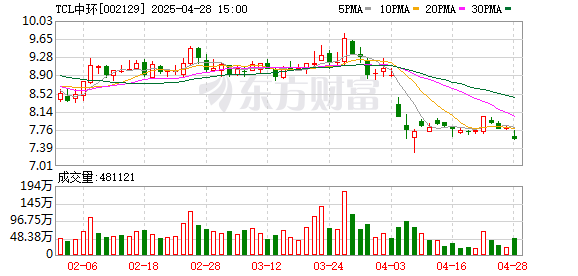
硅片综合市占率下滑,TCL中环如何扭转颓势?
Di Yi Cai Jing· 2025-04-28 12:33
Core Viewpoint - TCL Zhonghuan's significant losses in 2024 are attributed to strategic misalignment, structural weaknesses, and operational decision errors, exacerbated by the industry's cyclical downturn [2] Financial Performance - In 2024, TCL Zhonghuan reported revenue of 28.418 billion yuan, a year-on-year decline of 51.95%, with net losses of 9.818 billion yuan and a decrease in net profit margin of 387.42% [3] - The company faced three main challenges leading to losses: 1) Industry price drops below cash costs, resulting in negative gross margins; 2) Insufficient competitiveness in battery and component sectors; 3) Declining prices in the European and American markets affecting subsidiary Maxeon's performance [3] Asset Impairment - Asset impairment losses contributed significantly to net profit losses, totaling 5.199 billion yuan, primarily from inventory write-downs of 4.054 billion yuan and goodwill impairment of 915 million yuan [4] - As of the end of 2024, the company's inventory balance was 8.676 billion yuan, with a write-down provision of 2.352 billion yuan, indicating ongoing challenges in inventory management [4] Market Share and Transition Challenges - TCL Zhonghuan's market share in the silicon wafer sector decreased by 4.6 percentage points in 2024, raising concerns about the company's ability to regain lost market share amid a transition to N-type technology [2] - The company reported a year-on-year increase of 19% in component shipments in Q1 2025, indicating some progress in addressing component business challenges [5] Industry Context - The solar industry is experiencing a demand contraction following a period of rapid installation, leading to uncertainties in cash flow and cost management for manufacturers [6] - The competitive landscape is intensifying, with companies needing to adapt quickly to market demands and technological advancements to maintain their market positions [6]