BC组件

Search documents
全球组件出货排名公布:隆基与晶科并列
Xin Lang Cai Jing· 2026-02-27 10:30
Core Insights - InfoLink has released the global component shipment rankings for 2025, indicating a total shipment volume of approximately 536GW from the listed suppliers [4][9]. Group 1: Shipment Rankings - The top four companies account for about 58% of the total shipments, with a clear division at 60GW between the leading companies and the subsequent ones [10]. - The first tier of suppliers has a shipment range of 80-90GW, with JinkoSolar and Longi Green Energy tied for first place, following the addition of U.S. component manufacturers [11]. - The second tier, with shipments between 60-70GW, includes Trina Solar and JA Solar, which are tied for third place [11]. Group 2: Additional Tiers - The third tier has shipments ranging from 30-50GW, with Tongwei and Chint New Energy maintaining their existing rankings as fifth and sixth, respectively [12]. - The fourth tier has shipments between 20-30GW, featuring GCL-Poly in seventh place, while LONGi and Canadian Solar are tied for eighth. TCL Zhonghuan, Yingli Green Energy, and Jida New Energy are tied for tenth place [12]. Group 3: Technology Trends - In terms of technology, TOPCon components have become the dominant product among the top ten suppliers, with nearly 95% of shipments attributed to this technology, while PERC accounts for only 1-2% [12]. - The statistics do not accurately reflect the global market share of BC and HJT technologies, as major HJT manufacturers were not included in the rankings, focusing instead on the mainstream companies' shipment strategies [12].






英大证券电力能源行业周报-20260225
British Securities· 2026-02-25 02:04
Investment Rating - The investment rating for the industry is "Outperform the Market" [1][57]. Core Insights - The report highlights the recent issuance of the "Implementation Opinions on Improving the National Unified Electricity Market System" by the State Council, marking a significant step in the market-oriented reform of the electricity sector [10][11]. - The report indicates that the electricity market reform has transitioned from regional trials to a systematic nationwide approach, aiming for a unified market by 2030 where 70% of electricity consumption will be market-based [10][11]. - The renewable energy sector has seen historic breakthroughs, with renewable energy accounting for 83% of new installed capacity in 2025, surpassing traditional coal power for the first time [12]. Industry Events - On February 11, 2026, the State Council released a document outlining the framework for a unified electricity market, emphasizing the need for a coordinated national approach to electricity market reforms [10][11]. - The National Energy Administration reported that in 2025, new renewable energy installations reached 45.2 million kilowatts, a 21% increase year-on-year, with wind and solar power contributing significantly to this growth [12]. Market Performance - During the period from February 9 to February 15, 2026, the Shanghai and Shenzhen 300 Index rose by 0.36%, while the electricity equipment index increased by 1.13%, outperforming the broader market by 0.77 percentage points [13][15]. - Among the sub-sectors of the electricity industry, transmission and transformation equipment, other power equipment, and grid automation equipment saw the highest increases, with respective gains of 5.24%, 5.22%, and 3.98% [19]. Electricity Industry Operations - In December 2025, the total electricity consumption reached 908 billion kilowatt-hours, reflecting a year-on-year growth of 2.77%. The cumulative electricity consumption for the entire year was 10,368.2 billion kilowatt-hours, marking a 5.00% increase [20][22]. - The total installed capacity of new power generation in 2025 was 546.17 million kilowatts, representing a year-on-year increase of 26.07% [22][24]. New Power System Developments - As of December 2025, the cumulative installed capacity of energy storage projects in China reached 213 GW, a 54% increase year-on-year, with new energy storage installations growing by 85% [40]. - The total number of charging infrastructure units in China reached 20.092 million by the end of December 2025, showing a year-on-year growth of 56.75% [49].
山西证券:AIDC电源革命创新机 光伏反内卷静待供需拐点
智通财经网· 2026-02-11 03:49
Group 1: Global AIDC and CAPEX Trends - The global demand for intelligent computing (AIDC) is experiencing significant growth, with major cloud companies increasing their capital expenditures (CAPEX). The top three global cloud providers are expected to cumulatively spend nearly $300 billion in CAPEX for the fiscal year 2025. Domestic companies in China are also accelerating their CAPEX, with Tencent's forecast raised from 300 billion yuan to 350 billion yuan for the fiscal years 2025-2027, and Alibaba's forecast increased to 460 billion yuan for the same period [1][2] Group 2: High Voltage Direct Current (HVDC) Technology - High Voltage Direct Current (HVDC) is emerging as a superior solution for powering next-generation data centers. The shift towards high-density and high-energy consumption data centers is driving the upgrade of power distribution systems. The expected market size for global HVDC is projected to reach 2.45 billion yuan, 14.49 billion yuan, and 30.26 billion yuan for the years 2025-2027 respectively [2][3] Group 3: Photovoltaic Industry Developments - The photovoltaic (PV) industry is transitioning towards high-quality development, with domestic PV installations reaching a record high in 2025. The cumulative new PV installations in China from January to November 2025 amounted to 274.89 GW, a year-on-year increase of 33.2%. However, global installation growth is expected to slow down after 2026, with projections indicating a decrease of 6 GW in global installations from 655 GW in 2025 to 649 GW in 2026 [3][4] Group 4: Industry Price Trends and Supply Chain Adjustments - The PV industry is witnessing a price turning point, with new technologies still commanding a premium. After a period of price fluctuations, the prices of PV products began to stabilize in late 2025. The price of BC components is currently at 0.76 yuan/W, showing a premium over TOPCon technology. The upstream segment is expected to benefit first, with significant profit recovery potential in the mid and downstream segments [4][5] Group 5: Investment Recommendations - The focus is on recommending investments in the AIDC sector, particularly in HVDC, SST, and energy storage solutions. Key recommended companies include Zhongheng Electric and Siyuan Electric, with additional attention on Keda Data, Kstar, and others. In the PV sector, recommendations include supply-side improvements and new BC technologies, with key companies such as Flat Glass and Quartz Shares highlighted [5][6]

电力能源行业周报-20260203
British Securities· 2026-02-03 12:53
Investment Rating - The industry investment rating is "Outperform the Market" [1][61] Core Insights - The report highlights the recent policy changes by the National Development and Reform Commission and the National Energy Administration regarding the capacity pricing mechanism for power generation, which aims to enhance the profitability of coal and gas power sources and stimulate investment in new energy storage projects [10] - The report indicates a significant increase in installed power generation capacity, with a total of 389 million kilowatts by the end of 2025, reflecting a year-on-year growth of 16.1%, and emphasizes the shift towards renewable energy sources [11][12] - The average utilization hours of power generation equipment decreased to 3119 hours in 2025, down 312 hours from the previous year, indicating challenges in energy consumption efficiency amidst rapid capacity expansion [12][27] Industry Events - On January 30, 2026, a notification was issued to improve the capacity pricing mechanism for coal, gas, and pumped storage power generation, establishing a new pricing mechanism for grid-side energy storage [10] - The National Energy Administration released national electricity statistics for 2025, showing a substantial increase in solar and wind power generation capacity [11] Market Performance - During the period from January 26 to February 1, 2026, the Shanghai and Shenzhen 300 index rose by 0.08%, while the power equipment index fell by 5.10%, underperforming the broader market [13][15] - Among the sub-sectors related to power energy, only the comprehensive energy service and hydropower sectors saw slight increases, while thermal power equipment and battery-related sectors experienced significant declines [19] Power Industry Operations - In December 2025, the total electricity consumption reached 908 billion kilowatt-hours, a year-on-year increase of 2.77%, with a total annual consumption of 10368.2 billion kilowatt-hours, reflecting a 5.00% growth [20][22] - The newly added power generation capacity for 2025 was 54617.1558 megawatts, with notable growth in thermal and wind power, while hydropower and nuclear power saw declines [22][24] New Power System Developments - As of December 2025, the cumulative installed capacity of energy storage projects in China reached 213 GW, a year-on-year increase of 54%, with new energy storage capacity growing by 85% [44] - The report provides detailed pricing trends for various components in the photovoltaic industry, indicating stability in polysilicon prices and fluctuations in battery component prices [37][47][48] - The total number of charging infrastructure units in China reached 20.092 million by the end of December 2025, marking a 56.75% increase year-on-year [51]
重回1元/W时代?2026年光伏组件价格有三重强支撑
3 6 Ke· 2026-01-23 02:19
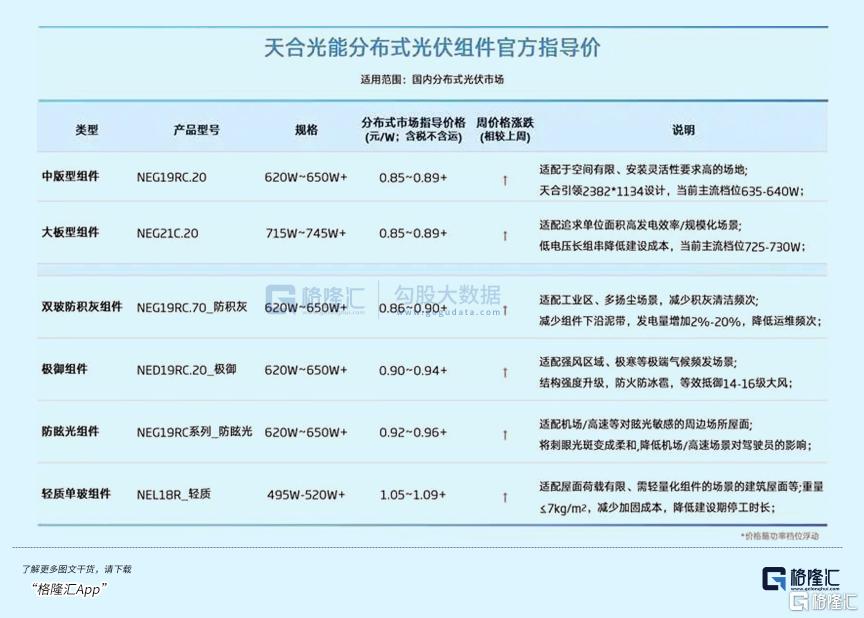
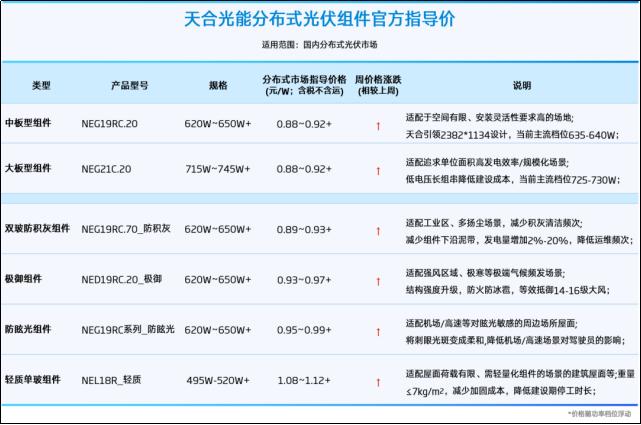
Core Viewpoint - The steady increase in photovoltaic module prices indicates a positive market trend, with major companies like Trina Solar raising their prices multiple times in January 2023, signaling strong demand and a potential return to the 1 yuan/W price point for modules [1][3]. Price Adjustments - Trina Solar has raised its distributed photovoltaic module market guidance price for the third time in January, with prices now ranging from 0.88 to 1.12 yuan/W depending on the module type [1][2]. - The average price of bifacial double-glass TOPCon modules reached approximately 0.7 yuan/W, reflecting a 0.3% increase from the previous week and a 1% increase from a month ago [3]. Demand Side - The photovoltaic industry has seen explosive growth since 2020, with China's new installed capacity expected to reach 277.17 GW in 2024, a significant increase from 48.2 GW in 2020 [4]. - Despite a generally pessimistic outlook for 2026, emerging markets like India are projected to see substantial growth, with an expected 25% increase in new installations [7][8]. Supply Side - The "anti-involution" policy is expected to continue, aiming to eliminate low-price competition and improve market conditions [10][12]. - Market-driven elimination of excess capacity is anticipated to accelerate in 2026, as many companies face financial difficulties and may exit the market [13][14]. Cost Factors - Rising silver prices, which have increased over 33% since the beginning of the year, are a significant factor driving up the costs of photovoltaic modules [15][17]. - The cancellation of export tax rebates is expected to increase cost pressures on exporting companies, further supporting price increases [18]. Overall Market Outlook - The combination of demand, supply, and cost factors is likely to keep module prices strong, with a potential return to the 1 yuan/W price point, indicating a recovery in the photovoltaic industry [19].

光伏龙头企业“亏损潮”延续,专家:2026年三四月份有望迎来拐点
Hua Xia Shi Bao· 2026-01-22 09:35
Core Viewpoint - The photovoltaic industry is experiencing significant losses across all major segments, with a call for recovery and improvement in profitability by 2026, focusing on asset management and pricing power [2][11]. Group 1: Industry Performance - The photovoltaic sector is in a "dark moment," with all major segments, including silicon materials, wafers, cells, and modules, reporting losses [2]. - The overall performance of the industry is characterized by high inventory and weak demand, despite some signs of recovery in silicon material prices [3]. - The integrated companies face significant pressure, with a notable decline in profitability due to rising costs of key materials like silver paste [3][6]. Group 2: Company-Specific Insights - Daqo New Energy forecasts a net loss of 1 to 1.3 billion yuan for 2025, but with a reduced loss margin of 52.17% to 63.21% year-on-year due to improved operational efficiency [3]. - Longi Green Energy expects a net loss of 6 to 6.5 billion yuan, a reduction of over 2 billion yuan compared to the previous year, driven by increased production efficiency [5]. - Junda Co. anticipates a net loss of 1.5 to 1.2 billion yuan, significantly higher than the previous year's loss of 590 million yuan, citing supply-demand imbalance and price transmission issues [4]. Group 3: Component and Equipment Sector - Companies focusing on Bifacial (BC) modules, such as Aiko Solar, are seeing a significant reduction in losses, with expected losses narrowing from 5.319 billion yuan to between 1.9 billion and 1.2 billion yuan [5]. - The equipment sector, represented by Aotai Technology, is also facing declines, with expected revenue dropping by 26.71% to 30.50% year-on-year [8]. - Silver paste manufacturer Dike Co. is projected to shift from profit to loss, with expected losses of 200 to 300 million yuan due to rising silver prices [9]. Group 4: Future Outlook - The industry is still in a phase of "deleveraging and capacity reduction," but there are signs of recovery in upstream segments, with discussions about potential profitability improvements in 2026 [11][12]. - Aiko Solar reports that its ABC module sales volume is expected to double, indicating a positive trend despite overall losses [12]. - Analysts predict that the industry may see a shift from supply-demand pricing to cost-based pricing by early 2026, potentially improving profit margins significantly [12].





巨亏!光伏龙头,突发利空!
券商中国· 2026-01-18 15:50
Core Viewpoint - The photovoltaic industry is experiencing widespread losses, with major companies like Longi Green Energy and Tongwei Co. both forecasting significant net losses for 2025, indicating ongoing challenges in the sector [1][2][6]. Group 1: Company Performance - Longi Green Energy expects a net loss of 60 to 65 billion yuan for 2025, with a projected loss of 68 to 74 billion yuan after excluding non-recurring items [2][5]. - Tongwei Co. anticipates a net loss of approximately 90 to 100 billion yuan for 2025, compared to a loss of 70.39 billion yuan in 2024 [6]. - Aiko Solar predicts a net loss of 12 to 19 billion yuan for 2025, citing structural overcapacity and ongoing price pressures [7]. Group 2: Industry Challenges - The photovoltaic industry is facing a deep adjustment phase, with supply-demand mismatches and intense price competition leading to sustained low operating rates [5][8]. - Rising costs of raw materials, such as silver and silicon, have further pressured profit margins, contributing to the overall losses in the sector [5][6]. - The industry is expected to undergo a reshaping process in 2026 as "anti-involution" measures take effect, potentially restoring supply-demand balance and improving pricing [1][10]. Group 3: Price Trends - Recent data indicates an increase in photovoltaic component prices, with TOPCon and BC components seeing price adjustments due to changes in export tax policies and rising silver prices [1][10]. - The average transaction price for distributed photovoltaic components has reached between 0.67 yuan/watt and 0.8 yuan/watt, with an average of 0.72 yuan/watt [10]. Group 4: Future Outlook - Analysts suggest that policy adjustments may accelerate industry consolidation and capacity elimination, with leading Chinese battery companies likely to enhance their global competitiveness in the long term [11].
毁约式涨价,光伏组件上演“最后的疯狂”
Ge Long Hui· 2026-01-17 13:22
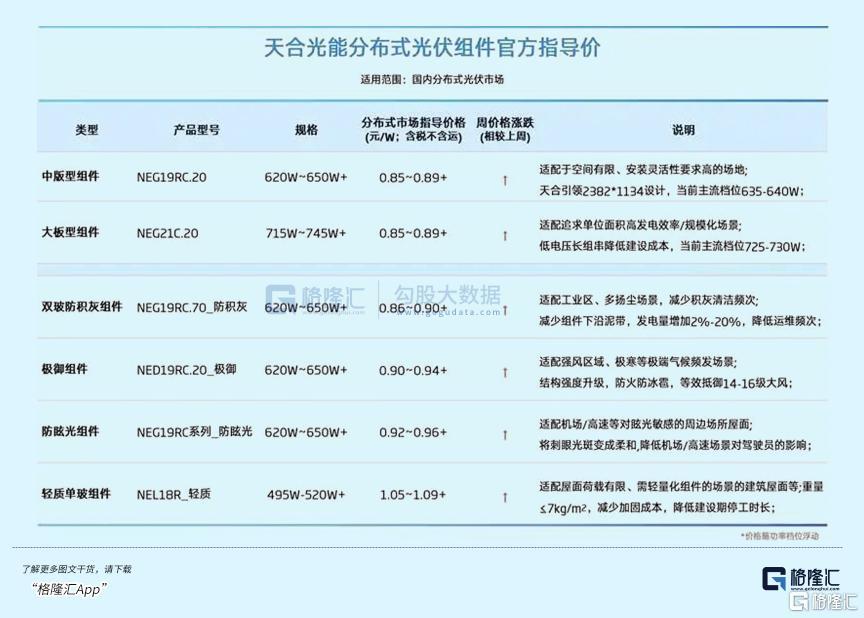
Core Viewpoint - The photovoltaic (PV) module industry is experiencing an unexpected price surge at the beginning of 2026, driven by factors such as the impending cancellation of export tax rebates and rising costs of key materials like silver and aluminum, leading to significant profit compression and potential industry-wide consolidation [1][13][20]. Price Surge and Contract Violations - Several distributed PV investment companies have reported sudden price increases on previously agreed contracts, with some major manufacturers raising prices from 0.73 yuan/W to 0.8 yuan/W [3]. - On January 13, Trina Solar announced collective price increases for various product models, with distributed PV module prices ranging from 0.85 to 0.89+ yuan/W [3]. - A total of 12 module manufacturers raised their prices this week, with increases of 0.04 to 0.15 yuan/W, and some companies have raised prices multiple times within a week [5]. - Reports indicate that some companies are delaying deliveries or demanding price increases, causing significant disruptions in the supply chain for terminal power station installations [5][6]. Causes of Price Increases - The cancellation of export tax rebates, effective April 1, 2026, is a major catalyst for the price surge, as manufacturers rush to ship products before the policy takes effect [6][7]. - The price of silver has skyrocketed, increasing from 7,600 yuan/kg at the beginning of 2025 to 23,688 yuan/kg by the end of the year, resulting in a cost increase of at least 0.16 yuan per watt for PV modules [8][10]. Industry Challenges and Overcapacity - The PV industry is facing severe challenges due to overcapacity, with silicon material production capable of covering more than double the global demand from 2025 to 2027, while actual demand is below 600 GW [13][14]. - Despite the overcapacity, over 40 billion yuan is still being invested in new PV projects, exacerbating supply-demand imbalances [14]. - The cancellation of export tax rebates is expected to be a turning point for the industry, as it has historically provided significant cash flow support to manufacturers [15][16]. Financial Impact on Companies - The removal of export tax rebates will reduce profits for manufacturers significantly, with estimates indicating a loss of 46-51 yuan per 210R module exported [17]. - Many companies are already experiencing negative cash flow, with 41% of listed firms reporting losses, leading to a potential wave of bankruptcies among smaller firms [17][20]. - Major companies like JA Solar and TCL Zhonghuan are reporting substantial losses, with JA Solar expected to lose between 4.5 to 4.8 billion yuan in 2025 [19]. Future Outlook and Industry Consolidation - The anticipated industry consolidation may eliminate over 30% of inefficient capacity, concentrating resources among leading firms with integrated capabilities and advanced technologies [22]. - The industry is expected to emerge healthier post-consolidation, with a focus on identifying valuable investment opportunities in robust companies with strong cash flow and competitive advantages [22].
告别“退税依赖” 中国光伏开启技术与全球化新竞速
Zheng Quan Shi Bao Wang· 2026-01-17 12:29
Core Viewpoint - The recent adjustment in the value-added tax export rebate policy for photovoltaic products has led to an unexpected increase in component prices, despite the typical seasonal demand downturn in the first quarter of the year [1]. Group 1: Policy Impact - The Ministry of Finance and the State Taxation Administration announced the cancellation of the value-added tax export rebate for photovoltaic products starting April 1, 2026, affecting 249 products across the entire industry chain [2]. - The cancellation of the rebate is expected to trigger a "last-minute rush" for exports, as overseas buyers place orders to avoid increased costs after the policy change [2]. - Analysts predict a significant increase in component export volume during this period, potentially boosting short-term industry demand [2]. Group 2: Financial Implications for Companies - Major photovoltaic and energy storage companies are projected to lose between 1 billion to 2 billion yuan in export rebates annually, which could reduce the profit per 210R photovoltaic component by 46 to 51 yuan, leading to a potential decline in export volume by 5% to 10% [3]. Group 3: Strategic Responses from Companies - In response to the policy changes, leading companies like Longi Green Energy, JinkoSolar, Trina Solar, and Canadian Solar are accelerating their global expansion efforts, establishing production bases in regions such as Southeast Asia, the Middle East, and the United States [4]. - Companies are focusing on local production to bypass export rebate losses and enhance supply chain resilience [4]. - The cancellation of the rebate is expected to diminish the cost advantage of Chinese photovoltaic components, prompting a shift towards technological innovation and brand development as key competitive strategies [4]. Group 4: Long-term Industry Outlook - The policy adjustment aims to address the long-standing issue of low-price competition in the photovoltaic industry, which has led to reduced profit margins and increased international trade friction [5]. - The removal of the export rebate is anticipated to redirect financial resources towards domestic technological research and development, thereby improving the efficiency of fund utilization [6]. - The adjustment is likely to accelerate industry consolidation and capacity elimination, with leading battery companies expected to enhance their global competitiveness and market share in the long run [6].
毁约式涨价!光伏组件上演“最后的疯狂”
Ge Long Hui A P P· 2026-01-17 11:23
Core Viewpoint - The photovoltaic (PV) module industry is experiencing an unexpected price surge in early 2026, driven by the impending cancellation of export tax rebates and rising costs of key materials like silver and aluminum, leading to significant profit compression and potential industry-wide upheaval [1][7][19]. Price Surge and Market Dynamics - Several distributed PV investment companies have reported sudden price increases on previously agreed contracts, with one leading manufacturer raising prices from 0.73 yuan/W to 0.8 yuan/W [2]. - On January 13, Trina Solar announced a collective price increase for various distributed PV module models, with official guidance prices ranging from 0.85 to 0.89+ yuan/W [2][3]. - A total of 12 module manufacturers raised their prices this week, with increases ranging from 0.04 to 0.15 yuan/W [4]. Cost Factors - The cancellation of export tax rebates, effective April 1, 2026, is a significant catalyst for the price increases, as companies rush to fulfill orders before the policy takes effect [7][8]. - The price of silver has surged over 150% in 2025, increasing its cost share in PV modules from approximately 17% to around 30%, making it the largest cost component [10][13]. - The rising prices of aluminum and other materials have further exacerbated cost pressures, with aluminum's cost share increasing from 8-12% to 12-15% [14][16]. Industry Overcapacity and Challenges - The PV industry is facing severe overcapacity, with silicon production capacity expected to cover more than double the global demand from 2025 to 2027, while actual demand is below 600 GW [17]. - Despite the overcapacity, over 40 billion yuan is still being invested in new PV projects, worsening the supply-demand imbalance [18]. - The cancellation of export tax rebates is anticipated to trigger a brutal industry-wide clearing, with many companies lacking competitive advantages likely to exit the market [19][24]. Financial Impact and Future Outlook - The removal of export tax rebates will significantly reduce profit margins for PV companies, with estimates indicating a profit reduction of 46-51 yuan per 210R module exported [24]. - Many companies are already reporting substantial losses, with projections indicating that the entire PV silicon industry could face losses amounting to hundreds of billions in 2025 [27][28]. - The industry is expected to undergo a significant consolidation, with over 30% of inefficient capacity being eliminated, allowing leading companies with strong technology and global presence to capture over 80% of the market share [29].