免签+免税

Search documents
免签入境海南外国人同比增长64%
Hai Nan Ri Bao· 2026-01-20 01:22
Core Insights - The entry tourism market in Hainan is experiencing rapid growth following the implementation of the free trade port policy, with a significant increase in both the number of inbound travelers and the diversity of source markets [2][3] Group 1: Market Growth - In the first month since the closure, Hainan welcomed 289,100 inbound and outbound travelers, marking a 31.3% increase year-on-year, with foreign visitors under visa exemption rising by 64% [2] - By December 2025, Hainan is projected to receive 773,000 overnight inbound tourists, representing a 59.5% increase compared to 2024, surpassing pre-pandemic levels [2] Group 2: Source Market Diversification - The structure of inbound tourist markets is improving, with stable growth from traditional markets such as Russia and Southeast Asia, while long-distance markets like Europe and Australia are also showing strong performance [2] - By December 2025, tourist numbers from the UK, France, Italy, Spain, and Australia are expected to increase by 56%, 83%, 144%, 62%, and 52% respectively [2] Group 3: Consumer Behavior Changes - Total spending by inbound tourists reached $14.14 million in December 2025, a 63% increase year-on-year, indicating a shift from shopping to immersive experiences [3] - The average length of stay for inbound tourists increased from 3.37 nights in 2024 to 3.96 nights, reflecting a transition from transit tourism to deeper travel experiences [3] Group 4: Future Strategies - The Hainan Tourism and Culture Department plans to enhance market outreach through international promotion and high-end platforms, while also improving service quality to strengthen Hainan's position as an international tourism consumption center [3]
持续打响“免签+免税”核心品牌
Xin Lang Cai Jing· 2026-01-19 17:09
Core Insights - The Hainan Free Trade Port has achieved a successful first month of operation with significant policy benefits for the inbound tourism market, marking a "good start" [1] Group 1: Market Development Strategies - The focus will be on three main areas for further development: deepening the source market, enhancing promotional efforts, and strengthening service foundations [1] - Plans include conducting no less than 10 promotional activities in key source markets and inviting overseas travel agencies and airlines for on-site discussions to deepen cooperation [1] - The aim is to secure long-term hosting of major events like the China International Tourism Trade Fair and to apply for the World Tourism Economic Forum [1] Group 2: Promotion and Branding - The strategy involves leveraging online international social platforms and the Ministry of Culture and Tourism's global promotion network to enhance the "visa-free + duty-free" brand [1] - There is a commitment to improving the international service environment to elevate overall competitiveness and enhance Hainan's image as an international tourism consumption center [1]
“免签+免税”黄金组合将流量变增量 “中国游”“中国购”呈现新亮点、新变化
Yang Shi Wang· 2025-12-18 01:59
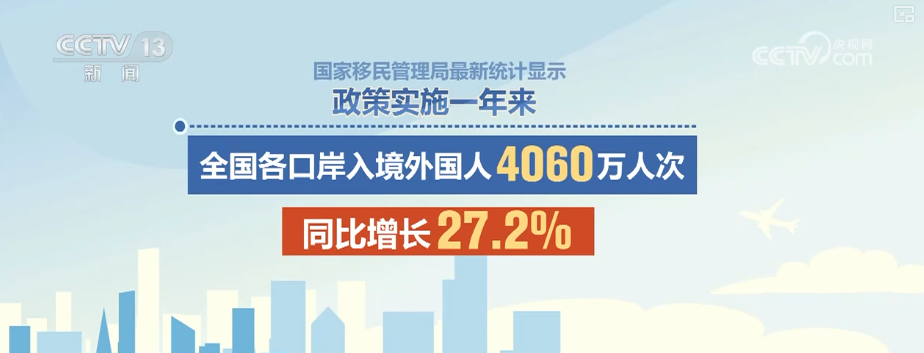
Core Viewpoint - The implementation of the 240-hour visa-free transit policy in China has significantly increased foreign traveler inflow and transformed tourism consumption patterns, marking a new era for inbound tourism in the country [1][3]. Group 1: Policy Impact - The 240-hour visa-free transit policy, effective from December 17, 2024, covers 55 countries and 65 open ports across 24 provinces, facilitating easier entry for foreign travelers [1]. - In the first year of implementation, the number of foreign entrants reached 40.6 million, a year-on-year increase of 27.2%, with those utilizing the 240-hour visa-free transit increasing by 60.8% compared to the period before the policy optimization [3][5]. Group 2: Regional Performance - Major entry hubs like Beijing, Shanghai, and Guangzhou have seen substantial growth in foreign traveler numbers, with Beijing receiving over 3.4 million foreign visitors, 55% of whom benefited from the visa-free policy [5]. - Other ports have experienced explosive growth, with Xiamen seeing a threefold increase in foreign entrants, and Liaoning witnessing a 5.7-fold increase [5]. Group 3: Tourism Consumption Trends - The extended stay period of 240 hours has shifted foreign travelers' focus from mere transit to deeper exploration, with 60% opting for cross-province travel [8]. - New tourism patterns such as "transit + deep travel" and "multi-stop journeys" have emerged, enhancing the overall travel experience [6][10]. Group 4: Economic Impact - Inbound tourism spending has surged, with Beijing's foreign visitor spending reaching 41.7 billion RMB, a 48% increase year-on-year [12]. - The combination of the visa-free policy and optimized tax refund services has effectively converted inbound traveler flows into economic growth, with a notable increase in second-time spending [13][15]. Group 5: Collaborative Opportunities - Regions like Guizhou are transforming from "geographical hinterlands" to "open gateways," leveraging the policy to attract foreign business and tourism [12]. - The synergy between visa-free entry and tax-free shopping has led to increased consumer spending, particularly in duty-free zones like Sanya, where average spending per visitor exceeds 8,000 RMB [16].