
全栈人工智能

Search documents
阿里喊出AI云五年干1000亿美元:底气还是画饼?
雷峰网· 2026-03-27 08:23
Core Viewpoint - Alibaba Cloud needs to balance "calculating accounts" and "telling stories" to navigate its growth strategy in the AI and cloud sectors [1] Group 1: Financial Performance and Growth - Alibaba's stock price dropped significantly after the Q3 FY2026 earnings report, with a decline of over 9% in US markets and 6.29% in Hong Kong markets [2][3] - Despite the stock drop, many investors are optimistic about Alibaba Cloud's growth potential, as its revenue growth rate has increased from 18% to 36% over the past four quarters, regaining its position among the top global cloud vendors [3][4] - In Q3, Alibaba Cloud reported total revenue of 43.284 billion yuan, a year-on-year increase of 36%, driven primarily by public cloud revenue growth [4] Group 2: Future Revenue Targets - Alibaba Cloud aims to achieve over $100 billion (approximately 690 billion yuan) in AI and cloud-related revenue over the next five years, which requires nearly a sevenfold increase from its current annual external commercialization revenue of 100 billion yuan [5][6] - The ambitious target implies a compound annual growth rate (CAGR) of approximately 47%, raising questions about the feasibility of such growth [5][6] Group 3: Growth Drivers - To reach the $100 billion revenue target, Alibaba Cloud must identify new and substantial growth drivers, with MaaS (Model as a Service) being highlighted as a key area [9] - Recent developments indicate a significant increase in token consumption for MaaS, with a reported sixfold increase in the past three months, driven by advancements in AI applications [12] - The pricing landscape for tokens is also changing, with recent price increases for various MaaS products, suggesting a potential for improved profitability [13] Group 4: Competitive Landscape - Alibaba Cloud holds a leading position in the AI cloud market with a 30.2% market share, but faces increasing competition from other cloud providers like Baidu and Volcano Engine [19][20] - The competitive pressure is heightened by the rapid advancements of competitors in the MaaS space, which could impact Alibaba's market share and growth trajectory [20][21] Group 5: Challenges Ahead - Achieving the $100 billion revenue target presents significant challenges, including maintaining a high compound growth rate while defending existing market share [23][24] - The traditional cloud market is experiencing slower growth, and Alibaba must also contend with aggressive pricing strategies from competitors [25] - The transition of customers from MaaS to core cloud services poses both an opportunity and a challenge for Alibaba Cloud in retaining its existing customer base [25][26] Group 6: Market Perception and Valuation - The market is reassessing Alibaba's identity as either an e-commerce or technology stock, with potential valuations for its cloud business significantly exceeding its current market cap if growth targets are met [30] - Investor anxiety regarding the high capital expenditures and long-term profitability of AI and cloud investments reflects the broader uncertainties in the market [30]


Gartner最新报告:亚太为何只有一家GenAI“领导者”?
2 1 Shi Ji Jing Ji Bao Dao· 2025-11-26 05:32
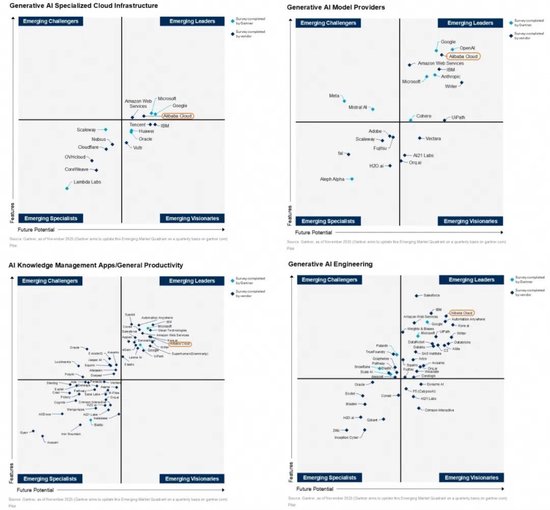
Core Insights - Gartner's latest report positions Alibaba Cloud as a "Leader" in the Generative AI market, making it the only vendor in the Asia-Pacific region to achieve this status alongside Google and OpenAI [1][3] - The report evaluates Generative AI across four dimensions: cloud infrastructure, engineering platforms, foundational models, and knowledge management applications, with Alibaba Cloud recognized as a leader in all four areas [3][5] - Multiple authoritative reports have reaffirmed Alibaba Cloud's leading position, with a significant market share in China's enterprise-level model usage [5][8] Group 1: Market Position and Recognition - Alibaba Cloud is the only company in the Asia-Pacific region to be rated as a leader across all four dimensions of Generative AI by Gartner [3][5] - Frost & Sullivan's report indicates that Tongyi, Alibaba's model, holds the largest market share in China's enterprise-level model usage as of the first half of 2025 [5] - Omdia's findings show that over 70% of Fortune China 500 companies have adopted Generative AI, with Alibaba Cloud having a penetration rate of 53%, the highest among competitors [5][8] Group 2: Competitive Landscape - The AI cloud market is filled with claims of being "number one," but definitions of "AI cloud" vary across different research firms, leading to different interpretations of market leadership [5][6] - The true competition lies in the ability to integrate across the entire stack rather than excelling in isolated segments, as highlighted by Gartner's four-dimensional evaluation [5][6] - Alibaba Cloud's comprehensive product offerings align with its positioning as a full-stack AI service provider, demonstrating its capability to deliver end-to-end solutions [11][14] Group 3: Infrastructure and Technological Advancements - Alibaba Cloud has committed significant investments in AI infrastructure, including a 380 billion yuan investment announced in February and plans to expand cloud data center energy consumption by tenfold by 2032 [6][14] - The efficiency of Alibaba Cloud's AI training and inference has improved significantly, with its one-stop AI development platform achieving over three times acceleration in model training [6][14] - The Tongyi model family has established a complete lineup, with a penetration rate of 53% among Fortune China 500 companies, serving over 1 million clients [8][16] Group 4: Global Influence and Strategic Moves - Alibaba's open-source models have gained significant traction globally, with Singapore's national AI initiative shifting to Alibaba's Tongyi Qwen architecture for its Southeast Asian language model project [16] - The vertical integration strategy, while requiring substantial upfront investment, is expected to yield long-term advantages in performance optimization and cost control [16] - The competition in AI is evolving into a systems battle rather than just a model competition, with Alibaba Cloud positioned as a leading player in the Asia-Pacific region [16]
Gartner最新报告:亚太为何只有一家GenAI“领导者”?
21世纪经济报道· 2025-11-26 05:29
Core Viewpoint - Alibaba Cloud has been recognized as a "Leader" in the Generative AI market by Gartner, being the only vendor in the Asia-Pacific region to achieve this status alongside Google and OpenAI [1][3]. Group 1: Market Position and Recognition - Alibaba Cloud is the only company in the Asia-Pacific region to be rated as a "Leader" across all four dimensions of Generative AI: cloud infrastructure, engineering platform, foundational models, and knowledge management applications [3]. - According to Frost & Sullivan, Alibaba Cloud holds the largest share in the enterprise-level model invocation market in China, while Omdia reports that over 70% of Fortune China 500 companies have adopted Generative AI, with Alibaba Cloud's penetration rate at 53% [3][6]. Group 2: Competitive Landscape - The AI cloud market is filled with various claims of being "number one," but the lack of a unified definition for "AI cloud" leads to different interpretations and statistics from various research firms [6]. - The real competition lies in the ability to integrate across the entire stack rather than excelling in isolated segments, as evidenced by Gartner's four-dimensional evaluation framework [6][20]. Group 3: Infrastructure and Engineering Capabilities - Alibaba Cloud has made significant investments in AI infrastructure, committing 380 billion yuan for AI infrastructure development and aiming to expand its cloud data center energy capacity tenfold by 2032 [7]. - The PAI platform and Tongyi model have been optimized for efficient training and deployment, achieving over three times acceleration in model training [7]. Group 4: Model Development and Application - The Tongyi Qianwen family of models has established a comprehensive lineup, achieving a 53% penetration rate among Fortune China 500 companies [8]. - Alibaba Cloud has open-sourced over 300 models, surpassing competitors like LLaMA and DeepSeek, which enhances its global influence and application [17][19]. Group 5: Strategic Insights - The competition in AI is not merely about models but is fundamentally a systems competition, where Alibaba Cloud is positioned as a leading provider of a complete solution in the Asia-Pacific region [20].
AI 投资浪潮来袭 如何在变革中抢抓投资机遇?
Zheng Quan Shi Bao Wang· 2025-08-02 03:41
Group 1: Core Insights - The rapid development of artificial intelligence (AI) is significantly transforming various industries, including investment, creating new opportunities for investors [1] - The 2024 AI industry investment in China is projected to reach nearly 85 billion yuan, with 1,156 investment cases reported [2] - Investment in the AI sector is predominantly early-stage, with nearly 70% of cases in A-round and earlier stages, and average investment amounts exceeding 10 million yuan [2] Group 2: Investment Trends - Key investment areas in 2024 include AI+ healthcare, intelligent driving, AI infrastructure, humanoid robots, AI large models, and AI chips, accounting for 78.4% of total cases [3] - The AI large model sector alone is expected to attract around 26 billion yuan, representing over 30% of total investment [3] - Beijing leads in AI investment cases and amounts, with 326 cases and 36.26 billion yuan, followed by Shanghai, Shenzhen, Jiangsu, and Zhejiang [2] Group 3: Market Dynamics - The AI industry is experiencing a phase of asset revaluation, particularly in GPU, semiconductor, and chip companies, which have not fully reflected their market value [4] - The open-source movement is crucial for China's technological development, with Chinese companies leading in the global open-source model landscape [4] - Investment strategies should focus on long-term trends and cultivating sustainable business models, with an emphasis on key segments within the industry [5][6] Group 4: Future Directions - The importance of a healthy software ecosystem is highlighted, as AI applications are fundamentally software-driven, necessitating a sustainable development model [6] - Companies are encouraged to adopt a diversified investment strategy to build resilient portfolios while tolerating a certain level of failure [5] - The integration of AI with robotics and the development of next-generation computing architectures are identified as critical investment areas for the coming years [6]