全栈AI基础设施

Search documents
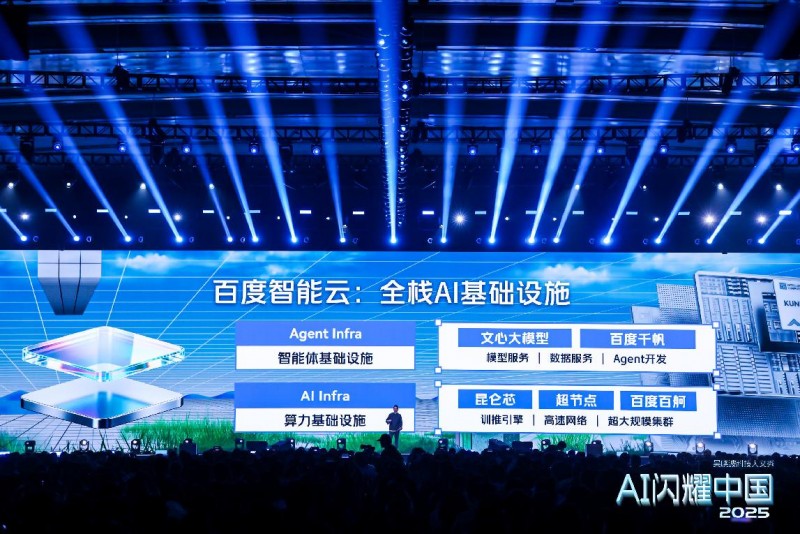
领跑十年:百度智能云全栈AI基础设施推动产业智能化
Sou Hu Wang· 2025-12-29 07:36
Core Insights - China is accelerating the integration of AI technology with the real economy, driven by its vast application scenarios and proactive industrial policies [1] - Baidu Smart Cloud is a key player in this transformation, providing a comprehensive AI infrastructure that translates cutting-edge AI capabilities into practical productivity for enterprises [1][6] Group 1: AI Infrastructure Development - Baidu Smart Cloud aims to position AI as a "profit center" for businesses rather than a "cost center," emphasizing the direct creation of business value through AI [2] - The infrastructure consists of a dual-layer architecture: a robust AI Infra for foundational computing power and a flexible Agent Infra for developing and managing intelligent agents [4] - Significant investments in AI infrastructure are projected, with an estimated 400 billion RMB in 2025 and over 10 trillion RMB by 2030, narrowing the gap in AI model capabilities between China and the U.S. from 20% to 0.3% [5] Group 2: Market Position and Achievements - Baidu Smart Cloud has evolved from a technology enabler to a builder of an industrial innovation ecosystem, providing end-to-end AI solutions that integrate cloud computing with advanced AI technologies [6] - The company has achieved notable market success, leading in core areas for six consecutive years and covering over 65% of state-owned enterprises and 100% of systemically important banks [6] - In 2025, Baidu Smart Cloud led the market with 95 winning projects and a total bid amount of 7.1 billion RMB in the large model sector [6] Group 3: Application Innovation - The "MiaoDa" platform enables no-code AI application development, significantly lowering the barrier for individuals and businesses to create efficient applications at minimal cost [8][9] - The platform has generated over 500,000 agents and served 10 million users within a year, demonstrating the high demand for zero-code AI development tools [9] - MiaoDa's core philosophy is to empower everyone, including non-technical individuals, to quickly turn ideas into operational digital products [9] Group 4: Future Outlook - Baidu Smart Cloud is set to play a crucial role in the deep integration of AI with the real economy over the next decade, fostering a collaborative AI ecosystem and enabling numerous entrepreneurs to leverage AI tools for value creation [11] - The ongoing transformation in various industries is expected to open up vast opportunities, driven by the advancements in AI technology [11]


英伟达的下一个统治阶段开始了
美股研究社· 2025-07-22 12:13
Core Viewpoint - Nvidia has transformed from a leading chip manufacturer to a full-stack AI infrastructure leader, with a 50% stock price increase in three months, driven by strong product offerings and robust financial performance [1][2][9]. Financial Performance - Nvidia maintains a gross margin of over 75% and expects Q2 revenue to reach $45 billion, exceeding market expectations [1][9]. - The company has a free cash flow margin exceeding 60%, indicating strong operational efficiency [1][14]. Product Roadmap - The upcoming GB300 series (Blackwell Ultra) is expected to enhance inference throughput and memory utilization by 50% [4]. - By Q4 2025, the NVL72 will achieve scale in large data centers, becoming a cornerstone for Nvidia's high-margin data center inference workloads, which currently account for over 70% of its data center business [4][9]. - The Vera Rubin architecture, set to launch in H2 2026, will offer over three times the inference computing capability compared to GB300, while maintaining backward compatibility [4][5]. - The Rubin Ultra design, expected by 2027, aims to deliver up to 15 exaFLOPS of FP4 throughput, significantly enhancing Nvidia's position in AI inference cloud [5][9]. Market Position and Competitive Landscape - Nvidia's structural advantages, including dominant platform economics and a deep ecosystem, position it as a core holding in AI infrastructure [2][10]. - The long-term potential market for AI is projected to reach $1 trillion, with infrastructure needs estimated at $300 billion to $400 billion [10][12]. - Despite competitive pressures from AMD and other custom chip developers, Nvidia's established software stack (CUDA, NeMo) and supply chain integration provide a buffer against market share erosion [12][17]. Valuation Metrics - Nvidia's current P/E ratio stands at 54, with a forward P/E of 40, indicating a premium valuation compared to industry averages [12][14]. - The company's PEG ratio is 0.68 (GAAP) and 1.37 (non-GAAP), suggesting that its valuation is at least partially supported by growth [14]. - Nvidia's expected EV/Sales ratio is 21, and EV/EBIT ratio is 34, reflecting a significant premium over industry standards, which reinforces its growth assumptions [14]. Strategic Outlook - Nvidia's roadmap for the next three years includes the launch of Blackwell GB300 in 2025, Vera Rubin in 2026, and Rubin Ultra in 2027, ensuring continued product leadership and predictable profitability [9][17]. - The company plans to invest over $10 billion in next-generation AI research and development, indicating a commitment to maintaining its competitive edge [12][15].