GB300系列

Search documents
英伟达GTC2026大会召开在即,科创人工智能ETF华夏(589010)近半年新增规模位居可比基金首位
Mei Ri Jing Ji Xin Wen· 2026-02-26 06:10
Group 1 - The core viewpoint of the news highlights the performance of the AI sector, particularly the rise of the Shanghai Stock Exchange's Sci-Tech Innovation Board AI Index and its constituent stocks, driven by increasing demand for computing power due to the AI wave [1] - Nvidia's CEO Jensen Huang is set to unveil a "world-first" new chip at the upcoming GTC 2026 conference, generating significant industry interest [1] - The report suggests focusing on key players in various segments of the AI supply chain, including PCB leaders, server ODMs, AI chip designers, and memory interface chip leaders, indicating a broad investment opportunity in the AI sector [1] Group 2 - The Huaxia Sci-Tech Innovation AI ETF has seen a significant growth of 2.393 billion yuan in scale over the past six months, ranking first among comparable funds [2] - The ETF's share count has increased by 1.498 billion shares in the same period, also placing it at the top of its peer group [2] - The ETF closely tracks the Sci-Tech Innovation Board AI Index, covering high-quality enterprises across the entire industry chain, benefiting from high R&D investment and policy support [2]

未知机构:英伟达将于周三公布财报其股价隐含波动率为44所有人的目光都集中在黄仁-20260224
未知机构· 2026-02-24 04:45
Summary of Conference Call Notes Company and Industry Overview - The focus is on NVIDIA, which is set to release its earnings report on Wednesday, with an implied volatility of 4.4% in its stock price. Investors are particularly interested in CEO Jensen Huang's performance during the announcement [1][1]. - Over the past six months, NVIDIA's stock has been trading sideways, underperforming the SOX index, leading to investor frustration. The preference among investors has shifted towards upstream supply chain companies such as storage, semiconductor equipment, TSMC, and optical modules, which are starting to gain pricing power, potentially at the expense of GPU/ASIC profit margins [1][1]. Core Insights and Arguments - Market consensus for NVIDIA's Q4 revenue is approximately $65.7 billion, with company guidance at $65 billion ±2%. However, buyers expect a continuation of the typical overperformance of over $2 billion, raising actual expectations to above $68 billion. For the data center business, the market consensus is around $60 billion, but the real target is about $62 billion [2][2]. - For Q1 FY2027 (April), market expectations are around $71.5-$71.8 billion, while buyers are looking for guidance of $73.5 billion (excluding the Chinese market), with actual expectations pointing to over $74 billion. Buyers anticipate earnings per share for FY2026 to be around $9-$10, exceeding the market consensus of $7.75, and for FY2027, expectations have reached $12-$14, significantly above the market consensus of $9.50 [3][3]. - Recent capital expenditure guidance from major cloud providers like Amazon, Google, Microsoft, and Meta has seen a substantial increase, with a combined upward revision of approximately $140-$145 billion for 2026, projecting total spending to exceed $600 billion, a 60% year-over-year increase [3][3]. Pricing and Profit Margin Concerns - The average selling price for Rubin series products is estimated between $7 million and $8 million, while the GB300 series is priced at $4 million to $5 million. The RubinUltra rack is priced around $10 million, with reports indicating prices between $8.5 million and $11 million. The price increase of 100% for RubinUltra compared to RubinVera is justified by significant performance improvements [5][5]. - Management has provided guidance for Q4 gross margins at 75% ±50 basis points, with expectations for next year at 74.5%. The rationale for a bullish outlook on margins is NVIDIA's pricing power in a constrained supply environment, allowing for higher average selling prices to offset rising input costs [5][5]. - However, there are concerns regarding the sustainability of margins, particularly in 2027, as each new product generation requires more high-bandwidth memory, which could increase the absolute dollar impact of memory price hikes. Additionally, the transition to rack-level solutions introduces complexities and costs that could pressure gross margins [6][6]. Upcoming Events and Market Sentiment - The market is closely watching the upcoming events, including the Morgan Stanley TMT Conference on March 4, where Jensen Huang is expected to present, and the GTC Conference on March 16, where further details on the Rubin roadmap and NVIDIA's full-stack AI platform vision will be discussed [6][7]. - Despite a cautious outlook on stock price movements, there is a maintained long position in the investment portfolio, with suggestions to consider bullish options in mid-March to capture potential market movements around the Morgan Stanley Conference and transition into the GTC phase [7][7].
集邦咨询:预估Blackwell将占2025年英伟达(NVDA.US)高阶GPU出货逾80%
智通财经网· 2025-07-24 08:59
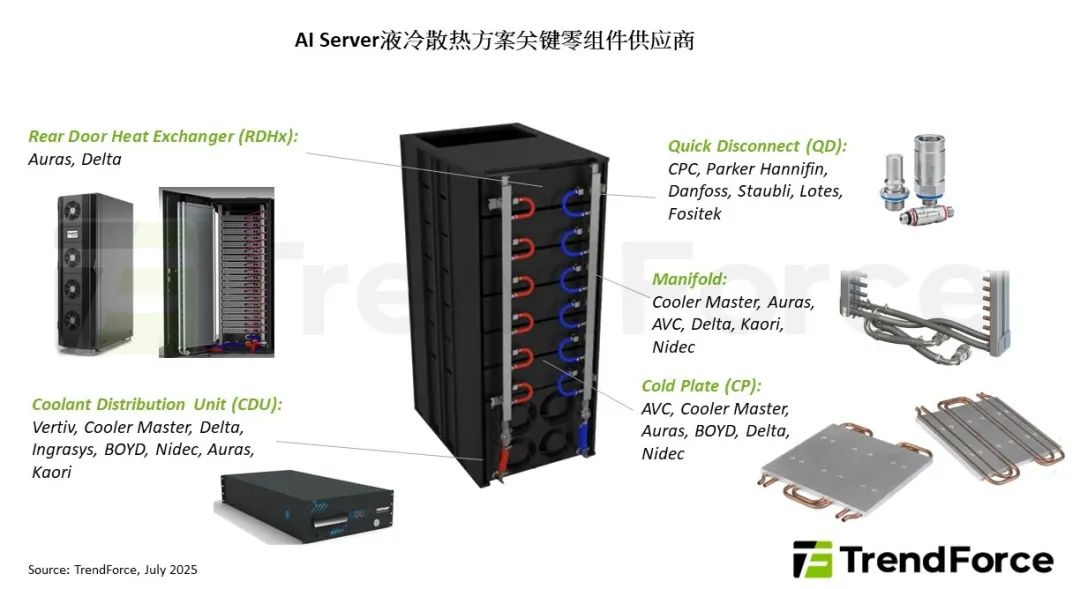
Group 1 - The overall Server market is stabilizing, with ODMs focusing on AI Server development, particularly with NVIDIA's new Blackwell platform products [1] - TrendForce estimates that Blackwell GPUs will account for over 80% of NVIDIA's high-end GPU shipments this year [1] Group 2 - North American CSP giant Oracle is expanding its AI data centers, benefiting companies like Foxconn, Supermicro, and Quanta [2] - Supermicro's growth this year is primarily driven by AI Servers, having secured some GB200 Rack projects [2] - Quanta has successfully expanded its GB200/GB300 Rack business due to collaborations with major clients like Meta, AWS, and Google, along with Oracle orders [2] - Wiwynn is deepening its partnerships with Meta and Microsoft, expecting performance growth in the second half of the year, focusing on ASIC AI Servers [2] Group 3 - The expansion of AI data centers will be crucial for the scaling of the liquid cooling industry [2] - Liquid cooling solutions are increasingly being adopted for high-end AI chips, with new data centers incorporating "Liquid Cooling Ready" designs to enhance thermal management efficiency [2] Group 4 - Liquid cooling is becoming a standard configuration for high-performance AI data centers, driving demand for cooling components [4] - Fositek has begun shipping components for the GB300 platform, competing with Danfoss in the supply of quick connectors for AWS ASIC liquid cooling [4] - Auras is actively entering the data center liquid cooling market, with its business becoming a core growth driver, serving major clients like Oracle, Supermicro, and HPE [4] - Auras has started supplying liquid cooling products to Meta, establishing a foundation for future participation in the GB200 platform's liquid cooling supply chain [4]

英伟达的下一个统治阶段开始了
美股研究社· 2025-07-22 12:13
Core Viewpoint - Nvidia has transformed from a leading chip manufacturer to a full-stack AI infrastructure leader, with a 50% stock price increase in three months, driven by strong product offerings and robust financial performance [1][2][9]. Financial Performance - Nvidia maintains a gross margin of over 75% and expects Q2 revenue to reach $45 billion, exceeding market expectations [1][9]. - The company has a free cash flow margin exceeding 60%, indicating strong operational efficiency [1][14]. Product Roadmap - The upcoming GB300 series (Blackwell Ultra) is expected to enhance inference throughput and memory utilization by 50% [4]. - By Q4 2025, the NVL72 will achieve scale in large data centers, becoming a cornerstone for Nvidia's high-margin data center inference workloads, which currently account for over 70% of its data center business [4][9]. - The Vera Rubin architecture, set to launch in H2 2026, will offer over three times the inference computing capability compared to GB300, while maintaining backward compatibility [4][5]. - The Rubin Ultra design, expected by 2027, aims to deliver up to 15 exaFLOPS of FP4 throughput, significantly enhancing Nvidia's position in AI inference cloud [5][9]. Market Position and Competitive Landscape - Nvidia's structural advantages, including dominant platform economics and a deep ecosystem, position it as a core holding in AI infrastructure [2][10]. - The long-term potential market for AI is projected to reach $1 trillion, with infrastructure needs estimated at $300 billion to $400 billion [10][12]. - Despite competitive pressures from AMD and other custom chip developers, Nvidia's established software stack (CUDA, NeMo) and supply chain integration provide a buffer against market share erosion [12][17]. Valuation Metrics - Nvidia's current P/E ratio stands at 54, with a forward P/E of 40, indicating a premium valuation compared to industry averages [12][14]. - The company's PEG ratio is 0.68 (GAAP) and 1.37 (non-GAAP), suggesting that its valuation is at least partially supported by growth [14]. - Nvidia's expected EV/Sales ratio is 21, and EV/EBIT ratio is 34, reflecting a significant premium over industry standards, which reinforces its growth assumptions [14]. Strategic Outlook - Nvidia's roadmap for the next three years includes the launch of Blackwell GB300 in 2025, Vera Rubin in 2026, and Rubin Ultra in 2027, ensuring continued product leadership and predictable profitability [9][17]. - The company plans to invest over $10 billion in next-generation AI research and development, indicating a commitment to maintaining its competitive edge [12][15].