
全球产业布局优化

Search documents
中国铝业拟63亿联合收购巴西铝业 总资产2304亿负债率优化降至46%
Chang Jiang Shang Bao· 2026-02-02 00:45
Core Viewpoint - China Aluminum (601600) plans to acquire a 68.596% stake in Brazilian Aluminum Company for approximately 6.286 billion RMB, partnering with Rio Tinto to enhance its global aluminum resource portfolio [1][2]. Group 1: Acquisition Details - The acquisition involves a joint venture where China Aluminum's subsidiary will pay about 4.211 billion RMB, while Rio Tinto will contribute approximately 2.074 billion RMB [2][3]. - The purchase price represents a 3.45% premium over the closing price of Brazilian Aluminum shares on January 28, 2026, and a 21.15% premium over the weighted average price of the previous 20 trading days [2][3]. Group 2: Financial Performance - In 2024, China Aluminum reported a revenue of 237.066 billion RMB, a year-on-year increase of 5.21%, and a net profit of 12.4 billion RMB, up 85.38% [6]. - For the first three quarters of 2025, the company achieved a revenue of 176.516 billion RMB, a 1.58% increase year-on-year, and a net profit of 10.872 billion RMB, reflecting a 20.58% growth [6][7]. Group 3: Market Position and Growth - China is the world's largest aluminum producer, maintaining its position for 23 consecutive years, with a significant increase in aluminum production and consumption expected in 2024 [5]. - The company’s total assets reached 230.4 billion RMB by the end of Q3 2025, with a debt-to-asset ratio of 46.38%, the lowest in a decade [6][7]. Group 4: Industry Trends - The price of alumina has shown a significant increase, with an average price of 4,084 RMB per ton in 2024, marking a 39.9% year-on-year rise [5]. - Despite a downward trend in alumina prices in 2025 due to increased global supply, strong demand in non-metallurgical sectors, particularly for high-purity alumina, has surged by 35% [6].

匠心家居:拟投资1.5亿在柬埔寨设立全资子公司
Sou Hu Cai Jing· 2025-12-02 02:42
Core Viewpoint - The company plans to invest 150.38 million yuan in establishing a smart furniture production base in Cambodia through a wholly-owned subsidiary in Hong Kong, aiming to enhance its global production capacity and competitiveness in the smart furniture market [1][3]. Group 1: Investment Details - The total investment for the Cambodia smart furniture production base project is 150.38 million yuan, with 123.04 million yuan allocated for construction and equipment, and 27.34 million yuan for working capital [1]. - The project will have an annual production capacity of 200,000 smart electric sofas, 100,000 smart electric beds, and 200,000 smart electric sofa accessories upon completion [1]. Group 2: Strategic Objectives - The investment aims to expand overseas production capacity, optimize global industrial layout, and enhance the company's ability to respond to international trade barriers [3]. - The project is expected to better meet the demand for smart furniture products in North America and global markets, thereby improving the company's overall competitiveness and profitability [3].

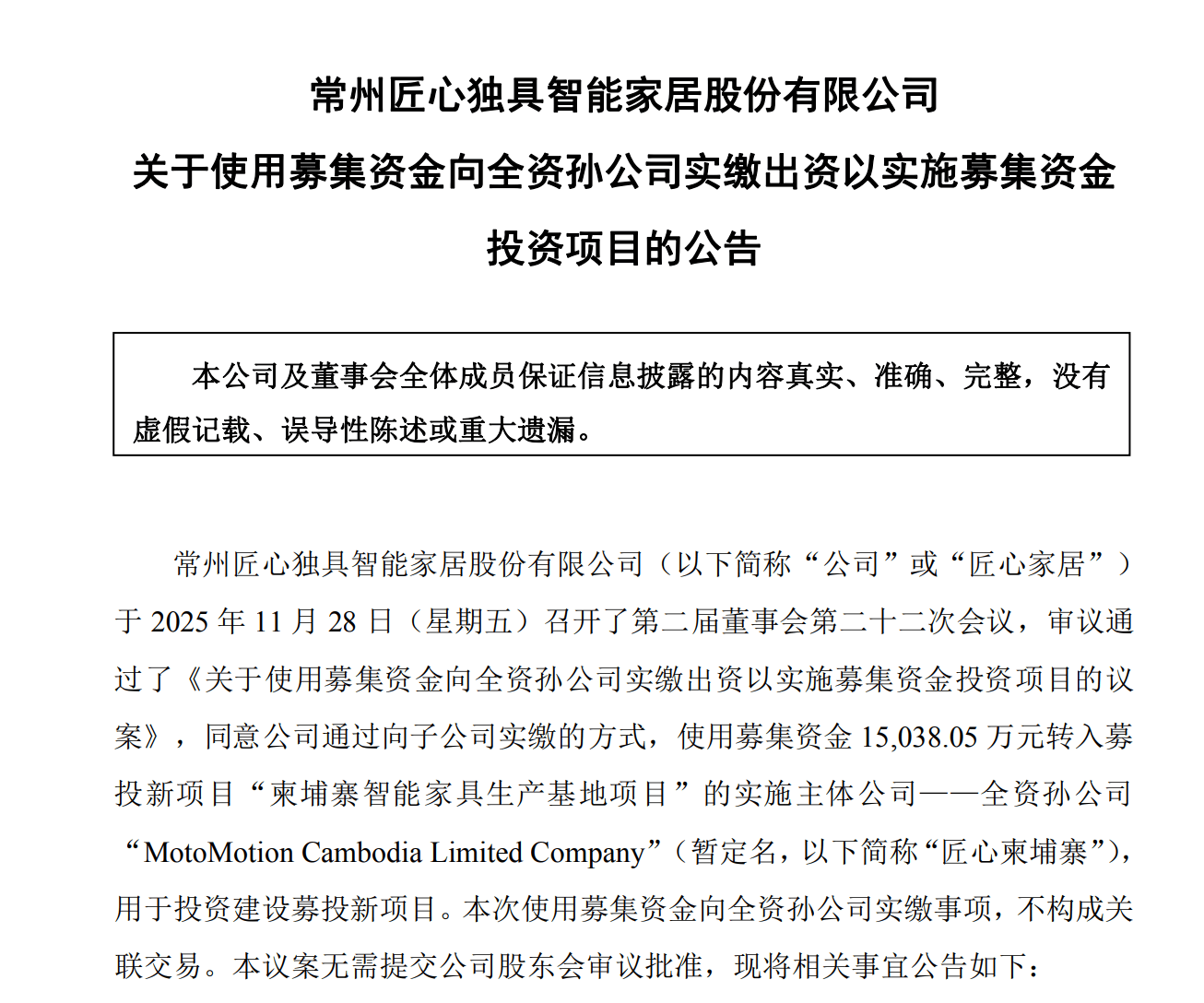
匠心家居:拟投资15038.05万元在柬埔寨设立全资子公司
2 1 Shi Ji Jing Ji Bao Dao· 2025-11-28 08:41
Core Viewpoint - The company plans to use 150.38 million yuan from its initial public offering to establish a wholly-owned subsidiary in Hong Kong and subsequently a wholly-owned subsidiary in Cambodia for the "Cambodia Smart Furniture Production Base Project" [1] Group 1: Investment Details - The registered capital for the Hong Kong subsidiary is set at 21.20 million USD (approximately 150.38 million yuan), with the same amount allocated for the Cambodian subsidiary [1] - The investment aims to expand overseas production capacity, optimize global industrial layout, and enhance the ability to respond to international trade barriers [1] Group 2: Market Demand and Strategic Goals - The project is designed to better meet the demand for smart furniture products in North America and global markets [1] - The investment is expected to improve the company's overall competitiveness and profitability, positively impacting future business development [1] Group 3: Regulatory and Approval Process - The project will require compliance with relevant national regulatory authorities for investment filing or approval and will need to be submitted for shareholder meeting approval [1]