
全球化瓦解

Search documents
美银展望2026年“最佳热门交易”:大宗牛市将继续
Feng Huang Wang· 2025-12-08 07:23
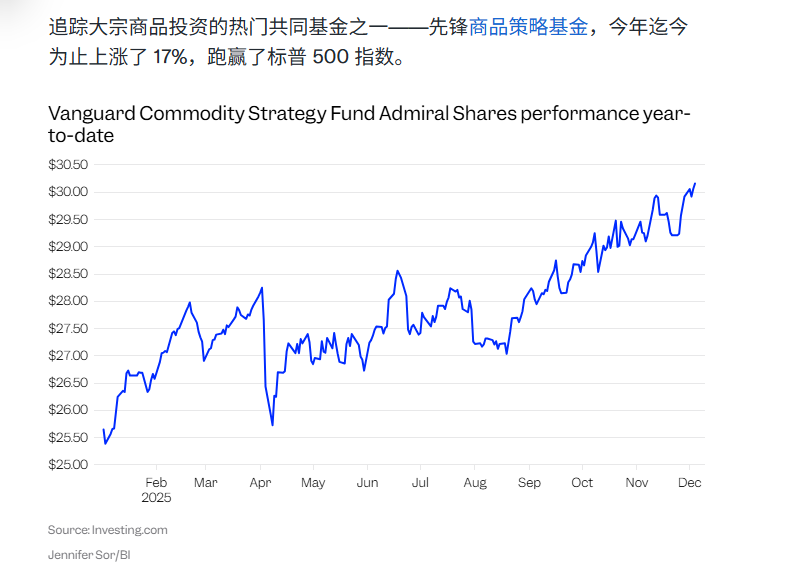
Group 1 - Bank of America predicts commodities will be the hottest investment choice in 2026, driven by economic "tailwinds" that will enhance performance [1] - The "run it hot" strategy suggests that tax cuts and interest rate reductions will stimulate economic growth, supporting strong performance in commodities despite some negative data [1][2] - Commodities are expected to yield significant returns in 2025, particularly metals and energy, which are key investment areas in the AI data center boom [2] Group 2 - Industrial stocks focused on commodities have risen 17% since January, while utility and energy stocks have increased by 15% and 7% respectively this year [4] - Factors supporting the sustained momentum in commodities include Trump's economic policies, which are expected to further stimulate growth [6] - The appeal of commodities has grown due to excessive fiscal spending, making them outperform traditional safe-haven assets like bonds [6] - Globalization is fracturing, with geopolitical conflicts and supply chain issues potentially boosting commodity demand as they are often transported and used as raw materials [6] - Higher inflation expectations may lead to rising prices for commodities like gold, which has increased by 60% this year, marking its best performance since the 1970s [6]


美元贬值具有确定性,看好出口和周期
2025-06-11 15:49
Summary of Conference Call Records Industry Overview - The records discuss the implications of the depreciation of the US dollar and its impact on global capital flows and economic dynamics, particularly focusing on the US economy and its relationship with non-US economies [1][2][5]. Key Points and Arguments 1. **Dollar Depreciation Certainty**: The trend of dollar depreciation is established due to the changing global capital flow patterns and the decoupling of the US economy from the global economy. This situation is exacerbated by the US's increasing debt levels and the inability to attract capital as before [1][2][3]. 2. **US Fiscal Policy**: The US government has expanded fiscal spending, including increasing transfer payments to residents by nearly 20%, to maintain economic resilience. This has helped stabilize consumer spending despite rising inflation pressures [4][5]. 3. **Inflation and Fed's Role**: The Federal Reserve's inability to control inflation has led to a collapse in its credibility, which in turn undermines the value of the dollar. The Fed's actions, including purchasing long-term bonds, may lead to persistent inflation [4][5]. 4. **Strong US Consumer Demand**: Despite challenges, US consumer demand remains robust, and trade deficits are expected to normalize over time. The depreciation of the dollar creates a favorable export environment for China [6][7]. 5. **Global Manufacturing Cycle**: The global manufacturing sector is entering a cyclical upswing, driven by improvements in supply-side conditions. Non-US economies are expected to perform better, with China's exports likely to exceed expectations [7][8]. 6. **Impact of De-globalization**: The breakdown of globalization allows emerging markets to have more autonomy in their monetary and fiscal policies, leading to enhanced domestic demand and positive growth for non-US economies [8][9]. 7. **US Re-industrialization**: The slow pace of re-industrialization in the US necessitates continued imports of capital goods, consumer goods, and intermediate goods, which is expected to benefit Chinese exports [9][10]. 8. **Chinese Market Dynamics**: The supply-demand balance in the Chinese market is improving, with rising asset prices driven by the appreciation of the yuan and favorable external demand conditions [11][12]. 9. **Core Asset and Financial Sector Outlook**: There is a positive outlook for core assets and the financial sector in China, particularly for insurance companies, as the yuan's appreciation benefits their operations [13][14]. 10. **Export Prospects and US Economic Policy Uncertainty**: Export prospects may exceed expectations, but there is a need to monitor uncertainties in US economic policy. A stable US economy, even without significant growth, can support good export performance [15]. Other Important Insights - The records highlight the structural changes in global capital flows and the potential for non-US economies to thrive in a weaker dollar environment, suggesting a shift in investment strategies towards emerging markets and commodities [1][2][6][8]. - The discussions emphasize the importance of monitoring US economic policies and their implications for global trade dynamics, particularly for countries like China that are positioned to benefit from these changes [15].