全球政策风险

Search documents
4900→5400美元!高盛大幅上调黄金目标价
美股研究社· 2026-01-22 11:11
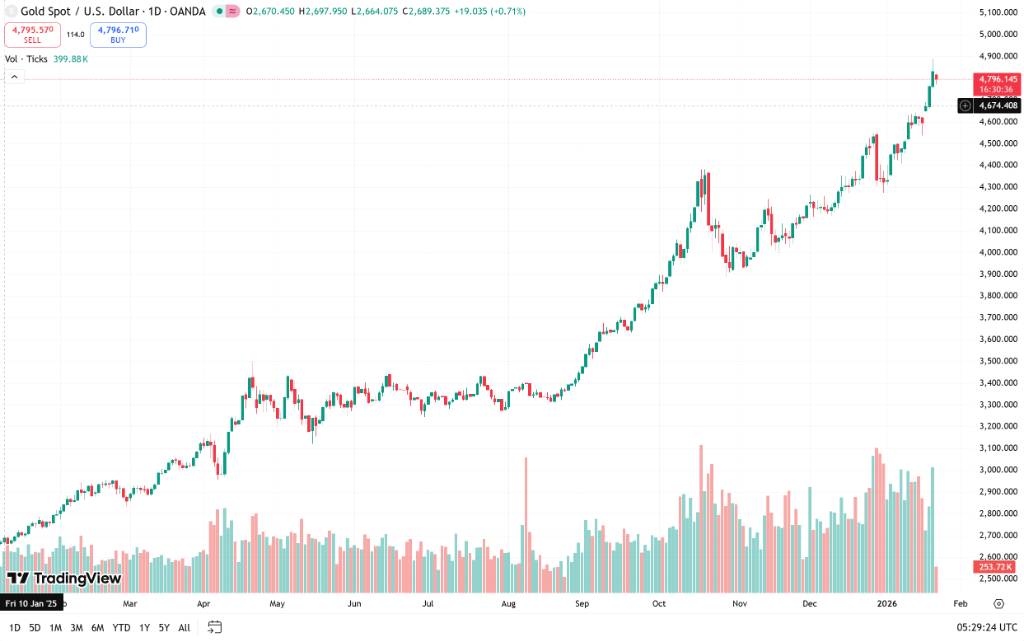
Core Viewpoint - The rules of the gold market have changed, with private sector players entering the market to hedge against global policy risks, alongside central banks [3]. Group 1: Central Bank and Private Sector Dynamics - Goldman Sachs has raised its gold price target for December 2026 to $5,400 per ounce from $4,900, driven by strong central bank purchases, favorable conditions for ETFs due to Federal Reserve rate cuts, and increased demand for safe-haven assets amid geopolitical and policy uncertainties [3][4]. - The past three years of gold price increases can be divided into two phases: 2023-2024, driven by central bank purchases, and 2025 onwards, where the competition for limited bullion between central banks and private investors accelerates the price increase [5][6]. Group 2: Demand Channels and Price Dynamics - The acceleration in gold prices from 2025 is attributed to a "cumulative effect" of demand from both traditional channels, such as Western gold ETFs, and new channels, including high-net-worth families' physical gold purchases and the use of less quantifiable hedging tools like call options [6][7]. - Goldman Sachs emphasizes that the new buying in gold resembles "long-term insurance" rather than event-driven trading, with private sector holdings expected to remain stable through 2026 [8][9]. Group 3: Price Forecast and Contributions - The forecast indicates a 17% increase in gold prices by the end of 2026, with contributions primarily from central bank purchases (approximately 60 tons per month) and a rebound in Western ETF holdings due to anticipated Federal Reserve rate cuts [12][13]. - The report highlights that the "sticky hedges" from private sector demand will help sustain high gold prices, making them a new benchmark rather than a bubble [13][14]. Group 4: Risk Signals and Monitoring - Goldman Sachs notes that while risks exist on both sides, the outlook remains significantly upward, driven by continued private sector demand for gold amid ongoing uncertainties [16]. - Key signals to monitor include whether central bank gold purchases decline, if the Federal Reserve's monetary policy shifts from easing to tightening, and whether macroeconomic policy uncertainties are resolved, as these factors could trigger a reduction in private sector gold holdings [16][17].



4900→5400美元!高盛大幅上调黄金目标价
华尔街见闻· 2026-01-22 09:37
Core Viewpoint - Goldman Sachs has raised its gold price target for December 2026 to $5,400 per ounce from a previous forecast of $4,900, driven by strong central bank demand, favorable conditions for ETFs due to potential Fed rate cuts, and increased safe-haven demand amid geopolitical and policy uncertainties [1][2][4]. Group 1: Demand Drivers - The report identifies a shift from central bank-driven demand to a combination of central bank and private sector demand for gold, with private sector hedging becoming more pronounced and sticky [1][4]. - The forecast for gold price increases is divided into two phases: 2023-2024 driven by central bank purchases, and a significant acceleration in 2025 due to competition for limited bullion between central banks and private investors [2][6]. - Central banks are expected to purchase approximately 60 tons of gold monthly in 2026, contributing about 14 percentage points to the price increase, with a long-term trend of emerging market central banks diversifying their reserves [7]. Group 2: Private Sector Influence - The private sector's role is highlighted as crucial, with high-net-worth families increasing their physical gold purchases and investors using options as hedging tools, which are harder to quantify [2][4]. - The report emphasizes that the "sticky hedges" from private sector demand will likely remain in place through 2026, supporting a higher baseline for gold prices rather than a temporary spike [9][10]. Group 3: Price Dynamics and Risks - The report outlines that 17% of the expected price increase is attributed to central bank and ETF demand, while the sticky hedges from the private sector help maintain a higher price level [7][9]. - Key signals to monitor for potential price peaks include the sustainability of central bank gold purchases, the Fed's monetary policy direction, and the resolution of macroeconomic uncertainties [11][12][13].
5400美元!高盛大幅上调黄金目标价:富豪们正跑步入场,与央行争夺“有限实物储备”
Hua Er Jie Jian Wen· 2026-01-22 06:03
Core Viewpoint - The rules of the gold market have changed, with private sector investors entering the market to hedge against global policy risks, leading to a significant upward revision of gold price targets by Goldman Sachs from $4,900 to $5,400 per ounce for the year [1] Group 1: Market Dynamics - The competition for physical gold is intensifying as central banks and private capital vie for limited supplies, accelerating the upward trend in gold prices [2] - In 2023 and 2024, gold prices are expected to rise by 15% and 26% respectively, primarily driven by panic buying from central banks following the freezing of Russian reserves [2] - By 2025, gold prices are projected to surge by 67%, as central banks are no longer the sole major buyers, leading to increased competition with private investors [2] Group 2: Investment Behavior - Analysts note a significant increase in physical gold purchases by high-net-worth families and a surge in bullish options buying, contributing to the upward pressure on gold prices [4] - The gap between actual gold prices and Goldman Sachs' traditional model predictions has widened since 2025, indicating a shift in buying behavior [4] - The demand for new hedging tools against global macro policy risks has surged, reflecting a change in investor sentiment [4] Group 3: Price Projections - Goldman Sachs forecasts a 17% increase in gold prices by the end of 2026, with emerging market central banks' diversification contributing 14 percentage points to this growth [5] - The average monthly gold purchases by central banks are expected to remain high at 60 tons, significantly above the pre-2022 average of 17 tons [5] - A return of funds to Western ETFs, driven by anticipated Fed rate cuts, is expected to contribute an additional 3 percentage points to gold price increases [5] Group 4: Signals for Reversal - Despite the upward price target revision, the risk distribution for gold prices remains skewed towards the upside, with potential for increased private sector allocation [7] - Two key signals for a potential reversal in gold prices include a decline in central bank gold purchases to pre-2022 levels and a shift in Fed policy from rate cuts to rate hikes [7] - The lack of elasticity in gold supply means that high prices alone cannot resolve supply issues, and demand collapse would be necessary for a price reversal [7]