全球统一关税

Search documents
拱火的来了,“美一众盟友惨了,中国巴西受益最大”
Sou Hu Cai Jing· 2026-02-23 18:15
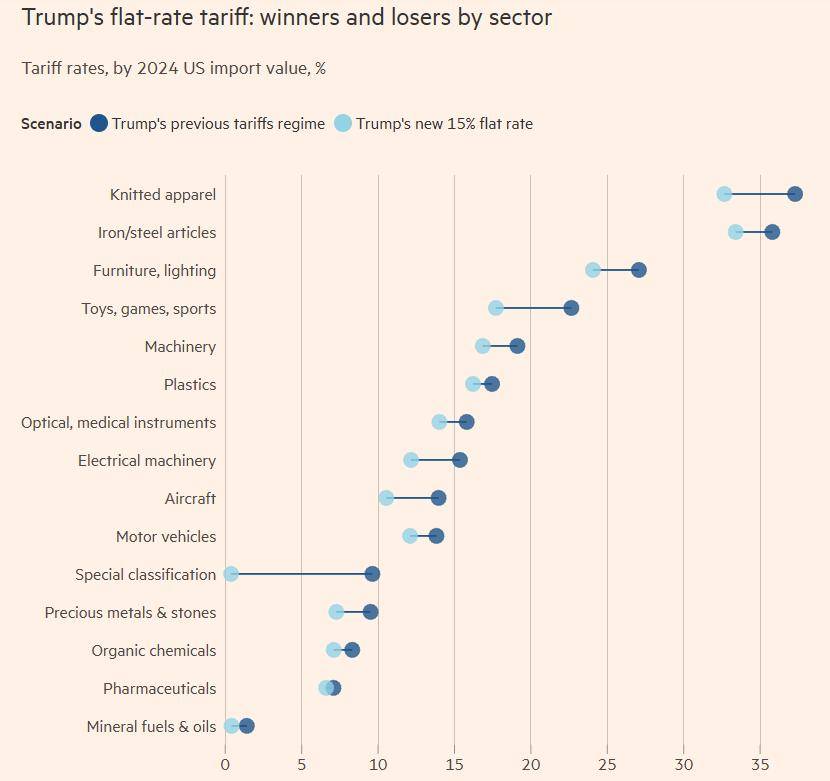
Core Viewpoint - The new 15% global uniform tariff introduced by Trump is expected to benefit countries like China and Brazil, while traditional allies such as the UK, EU, and Japan will face significant losses [1][6]. Group 1: Impact on Countries - Brazil will see the largest average tariff reduction of 13.6 percentage points, followed by China with a 7.1 percentage point decrease [1]. - The new tariff structure will particularly benefit countries previously criticized by the U.S., such as Mexico, Canada, Vietnam, Thailand, and Malaysia, in sectors like apparel, furniture, toys, and plastics [1]. - The UK is projected to be the most adversely affected, with an average tariff increase of 2.1 percentage points, disappointing around 40,000 exporting companies [6]. - The EU will experience an overall average tariff increase of 0.8 percentage points, with Italy and France being the most impacted [6]. Group 2: U.S. Trade Policy and Reactions - The U.S. government has indicated a willingness to utilize legal provisions to impose additional tariffs, signaling a new round of trade negotiations [2]. - U.S. Treasury Secretary and Trade Representative have defended the new tariffs, asserting that all trade partners wish to maintain existing agreements despite the changes [8][10]. - The U.S. Trade Representative plans to initiate investigations into unfair trade practices, particularly concerning overcapacity in Asian countries [10]. Group 3: Future Trade Dynamics - The uncertainty surrounding U.S. tariff policies remains high, with potential for further investigations and tariffs based on the 1974 Trade Act [1][10]. - Trump's upcoming visit to China is aimed at maintaining bilateral stability and encouraging China to fulfill agreements, including purchasing U.S. agricultural products and aircraft [11][12].

捋一捋特朗普关税的全貌及各国如何出招
日经中文网· 2025-04-12 00:10
Core Viewpoint - The article discusses the impact of President Trump's tariff policies on global trade, highlighting the three main types of tariffs imposed by the Trump administration and the varying responses from different countries [1][3]. Group 1: Types of Tariffs - The tariffs imposed by the Trump administration can be categorized into three types: "reciprocal tariffs" applicable globally, "sector-specific tariffs" targeting industries like automobiles, steel, and aluminum, and "specific country tariffs" directed at Canada, Mexico, and China [3][4]. - Reciprocal tariffs are designed to counter high tariffs and non-tariff barriers from trade partners, with a base rate of 10% and additional rates based on the specific barriers of each country [4]. - Sector-specific tariffs are based on national security concerns, requiring the U.S. Department of Commerce to certify that security issues have been resolved before any reduction in these tariffs can occur [5][6]. Group 2: Global Responses and Negotiation Strategies - Countries are responding to Trump's tariff policies with various negotiation strategies, including "individual topic negotiations," "bilateral agreement negotiations," and China's "comprehensive countermeasures" [7]. - Japan is pursuing topic-based negotiations, focusing on modifying safety standards for automobiles and expanding agricultural imports, rather than altering existing trade agreements [7]. - Other countries like India, Vietnam, and the UK are seeking trade agreements with the U.S., while China is adopting a hardline approach to compel the U.S. to make concessions [7].