
全生命周期监管

Search documents
国家级权威报告发布!海龟爸爸是唯一共研品牌代表
Xin Lang Cai Jing· 2026-02-06 11:27
Group 1 - The concept of "refined parenting" is driving explosive growth in the children's cosmetics market, with an expected market size of approximately 50 billion yuan by 2025, maintaining an annual growth rate of about 10% from 2022 to 2024 [2][31]. - Despite the booming market, challenges such as weak foundational databases, ambiguous regulatory definitions, and a lack of long-term safety research persist [4][33]. - The "2025 China Children's Cosmetics Industry Development Research Report" was released to promote high-quality development in the industry, marking a significant collaboration between regulatory bodies and industry players [4][36]. Group 2 - The report provides a comprehensive analysis of the policy environment, market landscape, and industry challenges, filling a gap in systematic research within the sector [7][36]. - Since the implementation of the "Children's Cosmetics Supervision and Administration Regulations" in 2021, the industry has shifted towards a "safety first, efficacy necessary, and minimal formulation" principle, with a focus on lifecycle regulation [8][37]. - The report emphasizes the need for collaboration among government, research, and enterprises to achieve sustainable and scientific development in the children's cosmetics sector [8][39]. Group 3 - The company "Hai Gui Ba Ba" has transitioned from a participant to a co-builder in the industry, recognized for its innovative practices and professional capabilities [12][41]. - Hai Gui Ba Ba's innovative achievements have been included as core case studies in the report, showcasing its role in advancing the scientific and standardized development of the industry [13][42]. - The establishment of the "Xi He Laboratory" by Hai Gui Ba Ba focuses on children's skincare efficacy, addressing long-standing issues in the field [13][44]. Group 4 - Hai Gui Ba Ba has developed the "PRE Barrier Repair Formula," which addresses the core needs of children's skin barrier protection through a scientifically driven approach [15][44]. - The company has introduced innovative technologies in sunscreen products, significantly improving safety and user experience, and has been recognized in international materials science publications [18][50]. - Hai Gui Ba Ba's comprehensive quality management system exceeds national standards, ensuring product safety and addressing packaging material risks [21][52]. Group 5 - The report predicts future trends in the children's cosmetics market will focus on the integration of channels, brand value, and social responsibility, creating a new phase centered on consumer trust and data-driven practices [24][53]. - Hai Gui Ba Ba plans to enhance its product development by focusing on age-specific and scenario-based research, strengthening collaborations with medical institutions, and improving digital quality management [25][54]. - The company aims to promote the use of environmentally friendly packaging while ensuring product safety and sustainability [25][54].


地方债券发行“开年提速”
Zheng Quan Ri Bao· 2026-01-27 16:25
Core Insights - The issuance of local government bonds in China has commenced, with a total of 584.7 billion yuan issued by January 27, 2024, including approximately 196.2 billion yuan in new special bonds, accounting for 33.6% of the total [1] Group 1: Local Bond Issuance - Various regions, including Jiangsu, Sichuan, and Shandong, plan to issue a cumulative total of 25,930 billion yuan in local bonds in the first quarter, marking the highest issuance plan in the past three years [1] - The planned issuance includes approximately 7,644 billion yuan in new special bonds and 12,106 billion yuan in refinancing special bonds, representing 29.5% and 46.7% of the total issuance plan, respectively [1] Group 2: Economic Implications - The high level of planned bond issuance reflects a proactive fiscal policy aimed at supporting stable economic operations, initiating infrastructure projects, and mitigating local debt risks [1] - The Chief Economist of CITIC Securities anticipates that the bond issuance will exhibit two main characteristics: an advanced issuance schedule due to the Spring Festival and a focus on refinancing special bonds to manage existing debt [2] Group 3: Innovations in Bond Management - Expectations for the issuance of special bonds include three new highlights: expansion of the "self-examination and self-issuance" pilot program, more flexible fund usage with a negative list management approach, and enhanced lifecycle supervision to ensure effective fund utilization [2] - The pilot program for "self-examination and self-issuance" has shown significant progress, with participating provinces demonstrating faster issuance rates and innovative uses for special bonds [3] - The focus on efficiency, fund allocation, and management is expected to improve, with an emphasis on new infrastructure and social welfare projects [3]
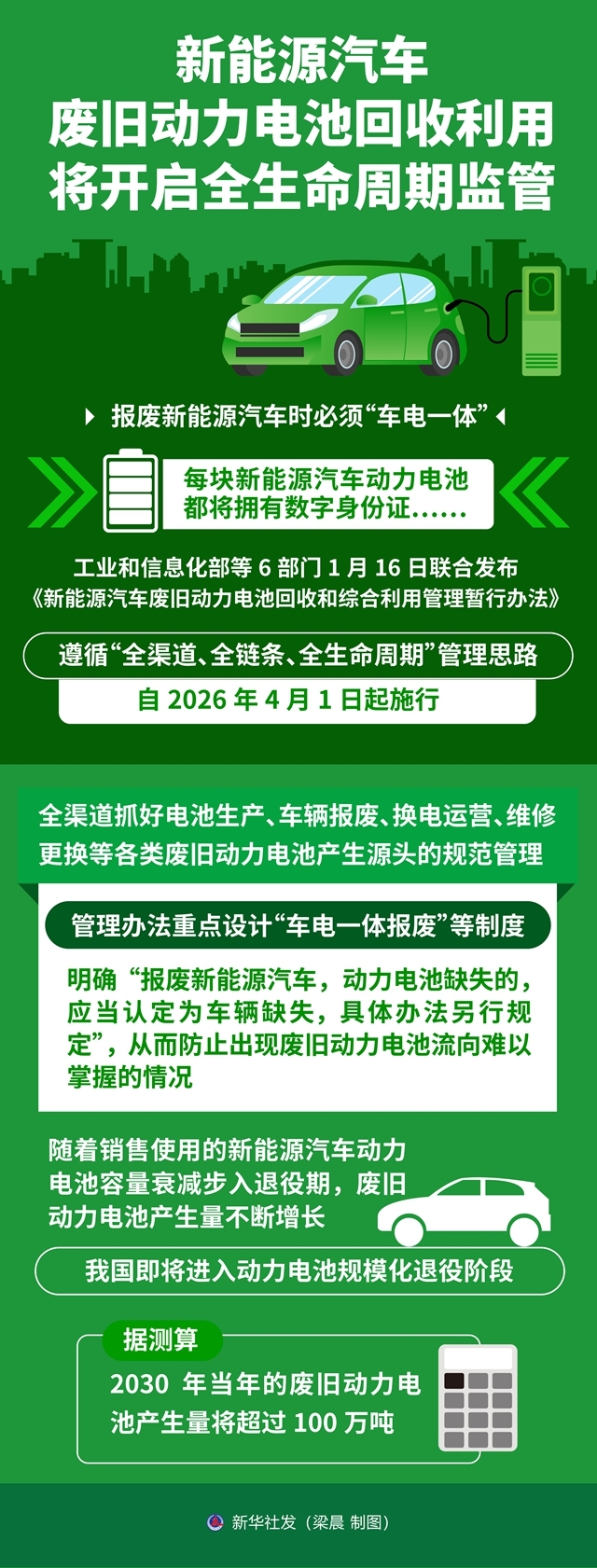
图表:新能源汽车废旧动力电池回收利用将开启全生命周期监管
Xin Hua She· 2026-01-18 01:39
Core Viewpoint - The article discusses the implementation of a new regulatory framework for the recycling and utilization of used power batteries from electric vehicles, emphasizing a comprehensive management approach that includes all channels, chains, and lifecycle stages [1][3]. Group 1: Regulatory Framework - The Ministry of Industry and Information Technology, along with five other departments, jointly released the "Interim Measures for the Recycling and Comprehensive Utilization of Used Power Batteries for New Energy Vehicles" on January 16 [1][3]. - The new regulations will take effect on April 1, 2026, and will enforce a "whole vehicle and battery" scrapping policy [1][3]. Group 2: Management Approach - The management strategy follows a "full-channel, full-chain, full-lifecycle" approach to ensure proper management of used power batteries from production to disposal [1][3]. - The regulations specifically design systems for "whole vehicle and battery scrapping," clarifying the requirements for scrapping electric vehicles and addressing the issue of missing power batteries [1][3].
【8点见】600余年城墙安装不锈钢台阶?河北定州回应
Yang Shi Wang· 2026-01-17 00:09
Group 1 - The Ministry of Defense stated that all measures capable of severely punishing "Taiwan independence" elements are options [2] - The recycling and utilization of used power batteries from new energy vehicles will initiate full lifecycle supervision [2] - The China Securities Regulatory Commission emphasized strict investigation and punishment of excessive speculation and market manipulation to prevent significant market fluctuations [2] Group 2 - The new results from China's "Sky Eye" reveal key evidence regarding the origins of fast radio bursts from binary stars [4] - The four departments announced that graduates in 2026 will be allowed to increase the number of one-way student ticket trips [4] - By 2025, the national ecological environment quality is expected to continue improving, with the proportion of days with good air quality reaching nearly 90% [4] Group 3 - The U.S. military unveiled the prototype of the next-generation main battle tank M1E3 "Abrams," which can identify battlefield threats and is user-friendly [7] - Australia has implemented a social media ban for minors under 16, resulting in the closure of over 4.7 million minor social media accounts [7] - The World Meteorological Organization reported that the global abnormal high-temperature trend continues, with ocean warming showing no signs of weakening [7]

动力和储能电池行业,为能源行业高质量发展打个样
中国能源报· 2026-01-11 23:34
Core Viewpoint - The recent policy signal to "further regulate the industrial competition order" provides a reference for the future development of the energy storage and other energy industries amidst challenges like price wars, overcapacity risks, and safety hazards [1][3]. Group 1: Industry Regulation and Development - A meeting held by multiple government agencies emphasized the need to strengthen market regulation, optimize capacity management, support industry self-discipline, and enhance regional collaboration [3]. - The shift in management philosophy from merely encouraging growth to preventing poor practices marks a significant change in the approach to the renewable energy industry [3][5]. - The industry is currently experiencing a "growing pain" period characterized by irrational behaviors such as blind construction and low-price competition, which undermine profitability and pose safety risks [5]. Group 2: Transition from Price Competition to Value Competition - The storage industry is transitioning from a "price war" to a "value war," where customer focus is shifting from initial pricing to the overall lifecycle value of products [4][6]. - Strengthening market regulation and quality supervision is expected to enhance product quality standards and encourage technological innovation [6]. - The meeting proposed creating a "fair competition market order" that rewards companies with superior technology and quality, thus breaking the cycle of unhealthy competition [6]. Group 3: Full Lifecycle Regulation and Quality Assurance - The concept of "full lifecycle regulation" was established to extend oversight beyond planning to include production processes, product quality, and after-sales service [8]. - Emphasizing "production consistency" is crucial for enhancing the safety and reliability of new energy equipment, addressing current industry pain points such as rapid technological iteration and safety hazards [8]. - Knowledge property rights protection is highlighted as essential for fostering innovation, with calls for stricter enforcement against infringement [8][9]. Group 4: Capacity Management and Market Dynamics - The meeting introduced an innovative "capacity macro-control" mechanism to establish a tiered early warning system to address overcapacity risks [10]. - Companies are encouraged to adopt a "demand-based, phased construction" approach to ensure that capacity expansion aligns with market needs [10]. - The balance between scale effects and overcapacity risks is seen as a new path for companies under policy guidance [10]. Group 5: Broader Implications for the Energy Sector - The insights from the battery and energy storage industry are viewed as a "high-quality development guide" for other emerging energy sectors like wind, solar, and hydrogen [12][14]. - The meeting's emphasis on balancing speed and quality serves as a warning to other energy sectors to avoid unsustainable practices [12]. - The proposed "central-local linkage and regional collaboration" mechanism aims to mitigate local protectionism and promote efficient resource allocation across regions [13].
多地全链条护航 医疗器械创新加速 企业如何借势抢机遇?
2 1 Shi Ji Jing Ji Bao Dao· 2025-12-02 23:10
Core Insights - Recent policies from Beijing and Shanghai aim to enhance the high-quality development of the medical device industry, with a focus on innovation and international competitiveness [1][4] - Multiple regions, including Guangdong and Hubei, have introduced supportive measures for the medical device sector, indicating a nationwide push for industry growth [1][4] - The Chinese medical device market is projected to reach 1.22 trillion yuan by 2025, with significant growth driven by innovation [6] Group 1: Policy Initiatives - Beijing's measures include 15 specific actions across five dimensions to promote innovation and quality upgrades in the medical device industry [1][3] - Shanghai's initiatives consist of 22 measures focusing on research and development, regulatory efficiency, and lifecycle management [1][4] - The national government emphasizes a comprehensive reform of drug and medical device regulation by 2027, aiming for modernization by 2035 [3] Group 2: Industry Transformation - The domestic medical device sector is transitioning from a "follower" to a "leader" in certain niche areas, with a focus on core technology breakthroughs and systemic capability building [2][5] - Companies are increasingly prioritizing original research and integrated innovation that aligns closely with clinical needs [2][5] - The emphasis on "me-better" products indicates a growing trend towards improved versions of existing technologies, leveraging China's manufacturing advantages [5] Group 3: Market Opportunities - The supportive policies are expected to facilitate faster approval and market entry for innovative medical devices, creating a clearer path for product commercialization [5][6] - The market is anticipated to benefit from an aging population, rising healthcare demands, and ongoing technological advancements [5][6] - Companies are encouraged to align their strategies with national innovation directions and engage in strategic collaborations with medical institutions [6][7] Group 4: Challenges and Strategic Focus - The shift towards domestic alternatives faces challenges in reliability, stability, and brand recognition compared to international competitors [7] - Companies are advised to focus on specific niche areas and collaborate early with leading medical institutions to address real clinical needs [7] - A robust quality management system and rigorous clinical validation processes are becoming increasingly important for success in the industry [7]
“向前一步”、“向深一尺” 智能网联汽车驶向监管深水区
Zhong Guo Qi Che Bao Wang· 2025-10-10 03:19
Core Viewpoint - The release of the draft notice for strengthening the recall and supervision of intelligent connected new energy vehicles signifies a more precise and comprehensive regulatory approach in the industry, particularly in the context of the rapid promotion of advanced driver-assistance systems and innovations in smart cockpit applications [2][3][4]. Group 1: Regulatory Focus - The draft notice emphasizes a problem-oriented approach, identifying four priority safety issues that need to be addressed, including inadequate safety prompts, data security risks, misleading market promotions, and frequent safety incidents during the use of driver-assistance systems [3][4]. - It establishes a full lifecycle and process safety management framework, providing legal basis and implementation norms for the supervision of intelligent connected vehicles [3][4]. - The document clarifies corporate responsibilities regarding product consistency, recall management, and promotional activities, including prohibiting misleading advertising [3][4][5]. Group 2: Enforcement Mechanisms - The draft notice provides specific enforcement mechanisms for regulatory authorities, allowing for targeted checks on technical parameters, OTA records, and accident reports [4][5]. - It introduces a three-dimensional approach to supervision, including routine compliance checks, targeted investigations, and special audits to ensure comprehensive coverage of regulatory requirements [5][6]. - The emphasis on actionable, verifiable, and accountable measures indicates a shift from theoretical regulations to practical enforcement [4][5]. Group 3: Industry Adaptation - The new regulatory framework is expected to prompt a reevaluation of the development logic for driver-assistance functions, prioritizing safety, stability, reliability, and prudence in product development [7][11]. - Companies are encouraged to adopt a proactive approach to safety risk management throughout the entire lifecycle of intelligent connected vehicles, from research and development to production and post-market activities [6][7]. - The draft notice is likely to accelerate the development and application of driver monitoring systems and enhance the overall safety culture within the industry [10][11]. Group 4: Testing and Compliance - Testing institutions are expected to enhance their capabilities to support both corporate R&D and regulatory compliance, transitioning from surface-level compliance to in-depth code-level verification [9][10]. - The draft notice necessitates the establishment of a comprehensive testing framework that includes functional safety, cybersecurity, and data compliance assessments [9][10]. - There is a call for the creation of a national testing scenario database and evaluation standards to support the evolving regulatory landscape [11].

国家药监局:加快制定医用手术机器人、重组胶原蛋白等高端产品的质量管理体系检查要点
news flash· 2025-07-03 10:13
Core Viewpoint - The National Medical Products Administration (NMPA) is accelerating the establishment of quality management system inspection points for high-end medical products, including surgical robots and recombinant collagen, to support the innovation and development of high-end medical devices [1] Group 1: Regulatory Measures - The NMPA has announced measures to optimize the lifecycle supervision of high-end medical devices, focusing on innovative products [1] - Regulatory discussions will be held for representative innovative medical devices, guiding local supervision in provinces with concentrated innovation [1] - The NMPA aims to analyze innovation points and risk points, and develop targeted regulatory measures [1] Group 2: Quality Management System - The NMPA is expediting the formulation of inspection points for quality management systems for various innovative products, including carbon ion/proton therapy systems and animal-derived artificial heart valves [1] - High-end products such as surgical robots, AI medical devices, and recombinant collagen will also have specific quality management system inspection points established [1] Group 3: Capacity Building - The NMPA plans to strengthen the selection and training of national-level inspectors for high-end medical devices [1] - There will be efforts to validate the quality management systems of provincial inspection agencies and enhance their capabilities [1] - The goal is to improve the quality and efficiency of inspections conducted by provincial agencies [1]
