全面上涨情景

Search documents
大摩:强有力的美元走势领先指标,美股、美债与美元指数的“共振模式”
美股IPO· 2025-10-20 12:37
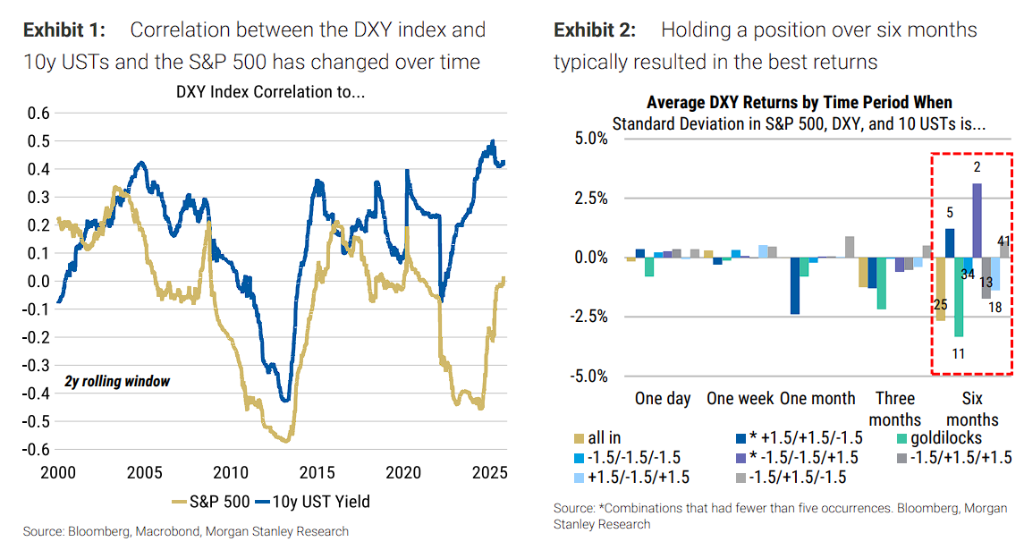
Core Insights - Morgan Stanley's research indicates that extreme "resonance" among the S&P 500, U.S. Treasury yields, and the U.S. dollar index often predicts a reversal in the dollar's strong cycle [3][7] - The analysis of the past 25 years shows two strong signals for a weaker dollar in the next six months: the "Goldilocks" scenario and the "Broad Up" scenario [3][10] Group 1: Goldilocks Scenario - The "Goldilocks" scenario occurs when the S&P 500 rises over 1.25 standard deviations while both the dollar index and Treasury yields fall over 1.25 standard deviations [8][15] - This scenario has appeared 12 times in the past 25 years, leading to an average dollar index decline of 3.3% over six months, with an 83% success rate for predicting dollar weakness [10][15] - The strong performance of the British pound in this scenario may reflect expectations of a soft landing for the economy [6][15] Group 2: Broad Up Scenario - The "Broad Up" scenario is characterized by simultaneous increases in the S&P 500, dollar index, and Treasury yields, each exceeding 1.25 standard deviations [16][20] - This scenario has occurred 26 times in the past 25 years, resulting in an average dollar index decline of 2.7% over six months, with a moderate success rate of 73% [16][20] - The occurrence of this scenario suggests a phase of global economic catch-up following a period of U.S. exceptionalism, with the Australian dollar often performing well during synchronized global economic recovery [20]



强有力的美元走势领先指标:美股、美债与美元指数的“共振模式”
Hua Er Jie Jian Wen· 2025-10-20 04:23
Core Insights - Morgan Stanley's latest research indicates that extreme "resonance" among the S&P 500, U.S. Treasury yields, and the U.S. dollar index often signals an impending reversal in the dollar's strong cycle [1][4] Group 1: Dollar Weakness Signals - The analysis of the past 25 years shows that extreme fluctuations (over 1.25 standard deviations) in the S&P 500, U.S. dollar index, and 10-year Treasury yields provide two strong signals indicating a weaker dollar in the next six months [1][5] - The "Goldilocks" scenario, characterized by a significant rise in the S&P 500 (over 1.25 standard deviations) while the dollar and Treasury yields decline (both over 1.25 standard deviations), has occurred 12 times historically, leading to an average 3.3% decline in the dollar index over six months [5][7] - The statistical analysis shows a high correlation between this scenario and dollar weakness, with an 83% success rate in predicting a weaker dollar following these occurrences [7] Group 2: Currency Performance Post Signals - In the "Goldilocks" scenario, the British pound tends to perform the best, reflecting expectations of a soft landing in the economy [4][10] - The "Broad Up" scenario, where all three indicators rise over 1.25 standard deviations, has occurred 26 times, indicating a 2.7% average decline in the dollar index over the following six months [13] - This scenario suggests a phase of global economic catch-up, where strong U.S. performance leads to a recovery in other regions, causing the dollar to give back gains [18]