
金发姑娘情景

Search documents
从通胀和增长数据看美国经济前景
2 1 Shi Ji Jing Ji Bao Dao· 2025-12-09 22:47
Economic Outlook - The core scenario for the U.S. economy in 2025 is described as a "Goldilocks scenario," where the economy experiences moderate growth without overheating or cooling excessively, with inflation returning to the 2% target, indicating a soft landing [2] Inflation Analysis - The U.S. PCE inflation data for September shows a year-on-year increase of 2.8% for both overall and core PCE, with the overall PCE rising by 0.1 percentage points from August, while core PCE decreased by 0.1 percentage points [3] - The increase in overall PCE inflation is primarily driven by a 0.5% rise in commodity prices, marking the largest monthly increase this year, with energy prices leading at a 1.7% increase [3] - Service prices in the U.S. only increased by 0.2%, with notable stagnation in financial services and dining sectors, while the SuperCore PCE year-on-year growth slightly decreased to 3.25% [3] - Housing inflation, a persistent component of service inflation, is significantly declining, and discounts from retailers have led to a slowdown in price increases for various categories [4] Consumer Behavior - U.S. residents' income growth has slowed, particularly affecting middle and low-income groups, leading to cautious spending behavior; the inflation-adjusted personal disposable income grew by only 0.1% in September, with personal savings rates at 4.7% [5] - The ISM services PMI index for November indicates a decrease in service and material payment prices, supporting the trend of cooling service inflation [5] Economic Growth Factors - Economic growth is slowing due to uncertainties from tariffs and geopolitical factors, with employment levels in a low recruitment state and a slight increase in unemployment rates [5] - The federal government shutdown is expected to negatively impact GDP growth by a few tenths of a percentage point, but a rebound may occur in the first quarter of the following year [5] - The primary driver of economic growth is large-scale investments in AI and related infrastructure, alongside increased consumption from middle and high-income earners [5] Future Risks and Uncertainties - Potential new risks for the U.S. economy include concerns over an AI bubble, high government debt, and other unforeseen events; however, the probability of economic recession may remain contained due to the Federal Reserve's ability to implement interest rate cuts and other monetary and fiscal policies [6]


“末日博士”展望2026年美国经济:“金发姑娘”式软着陆成基准情景!
Jin Shi Shu Ju· 2025-12-02 08:59
Core Viewpoint - The U.S. economy is expected to face volatility in 2025, with significant growth in AI-related investments, but uncertainty from tariffs and policies may suppress growth in the latter half of the year, compounded by the longest government shutdown in history affecting employment and inflation data [2][3] Group 1: Economic Scenarios - The baseline scenario predicts a few months of growth recession followed by recovery, with inflation gradually declining to the Federal Reserve's 2% target, termed the "Goldilocks scenario" [2][3] - The second scenario involves a shallow recession lasting several quarters, with a slower recovery compared to the first scenario [3] - The third scenario, termed "no landing," suggests strong growth without inflation returning to target levels [3] Group 2: Factors Influencing Recovery - A strong recovery in mid-2026 could be driven by further monetary easing from the Federal Reserve, ongoing fiscal stimulus, robust household and corporate balance sheets, a loose financial environment, and strong capital expenditures related to AI [3][4] - The easing of tariff effects and productivity improvements driven by technology may lead to a decline in inflation after peaking in the following year [4] Group 3: Risks and Considerations - The possibility of a shallow recession with slow recovery is considered lower than the baseline scenario, but trade policies may still push inflation higher, eroding real wages and consumer confidence [4][5] - Concerns about an AI bubble could impact corporate confidence, potentially leading to a significant stock price correction and weak capital expenditures [4] - The "no landing" scenario remains a possibility, as recent indicators suggest the U.S. economy may be more resilient than previously thought, with tight labor and product markets driving wage increases and overall growth [4][5] Group 4: Global Economic Outlook - If the U.S. economy recovers in 2026 and China maintains resilience with close to 5% growth, the global outlook could improve, with both developed and emerging markets expected to achieve stronger growth compared to 2025 [5]
大摩:强有力的美元走势领先指标,美股、美债与美元指数的“共振模式”
美股IPO· 2025-10-20 12:37
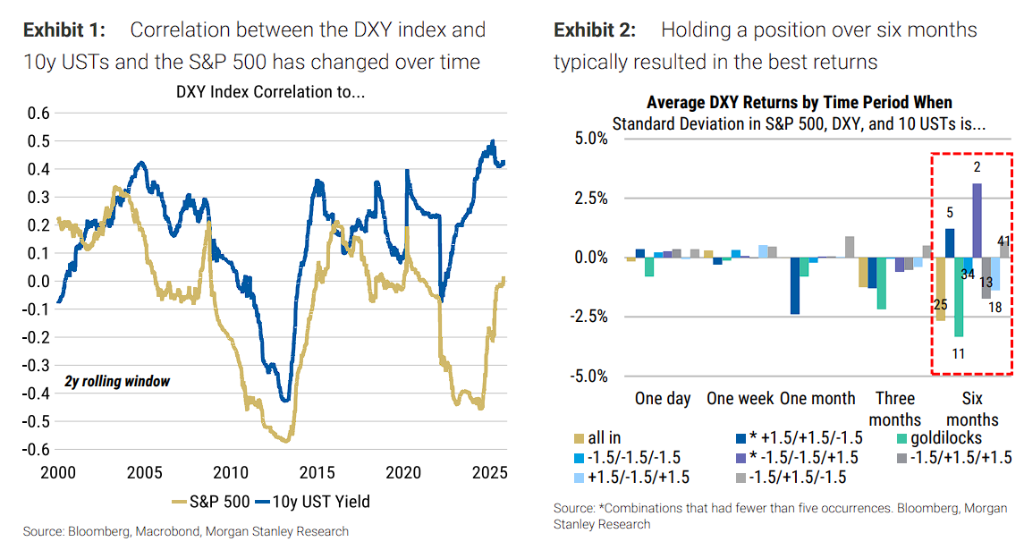
Core Insights - Morgan Stanley's research indicates that extreme "resonance" among the S&P 500, U.S. Treasury yields, and the U.S. dollar index often predicts a reversal in the dollar's strong cycle [3][7] - The analysis of the past 25 years shows two strong signals for a weaker dollar in the next six months: the "Goldilocks" scenario and the "Broad Up" scenario [3][10] Group 1: Goldilocks Scenario - The "Goldilocks" scenario occurs when the S&P 500 rises over 1.25 standard deviations while both the dollar index and Treasury yields fall over 1.25 standard deviations [8][15] - This scenario has appeared 12 times in the past 25 years, leading to an average dollar index decline of 3.3% over six months, with an 83% success rate for predicting dollar weakness [10][15] - The strong performance of the British pound in this scenario may reflect expectations of a soft landing for the economy [6][15] Group 2: Broad Up Scenario - The "Broad Up" scenario is characterized by simultaneous increases in the S&P 500, dollar index, and Treasury yields, each exceeding 1.25 standard deviations [16][20] - This scenario has occurred 26 times in the past 25 years, resulting in an average dollar index decline of 2.7% over six months, with a moderate success rate of 73% [16][20] - The occurrence of this scenario suggests a phase of global economic catch-up following a period of U.S. exceptionalism, with the Australian dollar often performing well during synchronized global economic recovery [20]

强有力的美元走势领先指标:美股、美债与美元指数的“共振模式”
Hua Er Jie Jian Wen· 2025-10-20 04:23
Core Insights - Morgan Stanley's latest research indicates that extreme "resonance" among the S&P 500, U.S. Treasury yields, and the U.S. dollar index often signals an impending reversal in the dollar's strong cycle [1][4] Group 1: Dollar Weakness Signals - The analysis of the past 25 years shows that extreme fluctuations (over 1.25 standard deviations) in the S&P 500, U.S. dollar index, and 10-year Treasury yields provide two strong signals indicating a weaker dollar in the next six months [1][5] - The "Goldilocks" scenario, characterized by a significant rise in the S&P 500 (over 1.25 standard deviations) while the dollar and Treasury yields decline (both over 1.25 standard deviations), has occurred 12 times historically, leading to an average 3.3% decline in the dollar index over six months [5][7] - The statistical analysis shows a high correlation between this scenario and dollar weakness, with an 83% success rate in predicting a weaker dollar following these occurrences [7] Group 2: Currency Performance Post Signals - In the "Goldilocks" scenario, the British pound tends to perform the best, reflecting expectations of a soft landing in the economy [4][10] - The "Broad Up" scenario, where all three indicators rise over 1.25 standard deviations, has occurred 26 times, indicating a 2.7% average decline in the dollar index over the following six months [13] - This scenario suggests a phase of global economic catch-up, where strong U.S. performance leads to a recovery in other regions, causing the dollar to give back gains [18]
高盛警告:美股已至“金发姑娘情景巅峰”,当心买预期卖事实行情!
Jin Shi Shu Ju· 2025-09-16 14:00
Group 1 - The S&P 500 index reached a new all-time high, driven by market optimism that the Federal Reserve will implement a 25 basis point rate cut [1] - Investors expect the Fed to prefer a 25 basis point cut over a 50 basis point cut to retain future flexibility, as indicated by the phrase "the more bullets you fire, the faster you run out" [1] - Goldman Sachs referred to the current market situation as the "Goldilocks scenario peak," supported by Oracle's positive cloud revenue revision and a broader AI sector boost [1] Group 2 - The upcoming Federal Reserve meeting is expected to be tense, with Powell and Governor Cook facing accusations from the Trump administration, which may influence their decision-making [2] - Market volatility is anticipated following Powell's statements and Q&A session, with a focus on the Fed's updated macroeconomic forecasts and interest rate path [3] - The dollar has declined significantly, with a 0.87% drop in the past month and a 10.56% decrease year-to-date, attributed to expectations of rate cuts and actions by the Trump administration [3]

纳指标普齐创新高,黄金突破3700美元
Di Yi Cai Jing Zi Xun· 2025-09-15 23:39
Group 1 - US stock market saw a broad increase, with the Dow Jones up 49.23 points (0.11%) closing at 45883.45, the Nasdaq up 0.94% at 22348.75, and the S&P 500 up 0.47% at 6615.31, marking a new high above 6600 points [2] - Tesla shares rose by 3.5% after Elon Musk increased his stake in the company by nearly $1 billion, contributing to a rise in the S&P 500 consumer discretionary sector by over 1%, reaching its highest level in nearly nine months [3] - Alphabet, Google's parent company, increased by 4.3%, reaching a market capitalization of over $3 trillion, which boosted the communication services sector by 2.1% [3] Group 2 - The New York Federal Reserve reported a significant drop in the state manufacturing index by 20.6 points to -8.7, marking the first decline below the neutral line since June [4] - Investors are focused on the upcoming Federal Open Market Committee (FOMC) meeting scheduled for September 16-17, with expectations of a 25 basis point rate cut due to signs of a weakening job market [4] - Carol Schleif, Chief Investment Officer at BMO Family Office, noted that the market anticipates a "Goldilocks scenario" where the job market is weak enough to prompt a series of rate cuts without disrupting overall economic growth [4] Group 3 - The yield on the benchmark 10-year US Treasury bond fell by 2.1 basis points to 4.04%, while the 2-year Treasury yield decreased by 1.9 basis points to 3.54% [5] - International oil prices saw a slight rebound, with WTI crude oil up 0.97% at $63.30 per barrel and Brent crude oil up 0.67% at $67.44 per barrel [5] - International gold prices reached a new historical high, with the main contract on the New York Commodity Exchange rising by 0.91% to $3720.01 per ounce [6]
美银报告:美股一周“失血”280亿美元 货币基金成香饽饽
Zhi Tong Cai Jing· 2025-08-08 13:03
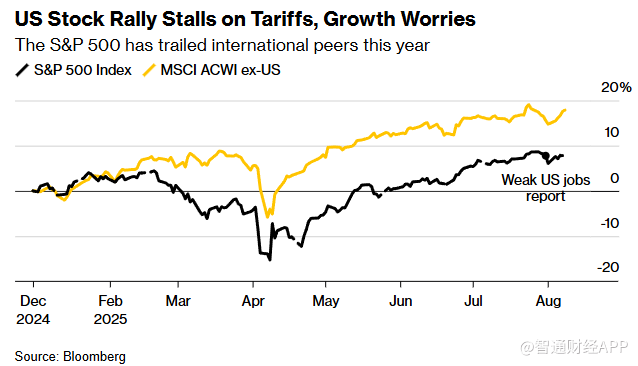
Group 1 - Investors are withdrawing from the US stock market due to concerns over high tariffs potentially suppressing economic growth, with nearly $28 billion redeemed from US equities as of the week ending August 6 [1] - Cash funds have seen an influx of approximately $107 billion, marking the largest inflow since January [1] - Global equity markets experienced a capital outflow of $41.7 billion, attributed to an "abnormal clearing outflow" from three UK-registered funds on July 31 [1] Group 2 - The S&P 500 index's record rally has stalled as signs of a slowdown in the US labor market emerge, coinciding with the implementation of comprehensive new tariffs by President Donald Trump [1] - The average tariff rate has risen to 15.2%, significantly higher than last year's 2.3%, reaching the highest level since World War II [1] - Market focus is shifting towards the Federal Reserve, with swap markets anticipating a rate cut of about 100 basis points by mid-2026 [3] Group 3 - Most clients of the bank expect a "Goldilocks" scenario where the economy neither overheats nor cools down, with anticipated rate cuts expected to boost the stock market [3] - The bank's strategist accurately predicted that international equities would outperform US stocks earlier this year, but has recently warned of rising bubble risks in the stock market due to easing monetary policy and financial regulation [3]
高贝塔股拥挤度飙至历史峰值!小摩警示:此轮行情无基本面支撑,回调风险迫近
智通财经网· 2025-07-22 02:41
Group 1 - The current market's enthusiasm for high beta stocks has reached a quantifiable historical peak, indicating potential short-term market risks [1][2] - High beta stocks, which typically have a beta coefficient greater than 1.0, offer higher potential returns but also come with greater risks [1] - The level of crowding in high beta stocks has reached the 100th percentile, a level only seen during extreme market conditions such as the dot-com bubble and post-financial crisis [1] Group 2 - The recent high beta market trend is driven by multiple factors, including pricing of a "Goldilocks" scenario, tariff policy effects, and institutional investors' pursuit of high-leverage speculative targets [1] - High beta funds have seen a continuous reduction in short positions, while previously crowded defensive sectors have shifted aggressively [1] - The crowding in high beta stocks surged from the 25th percentile to the 100th percentile within three months, marking the fastest increase in thirty years, driven by sentiment reversal and technical factors rather than macroeconomic improvements [1] Group 3 - Despite optimistic market expectations, the current high beta rally lacks support from the business cycle recovery and significant monetary or fiscal policy easing, differing fundamentally from post-global financial crisis or pandemic market environments [2] - The highest beta stocks in the S&P 500 include technology growth stocks like Super Micro Computer (SMCI.US), Coinbase (COIN.US), and Palantir (PLTR.US), as well as semiconductor leaders like Nvidia (NVDA.US) and Micron Technology (MU.US) [2] - Without substantial fundamental and policy support, the current high beta rally may not be sustainable, and accumulated complacency in the market could pose risks for short-term corrections [2]
市场正押注特朗普会对关税让步,并寄望于美联储救市
财富FORTUNE· 2025-07-16 13:01
Group 1 - The core viewpoint of the article is that investors are currently underestimating the potential impact of Trump's tariffs on Mexico and the EU, believing that these tariffs will eventually be negotiated away or postponed [1][3]. - Deutsche Bank warns that the "TACO trade" (the belief that Trump will ultimately back down) is accumulating significant risks, suggesting that the market has not fully absorbed the implications of the high tariffs [2][3]. - Analysts from Deutsche Bank and Goldman Sachs express concerns that the market's expectation of these tariffs not being implemented may lead to severe market reactions if they do come into effect [3][4]. Group 2 - Morgan Stanley predicts that the economic impact of tariffs will lead to "stagflation tendencies" in the second half of the year, highlighting a disconnect between market pricing and economic forecasts [4]. - The article discusses the prevailing market sentiment that if the "TACO trade" fails, the Federal Reserve will intervene to support the market, but rising tariffs could complicate this scenario by increasing inflation [3][4].

重大不确定性袭来!美股本轮涨势将迎严峻考验
Di Yi Cai Jing· 2025-06-15 03:00
Market Overview - The US stock market experienced volatility last week, influenced by developments in US-China trade negotiations and rising tensions in the Middle East due to Israel's strikes on Iranian nuclear facilities, leading to a retreat in major indices [1][4] - The Cboe Volatility Index (VIX) surged by 22%, indicating increased market volatility and returning above the long-term average of 20 [1][4] Economic Indicators - The Federal Reserve is expected to maintain its current stance in the upcoming meeting, with recent economic data showing improvement, including a 0.1% month-over-month increase in the Consumer Price Index (CPI) and a year-over-year growth of 2.4% [2][3] - The NFIB Small Business Optimism Index rose from 95.8 to 98.8, ending a four-month decline, while the University of Michigan Consumer Sentiment Index increased from 52.2 to 60.5, surpassing market expectations [2][3] Employment and Inflation - Initial jobless claims remained steady at 248,000, while continuing claims rose by 54,000 to a cycle high of 1.956 million, indicating some weakness in hiring [3] - The Producer Price Index (PPI) showed a month-over-month decline of 0.1% and a year-over-year increase of 2.6%, aligning with or falling below market expectations [2][3] Market Sentiment and Sector Performance - The energy sector saw a significant increase of 5.7%, driven by a surge in international oil prices, while the financial sector declined by 2.6% [4] - Bank of America noted that as long as oil prices do not continue to rise sharply, the stock market's upward trend could persist, despite geopolitical tensions [5] Seasonal Trends and Future Outlook - Historical trends suggest a potential slowdown in market momentum as it enters the "summer lull" period, with concerns about earnings growth in the second half of the year [5] - Investors are advised to remain cautious due to the uncertainty surrounding the Middle East situation and upcoming US retail sales reports [6]