
美元走势预测

Search documents
中国经济与外汇策略_上调人民币预期,但通缩使我们低于共识-China Economics & FX Strategy-Revising Up RMB, but Deflation Keeps Us Below Consensus
2026-01-09 05:13
Summary of Key Points from the Conference Call Industry Overview - **Industry**: Foreign Exchange (FX) and Economic Strategy in China - **Company**: Morgan Stanley Asia Limited Core Insights and Arguments - **RMB Forecast Revision**: The forecast for the USDCNY exchange rate has been revised upward, expecting it to reach 6.85 by Q1 2026 and finish at 7.0 by the end of 2026, compared to previous estimates of 7.05 for both periods [8][11] - **Export Strength**: Robust export momentum is anticipated to continue through 2026-27, with expected growth rates of 5-6% in export volume, supported by a strong external balance and improved competitiveness [12][9] - **Deflationary Pressures**: Lingering domestic deflation is a significant constraint on the RMB's appreciation potential, limiting the economy's ability to sustain a stronger currency [17][18] - **Dollar Dynamics**: The dollar is expected to weaken in the first half of 2026 due to anticipated Fed rate cuts, followed by a rebound in the second half as US economic growth accelerates [10][41] - **Policy Guidance**: The People's Bank of China (PBoC) has maintained a consistent FX policy aimed at managing volatility and preventing excessive exchange rate fluctuations, indicating a preference for stability around an equilibrium level [19][11] Additional Important Insights - **Geopolitical Risks**: Potential risks to the RMB outlook include renewed geopolitical tensions and capital outflows, which could negatively impact the currency [23] - **Technical Analysis**: The USD/CNH pair is currently oversold, and a break below 6.97 could lead to further downside towards approximately 6.80 [30][29] - **Limited Spillover Effects**: The recent strength of the CNH has had limited positive implications for other Asian currencies, with only the Malaysian Ringgit (MYR) showing a potential benefit due to its stronger relationship with the CNY [36][37] - **Exporters' FX Conversion**: Seasonal increases in exporters' FX conversion are expected, particularly in December, but may slow in January due to historical trends [24][26] This summary encapsulates the key points discussed in the conference call, focusing on the RMB's outlook, export dynamics, and the broader economic context affecting currency movements.
大摩:强有力的美元走势领先指标,美股、美债与美元指数的“共振模式”
美股IPO· 2025-10-20 12:37
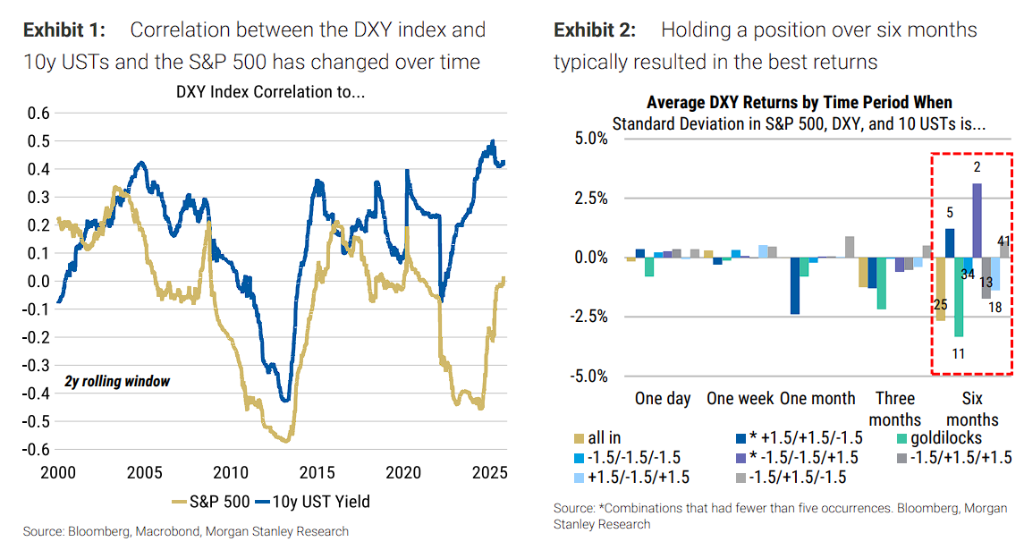
Core Insights - Morgan Stanley's research indicates that extreme "resonance" among the S&P 500, U.S. Treasury yields, and the U.S. dollar index often predicts a reversal in the dollar's strong cycle [3][7] - The analysis of the past 25 years shows two strong signals for a weaker dollar in the next six months: the "Goldilocks" scenario and the "Broad Up" scenario [3][10] Group 1: Goldilocks Scenario - The "Goldilocks" scenario occurs when the S&P 500 rises over 1.25 standard deviations while both the dollar index and Treasury yields fall over 1.25 standard deviations [8][15] - This scenario has appeared 12 times in the past 25 years, leading to an average dollar index decline of 3.3% over six months, with an 83% success rate for predicting dollar weakness [10][15] - The strong performance of the British pound in this scenario may reflect expectations of a soft landing for the economy [6][15] Group 2: Broad Up Scenario - The "Broad Up" scenario is characterized by simultaneous increases in the S&P 500, dollar index, and Treasury yields, each exceeding 1.25 standard deviations [16][20] - This scenario has occurred 26 times in the past 25 years, resulting in an average dollar index decline of 2.7% over six months, with a moderate success rate of 73% [16][20] - The occurrence of this scenario suggests a phase of global economic catch-up following a period of U.S. exceptionalism, with the Australian dollar often performing well during synchronized global economic recovery [20]



强有力的美元走势领先指标:美股、美债与美元指数的“共振模式”
Hua Er Jie Jian Wen· 2025-10-20 04:23
Core Insights - Morgan Stanley's latest research indicates that extreme "resonance" among the S&P 500, U.S. Treasury yields, and the U.S. dollar index often signals an impending reversal in the dollar's strong cycle [1][4] Group 1: Dollar Weakness Signals - The analysis of the past 25 years shows that extreme fluctuations (over 1.25 standard deviations) in the S&P 500, U.S. dollar index, and 10-year Treasury yields provide two strong signals indicating a weaker dollar in the next six months [1][5] - The "Goldilocks" scenario, characterized by a significant rise in the S&P 500 (over 1.25 standard deviations) while the dollar and Treasury yields decline (both over 1.25 standard deviations), has occurred 12 times historically, leading to an average 3.3% decline in the dollar index over six months [5][7] - The statistical analysis shows a high correlation between this scenario and dollar weakness, with an 83% success rate in predicting a weaker dollar following these occurrences [7] Group 2: Currency Performance Post Signals - In the "Goldilocks" scenario, the British pound tends to perform the best, reflecting expectations of a soft landing in the economy [4][10] - The "Broad Up" scenario, where all three indicators rise over 1.25 standard deviations, has occurred 26 times, indicating a 2.7% average decline in the dollar index over the following six months [13] - This scenario suggests a phase of global economic catch-up, where strong U.S. performance leads to a recovery in other regions, causing the dollar to give back gains [18]
瑞银:美元2025Q4延续弱势,2026年末或迎复苏拐点
智通财经网· 2025-09-25 08:30
Core Viewpoint - UBS's latest global forex strategy report predicts a continuation of the weak dollar trend into Q4 2025, with a potential turning point by the end of 2026, contrary to previous market expectations of a prolonged downtrend [1] Summary by Sections Dollar Forecast - The report suggests that the U.S. may lower interest rates by more than the expected 75 basis points in 2025, influenced by the nomination of a new Fed chair, which could lead to more aggressive cuts in 2026, potentially pushing one-year forward rates below 3.00% [1] - A persistent weakness in the U.S. labor market is expected to suppress front-end Treasury yields, directly contributing to the dollar's weakness [1] - The global consensus on "de-dollarization" is strengthening, which structurally limits the dollar's rebound potential [1] Currency Pair Analysis - Euro to Dollar: Q4 target set at 1.2300, with a fluctuation range of 1.1500-1.2300. If U.S. employment data exceeds expectations, it may raise doubts about two rate cuts by the Fed in Q4, potentially pushing the exchange rate to the lower limit of the range. However, structural hedging demand is expected to prevent excessive dollar rebounds, suggesting buying opportunities during declines [1] - Dollar to Yen: Q4 target at 143.00, with a range of 143.00-151.00. A dovish stance from the Bank of Japan and a low volatility environment make the yen an ideal funding currency. If the new Prime Minister leans dovish, the dollar-yen rate may challenge 150.00; however, any signals of rate hikes from the Bank of Japan on October 30 could strengthen the yen [2] - Euro to Pound: Q4 range of 0.8600-0.8900. The pound performs well in rising risk appetite, but the UK's fiscal challenges and potential wage service price slowdowns may trigger aggressive rate cut expectations from the Bank of England in 2026, with the November 26 budget becoming a key risk event [2] - Euro to Swiss Franc: Q4 range of 0.9200-0.9450. Despite a softened market expectation for the Swiss franc's strength, demand for "hard assets," limited easing space from the Swiss National Bank, and domestic dollar risk hedging needs will support the franc's relative strength against the euro and dollar [2] Actionable Strategies - UBS recommends three strategies: buying euros against the dollar during declines to prepare for potential rebounds; closely monitoring U.S. employment data, Fed chair nominations, and the UK budget to adjust trading strategies; and focusing on the Bank of Japan's October meeting for any rate hike signals to assess dollar-yen exchange rate trends [3]